What Does a Valve Manufacturer's Certification Actually Prove?
Key Takeaway
Supplier certificates fall into three families. A management system certificate (ISO 9001, AS9100D, IATF 16949) is an audit result about how a named site is run, and says nothing about whether a valve holds pressure. A product certification (CSA, ASSE, WRAS, NSF/ANSI 61 and 372, UL, CE under the PED) says a defined model and size range passed a named test standard. A material or test document (EN 10204 3.1, an AS9102 first article report, an API 598 test record) applies to one lot. What decides whether any of them is relevant to your order is scope: the legal entity and site, the wording of the scope statement, the sizes listed, the standard edition, the expiry date. Every major scheme publishes a searchable directory, so checking takes minutes.
What question does each certificate answer?
Supplier profiles present certificates as a row of logos, which flattens three different kinds of evidence into one impression of competence. They are not tiers, and one does not stand in for another.
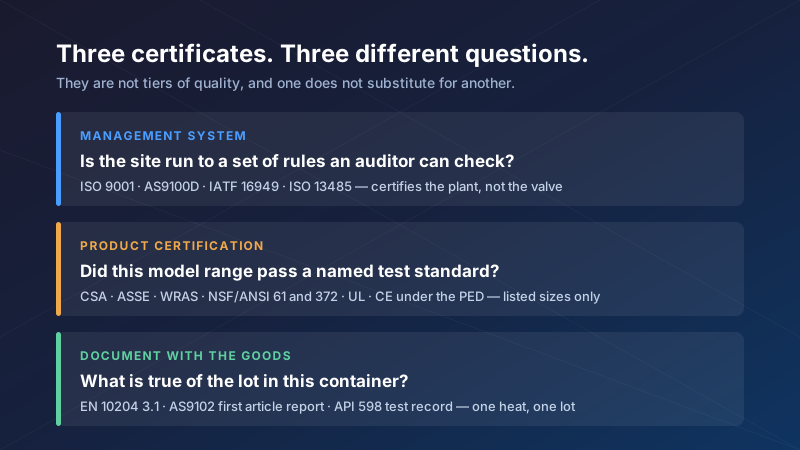
| Family | Question it answers | Applies to | Typical validity |
|---|---|---|---|
| Management system | Is this site run to rules an auditor can check? | One legal entity, named sites, one scope | Three years, annual surveillance |
| Product certification | Did this model range pass a named test standard? | Listed models, connections, sizes and classes | Scheme dependent; WRAS five years, then re-test |
| Material or test document | What is true of the goods in this container? | One heat, one lot, one serial range | A permanent record of that lot |
A factory with AS9100D and no WRAS approval cannot supply a fitting into a UK potable water system that requires one. A factory with a WRAS approval on one model and no quality system certificate at all can. That is why "our supplier is certified" carries no information until you can say certified to what, for which products, at which site.
How do you read the scope?
Scope is where a certificate stops being a badge and becomes evidence. Six fields decide whether it covers the valve on your purchase order.
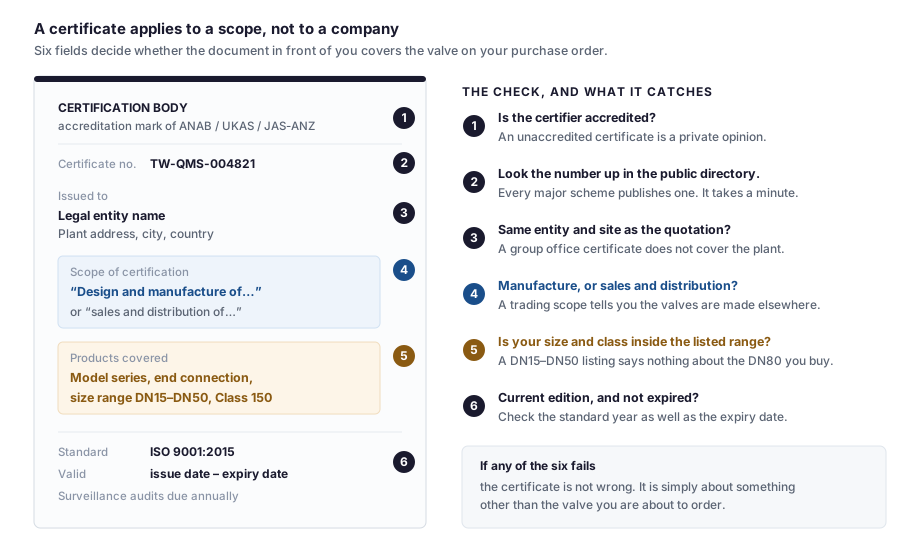
Two of the six need spelling out. Neither makes a certificate false; they make it irrelevant to the part being quoted.
The scope statement says sales. "Design and manufacture of ball valves" and "sales and distribution of valves" are both valid certified scopes, audited to the same standard. The second one tells you the valves are made somewhere else, by a manufacturer whose system you have not seen. Group structures often put the certificate on the trading company while the plant is a separate legal entity, so compare the name and address against the quotation and the shipper.
Your size sits outside the listing. Product certifications are model and size specific, so a WRAS, NSF, CSA or UL listing covering DN15 to DN50 says nothing about the DN80 on the order. Check the year of the standard while you are there. ISO 9001:2008 certificates ceased to be valid when the transition closed in September 2018.
What does AS9100D add beyond ISO 9001?
AS9100D contains the full text of ISO 9001:2015 and adds aerospace requirements on top, on the order of a hundred depending how you count. Four govern whether the tenth lot matches the sample.
| AS9100D addition | What it requires | Why it matters to a valve buyer |
|---|---|---|
| Configuration management | Drawing, tooling, programme and inspection revisions tracked for the product's life | The supplier can show no superseded-revision parts shipped after a change |
| Counterfeit part prevention | Controlled raw material sourcing, certificates with every shipment, sub-tier risk assessment | Material in the box traces back to a vetted source |
| Product safety | Documented risk assessment for processes affecting safety, not only conformity | Pressure boundary and seat retention get treated as safety items |
| First article inspection to AS9102 | Ballooned drawing, every characteristic reported with its measured value | The approved sample is documented well enough to repeat |
Outside aerospace the certificate itself is not the useful part. All four controls can be written into a quality agreement with a supplier holding only ISO 9001: name the drawing revision on the purchase order, require written notice before any change to it, material certificates with every shipment, and a ballooned first article report on the first lot and after any process change.
Two limits are worth knowing. AS9100D is a system certification, not a product approval, so it says nothing about a valve being fit for an application. And it does not cover special processes the way an aerospace prime expects: heat treatment, non-destructive testing, welding and chemical processing are accredited separately through Nadcap.
Accredited 9100-series certificates have to be entered in the IAQG OASIS database, so one that cannot be found there is worth a question. And an aerospace certificate tells you the factory has an aerospace customer. Whether that reaches your part depends on which lines and product families sit inside its scope.
Where do IATF 16949 and the other system standards fit?
IATF 16949:2016 is not standalone. It is applied with ISO 9001:2015, adds automotive requirements aimed at defect prevention and variation reduction, and is where the AIAG core tools live: APQP, PFMEA, MSA, PPAP and SPC. PPAP travels outside automotive. A specification asking for "PPAP Level 3" wants a defined document package, and a supplier that has not worked to IATF may not hold the manual defining the levels, so say which elements you want.
| Standard | What it is | What it tells a valve buyer |
|---|---|---|
| ISO 9001:2015 | Generic quality management system | Documented, audited processes within a stated scope |
| AS9100D | ISO 9001 plus aerospace requirements | Configuration management, counterfeit control, AS9102 first articles |
| IATF 16949:2016 | ISO 9001 plus automotive requirements | APQP, PPAP, MSA, SPC and FMEA in routine use |
| ISO 13485 | Medical device quality management | Traceability built for regulated devices |
| ISO 14001 / ISO 45001 | Environmental / occupational health and safety | Not quality standards, not evidence about the product |
Which product certifications apply to valves?
CSA, ASSE, WRAS, NSF and UL each certify a listed model range against a named standard, and what each requires is set out in the guide to those five schemes. Two others turn up on valve documents with less scrutiny. NSF/ANSI 61 and 372 cover material safety in drinking water contact and weighted lead content, verifiable in the NSF listings. API 607 and ISO 10497 cover the fire type-test of a design with non-metallic seats, and the evidence is the type-test report rather than a mark.
The CE mark is the one that gets misread
Under PED 2014/68/EU a valve counts as piping, so DN governs alongside fluid group and maximum allowable pressure PS. Article 4(1)(c) sets the thresholds, and equipment below them falls under Article 4(3): built to the sound engineering practice of a Member State, no conformity assessment, no EU declaration of conformity, and in the directive's words it shall not bear the CE marking unless another Union directive requires it.
The thresholds are arithmetic, so a valve can be placed in a minute.
| Fluid | Inside the PED when |
|---|---|
| Group 1 gas | DN > 25 |
| Group 2 gas | DN > 32 and PS × DN > 1,000 bar |
| Group 1 liquid | DN > 25 and PS × DN > 2,000 bar |
| Group 2 liquid | PS > 10 bar and DN > 200 and PS × DN > 5,000 bar |
Worked on three valves. A DN25 chilled water valve at PS 16 bar gives PS × DN = 400 bar, below every group 2 liquid threshold, so it is Article 4(3) equipment. A DN250 water valve at PS 25 bar gives 6,250 bar and clears all three conditions, so it sits inside the directive. A DN50 compressed air valve at PS 25 bar gives 1,250 bar and clears both group 2 gas thresholds. The small air valve is in scope while the larger DN200 water valve beside it is not.
A neighbouring confusion is between certificates and manufacturing standards. API 608, ISO 17292, ASME B16.34 and MSS SP-110 are standards a valve is built to, and conformance is normally declared by the manufacturer. API licenses its Monogram against specific specifications, Spec 6D among them, so where a document says "API 608 certified", ask whether that is a licensed mark or a declaration.
What travels with the goods?
The third family ends up in the file when something goes wrong in service, and the wording on the purchase order decides what arrives.
| EN 10204 type | What it contains | Whose material it describes | Validated by |
|---|---|---|---|
| 2.1 | Declaration of compliance with the order, no test results | General production | The manufacturer |
| 2.2 | Test report, non-specific inspection | Possibly a different heat than the one delivered | The manufacturer |
| 3.1 | Inspection certificate, specific inspection | The lot actually supplied | An inspection representative independent of production |
| 3.2 | As 3.1, additionally countersigned | The lot actually supplied | A third party or the purchaser's representative |
An order asking for "a mill certificate" invites a 2.2, and a 2.2 can legitimately report a heat that is not in the box. If you need traceable chemistry for the material delivered, the words are EN 10204 3.1, on the purchase order.
Then ask how the heat number reaches the finished valve: cast into the body, laser marked after machining, or recorded only on a tag. Machining removes as-cast marking from any surface it touches, so if the number sits on a face that gets faced off, traceability lives in the paperwork alone.
PMI answers a narrower question than the specification usually asks
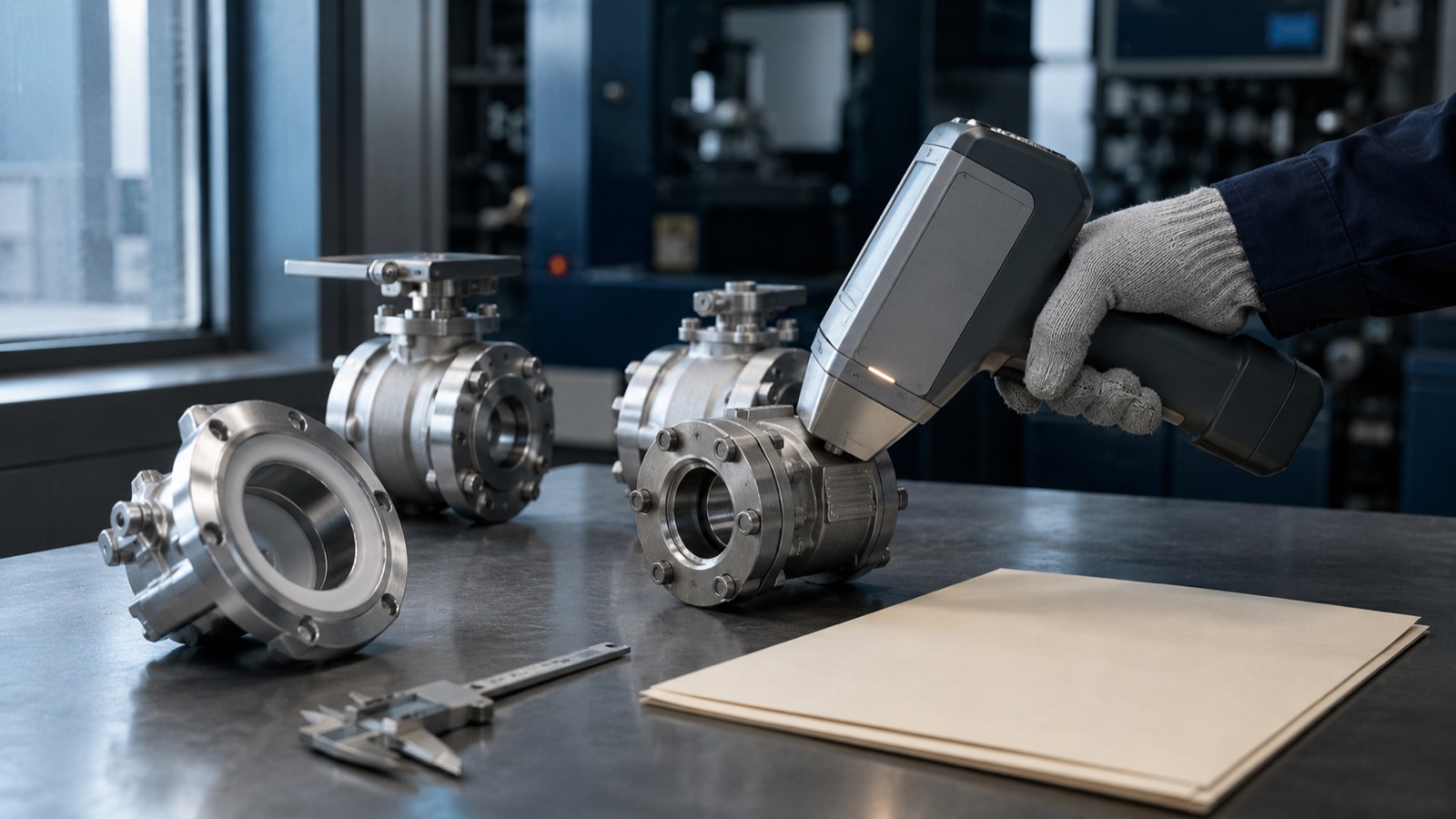
Handheld XRF cannot measure carbon. The technique does not see elements lighter than magnesium, which is physics, not instrument grade. It separates CF8M from CF8 by reading molybdenum, but it cannot separate a standard grade from its low-carbon L variant, because that distinction is a carbon limit. A specification that says "PMI required" and stops there gets a reading that cannot answer the question intended. If an L grade has to be confirmed on the part, the method is optical emission spectrometry or LIBS, or the mill certificate for that heat.
Test records deserve the same care. API 598 sets the shell test at 1.5 times the 38°C (100°F) rating, the hydrostatic closure test at 1.1 times that rating, and a low pressure gas closure test at around 80 psig, with no visible leakage through a resilient seat. A usable record states the medium, pressure, duration and acceptance criterion, and identifies the lot. "Hydro test: pass" is not a record.
What none of it tells you
All three families describe conformity at a point in time, within a stated scope. None tells you which foundry poured the body, whether the seat compound supplier changed between lots, or whether machining moved to a subcontractor. All three can happen while every certificate on file stays valid.
The cover for that gap is contractual. Name the casting source and drawing revision on the purchase order, require written notice before either changes, and require a first article report after any change of source, seat compound or machining route. What casting quality does to a finished valve is settled in the foundry long before any test a certificate covers, and the plant-level checks are in how to verify a supplier's claims about its own operation.
A verification routine you can run in twenty minutes
- Ask for the certificate PDFs, not the logo strip on the website.
- Check the entity, the scope wording, your size and class, the standard edition and the expiry date.
- Look the number up in the scheme's public directory, and confirm the certification body carries an accreditation mark.
- Write EN 10204 3.1 on the purchase order, with a change notification clause covering casting source, seat material and machining route.
The first three are desk work on documents the supplier already has. If a step cannot be completed, ask why.
Frequently Asked Questions
The short version:
Read the scope, not the logo. A management system certificate describes a site, a product certification describes a listed model and size range, an EN 10204 document describes one lot. Check the entity, the scope wording, the size coverage, the standard edition and the expiry, then look the number up in the public directory. Where a control matters to your part, specify it directly instead of inferring it from a certificate someone else's industry required.
Related Articles
- API 598 Is Three Tests, and Only One Is About Shut-Off
- Why Does an OEM Ball Valve Carry a Minimum Order Quantity?
- Tooling Ownership in a Private Label Valve Programme
- Stainless Steel Ball Valve OEM Manufacturer in Taiwan: Range, Capacity and Certifications
- What ISO 9001, CSA, ASSE, WRAS and UL Mean for Ball Valves
- Sourcing Ball Valves from Taiwan: What Differs Between Factories
- What Casting Quality Does to a Ball Valve: Porosity and Field Failure
- How Ball Valves Are Made: Investment Casting, Forging and CNC
- SS316 vs SS304 Ball Valve: Material Selection
- Is CF8M the Same as 316? What Changes When a Ball Valve Body Is Cast
- What Should You Check When You Audit a Ball Valve Factory?
Referenced standards: ISO 9001:2015, AS9100D / EN 9100, AS9102, IATF 16949:2016, ISO 13485, EN 10204, API 598, API 607 and ISO 10497, API 608, ISO 17292, ASME B16.34, MSS SP-110, NSF/ANSI/CAN 61 and 372, Directive 2014/68/EU Article 4(1)(c) and 4(3). Verification directories: IAQG OASIS, UL Product iQ, WRAS Approved Products, NSF listings, API standards.
Validity periods, surveillance intervals and directory coverage are set by each scheme and change over time, so confirm them against the scheme in force when you audit. The count of additional AS9100D requirements depends on how clauses are counted and is an order of magnitude. The PED thresholds quoted are those of Article 4(1)(c); the category for equipment above them is read from the Annex II tables.