Why Does an OEM Ball Valve Carry a Minimum Order Quantity?
Key Takeaway
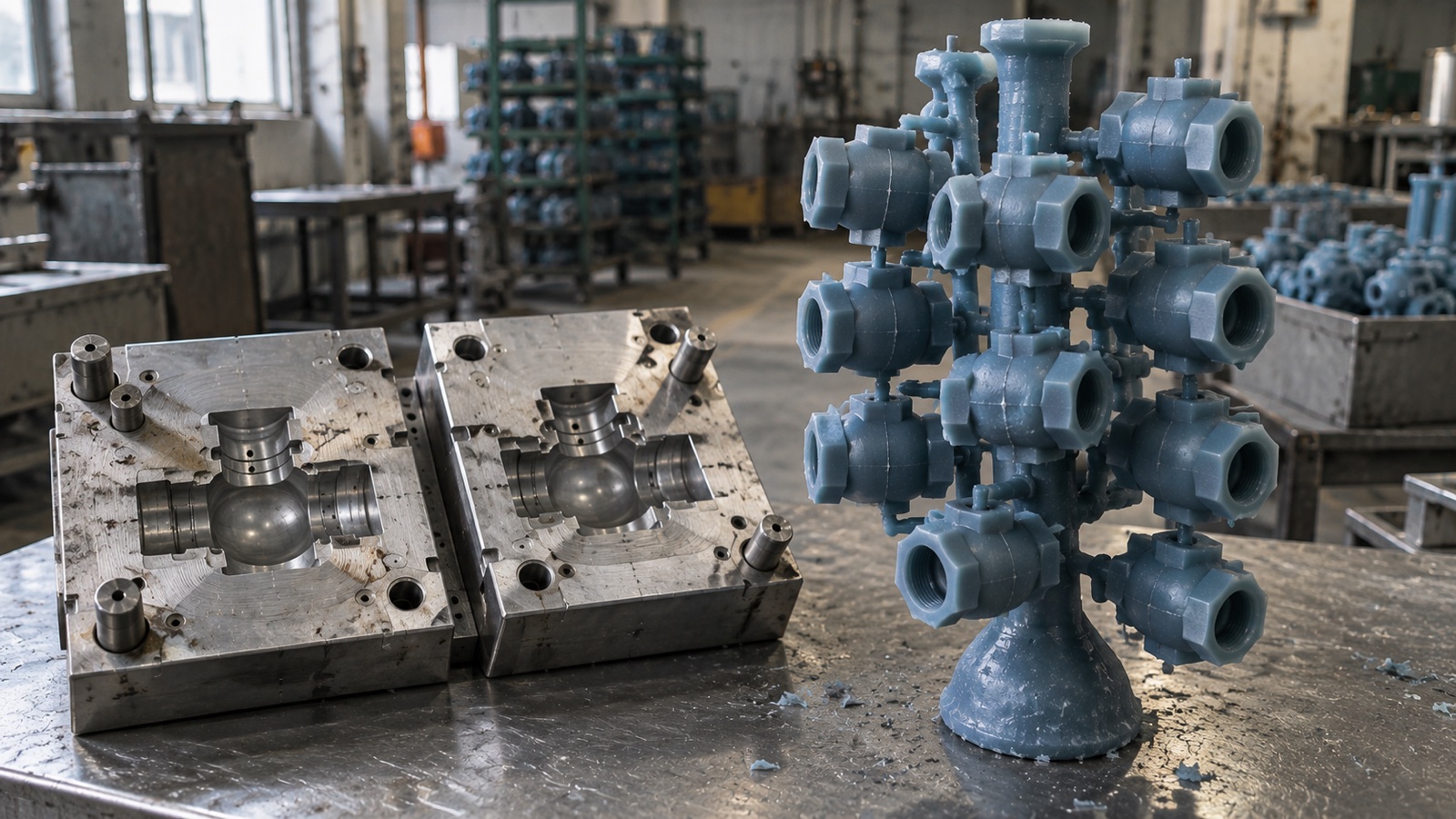
A minimum order quantity is three numbers reported as one. The melt sets the first: austenitic castings under ASTM A351 are certified per heat, and a heat is one furnace batch, so the certificate belongs to the batch and not to your order. The tooling sets the second: an investment-cast body needs a wax injection die machined for that part number, paid once however many valves come off it. The machining setup sets the third: a fixture, a proven program and a first article are spent per run, not per piece. The quote shows whichever floor is highest. Asking which one it is will get you further than asking for a smaller number, because the three move for different reasons and only one of them normally needs to move.
What actually sets the minimum order quantity?
Ask a factory for its minimum and one number comes back. Three separate constraints went into it, and they have nothing to do with each other.
They are also rarely binding at the same time. A buyer who knows which one is active can often satisfy it without touching the commercial terms at all.
| Floor | What sets it | What moves it |
|---|---|---|
| The melt | Chemistry is certified per heat under ASTM A351, and the certificate belongs to that heat | A grade the foundry melts regularly, and a heat shared with other work |
| The tooling | An investment-cast body needs a wax injection die cut for that part number | An existing die, and changes kept in the features machined after casting |
| The machining setup | A fixture, a proven program and a first article, spent per run | One run for the year instead of staged deliveries |
Why does the melt set the first floor?
ASTM A351 covers austenitic castings for pressure-containing parts. The steel is made by the electric furnace process, with or without separate refining such as argon-oxygen decarburisation, and every casting gets a heat analysis and a product analysis against the chemistry table.
A heat is one furnace batch.
That sentence is the whole constraint. The chemistry on a certificate belongs to a batch of metal, and an EN 10204 type 3.1 inspection certificate reports results for the test unit that the order and the product specification define, validated by an inspection representative independent of the manufacturing department. None of that makes the batch smaller. An order below the size of a heat gets filled out of a heat that also serves stock, or another customer, or both.
So quantity is easy on a grade the foundry melts every week and harder on one it does not. CF8M is in continual production. Anything that narrows which heats can qualify pushes the floor up, and the clauses that do this are ordinary ones:
- A low carbon grade such as CF3M where the certificate has to show it, and the dual-marked equivalent will not do
- A controlled ferrite number, which restricts the order to heats whose balance was measured and landed in range
- A heat reserved to one customer, which removes sharing entirely
- Third party witnessed testing, where an EN 10204 type 3.2 certificate replaces a 3.1 and an outside inspector has to be present
Every one of those is a legitimate thing to ask for. Each also carries a quantity consequence, and it is cheaper to find that out while the specification is still a draft. If the reason behind the clause is corrosion performance and not a contractual requirement, the grade comparison is the place to start: the difference between a cast CF8M body and wrought 316 is not what a drawing usually assumes.
When does tooling add nothing to the minimum?
Stainless bodies are generally investment cast and bronze sand cast, for reasons of shrinkage and finish set out in the process comparison. The tooling follows from that choice.
A wax injection die is machined metal, cut once per part number. Suppliers publish figures around US$6,000 to US$30,000 and four to twelve weeks to produce, against roughly US$500 to US$3,000 and one to two weeks for a wood or resin sand pattern. Those are published ranges and not quotations. Most of the spread inside them is part complexity and how many cavities the die carries.
Tooling is paid once and spread over everything that comes off it. A die amortised across 500 pieces carries a different unit burden from the same die across 5,000, and that arithmetic is what a buyer is arguing with when a minimum looks arbitrary.
But a new part number does not automatically mean a new die.
A die holds the cast shape and nothing else. Threads, machined face-to-face dimensions, the stem bore, the seat pocket and the actuator pad are all cut afterwards. Change the end connection and you may have changed a program and a fixture, not a tool. An ISO 5211 pad is machined into the bonnet, not cast into it.
Which question actually moves a quotation?
Not whether tooling exists. Which features come out of the die, and which are cut after casting. Only the first group carries a tool charge, and a specification that keeps its distinguishing features in the second group can often run on a die the factory already owns.
Development quantities have a third path. A wax pattern can be printed instead of injected, which takes the die out of the sample stage entirely. It does not take it out of production, and a printed pattern differs from an injected one in surface and in shrinkage behaviour, so a sample made this way is a design and fit check and not a production part.
| Route | Tooling required | Published cost and lead | Where it fits |
|---|---|---|---|
| Investment casting | Machined metal wax injection die, per part number | US$6,000 to US$30,000, 4 to 12 weeks | Stainless bodies in repeat production |
| Sand casting | Pattern in wood or resin | US$500 to US$3,000, 1 to 2 weeks | Bronze bodies, and larger sizes |
| Printed wax pattern | None | Per piece, no tool charge | Samples and design verification only |
Why does the machining setup have its own minimum?
A casting arrives near net shape and still needs its sealing surfaces, threads and stem bore cut. That takes a fixture built to hold this body and a program proven on it, and the proving happens on a first article that gets measured before the rest of the run is released.
Setup is spent per run, not per piece.
Split a year into four deliveries and you have bought four setups and four first articles. The second run does not inherit the first run's proving unless nothing changed in between.
This is the floor a buyer moves most directly. It is also the one a buyer can raise by accident, because a request for staged deliveries is a working capital question on one side of the table and a setup question on the other. Where the storage exists, one run with called-off deliveries settles both.
Which floor is binding on your part?
The three move independently, so the one that sets the quoted figure changes with the part. A standard body on an existing die is held by the setup. A new shape is held by the tooling, and held there by a wide margin while the quantity is small. A restricted material clause can be held by the melt while the other two sit comfortably below it.
A quotation shows the top line only. Ask which floor is binding and you get something negotiable. Ask for a lower number and the same figure comes back.
Does pressure testing raise the minimum?
Pressure testing is a per valve operation and scales linearly, so it does not push a minimum up. It belongs here for a different reason: the scope is a purchase term, and no standard settles it on a buyer's behalf.
API 598 sets minimum durations, counted once the valve is at full test pressure and not from the start of the operation.
| Valve size | Shell test | Closure test, valves other than check valves |
|---|---|---|
| DN 50 and below (NPS 2 and below) | 15 seconds | 15 seconds |
| DN 65 to 150 (NPS 2½ to 6) | 60 seconds | 60 seconds |
| DN 200 to 300 (NPS 8 to 12) | 120 seconds | 120 seconds |
Whether every valve is tested or a sample, and which acceptance applies, belongs in the order. So does witnessing. A witnessed shell test is a scheduling constraint on the production run, which is a different kind of cost from a price per piece.
The test also has a known blind spot. It proves the assembled pressure boundary at that moment. Subsurface porosity that has not yet opened a leak path will pass it, which is why casting quality gets specified on its own terms instead of being read off a test report.
Five questions that get further than asking for the MOQ
- Which of the three floors is setting this figure on my part?
- Which features come out of the die, and which are cut after casting?
- Is there an existing die this body can run on, and what would my part have to accept to use it?
- What does the quantity look like if the year is one run with called-off deliveries?
- What does the certificate have to say, and does that restrict which heats can fill the order?
The fifth is the one that gets skipped. A clause written for a different product line can restrict an order in ways its author did not intend, and checking costs nothing while the document is still a draft.
When is a factory the wrong place to buy?
Below some quantity a distributor is cheaper even at a higher unit price, because somebody else's order already absorbed the tooling and the setup. The crossover point is specific to the part. Its shape is not: the smaller the quantity and the more standard the valve, the larger the share of a direct price that is fixed charge instead of metal and labour.
Two other cases are not quantity questions at all.
A fire-tested valve to API 607, or a pipeline valve to API 6D, turns on whether a supplier's qualification covers that product in that size and that material. Order size does not answer it and a certificate on a wall does not either. It is a question of scope.
And if delivery is needed inside a few weeks, nothing above compresses far enough to help. Casting, heat treatment, machining, assembly and test are serial operations on a physical part. Stock is the answer to a short lead time. A factory that agrees to a two-week delivery without naming the step it removed is quoting from stock, its own or somebody else's.
Frequently Asked Questions
Related Articles
- API 598 Is Three Tests, and Only One Is About Shut-Off
- How Ball Valves Are Made: Casting, Forging and CNC
- Ball Valve Casting Quality: Porosity and How It Fails
- Is CF8M the Same as 316? What Changes When a Body Is Cast
- Valve Manufacturer Certifications: How to Verify Scope
- ISO 5211 Actuator Flange Dimensions: F03 to F100
- What the Markings on a Ball Valve Body Mean
- Stainless Steel Ball Valve OEM Manufacturing in Taiwan
Referenced standards: ASTM A351 (castings, austenitic, for pressure-containing parts), BS EN 10204:2004 (metallic products, types of inspection documents), API Standard 598, 11th edition (valve inspection and testing, minimum test durations), ISO 5211 (part-turn actuator attachments), API 607 (fire test for quarter-turn valves), API 6D (pipeline and piping valves).
Tooling cost and lead time ranges are as published by investment and sand casting suppliers and are quoted to show the relative scale of the two routes. They are not a quotation, and they vary with part complexity, cavity count and region. Source: investment casting versus sand casting tooling comparison. Minimum order quantities are set by each manufacturer against its own furnace, tooling and machining practice, and no figure here represents the practice of any particular supplier.