API 598 Is Three Tests, and Only One Is About Shut-Off
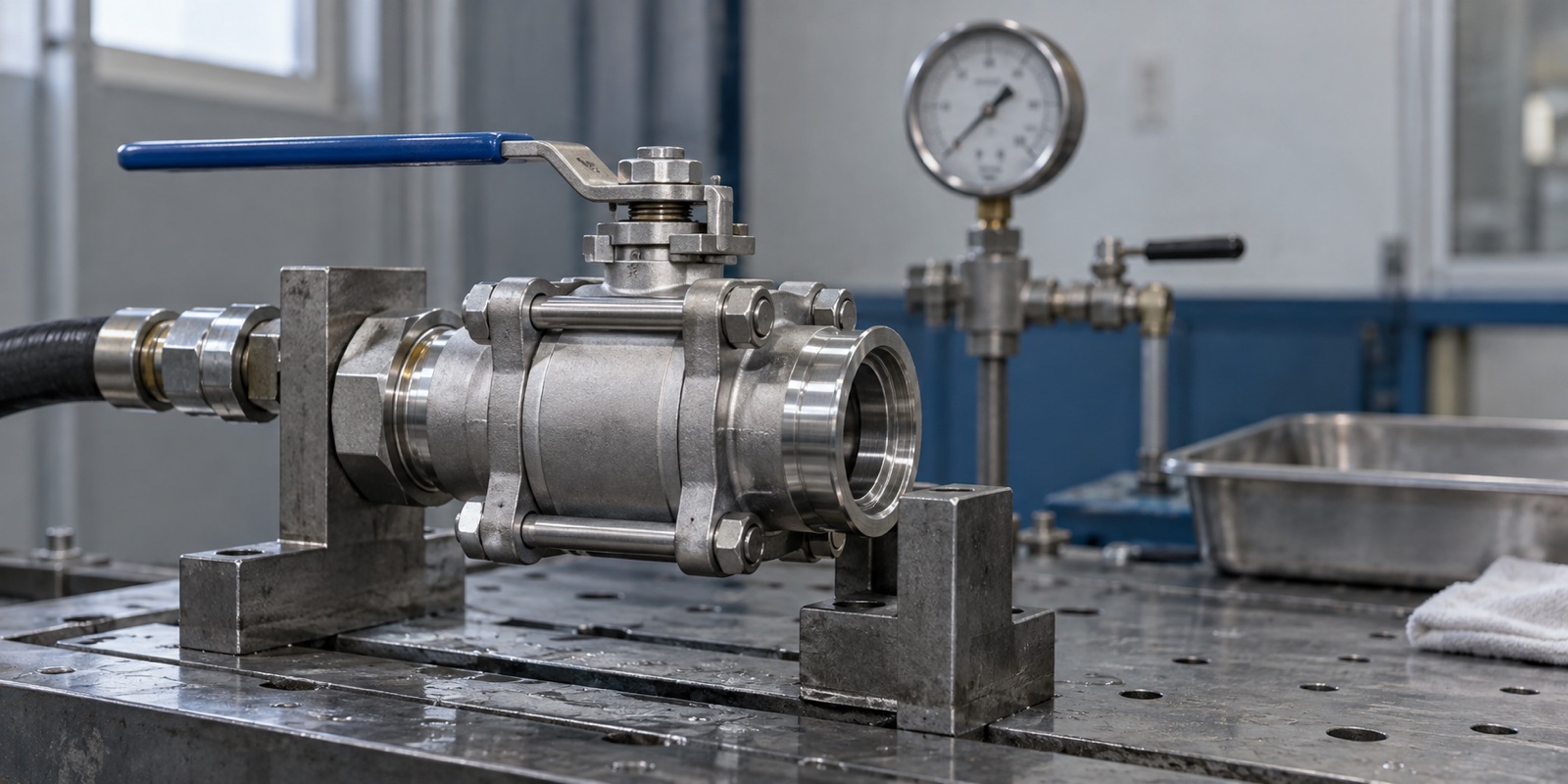
Key Takeaway
API 598 is three separate tests, and only the closure test asks whether the valve seals when it is shut. For a soft-seated ball valve the standard permits zero visible leakage, which reads as an absolute, but it is measured on a new, clean, unrestrained valve at 38 °C for a minimum duration counted in seconds. Nothing in the test describes how the seat behaves after a year at process temperature, after thermal cycling, or with a bending load from the piping. A test certificate that says only “tested per API 598” does not say which of the three tests were run, at what pressures, or in what medium.
API 598 is three tests, not one
The standard covers inspection and testing for gate, globe, check, ball, plug and butterfly valves. Within it there are three distinct pressure tests, and they answer three different questions.
The shell test asks whether the pressure boundary holds. It is run at 1.5 times the valve’s rated pressure at 38 °C (100 °F), with the valve part open so the body cavity sees full pressure, and no visible leakage is permitted through the body, the body joint or any liner.
The backseat test checks the stem sealing area with the valve fully open. It applies only to valves that have a backseat feature, which in practice means many rising-stem gate and globe valves. A conventional ball valve has no backseat, so this test usually does not apply to one at all. If a ball valve certificate has a backseat column filled in, that is worth a question.
The closure test, often called the seat test, is the only one that asks whether the valve shuts off. It is the test a buyer usually has in mind, and it is the one most often left unspecified.
Why there are two closure tests
A floating-ball valve seals by letting line pressure push the ball into the downstream seat. The higher the differential, the harder the ball is pressed, and the tighter the seal becomes. That is a useful property in service and a misleading one on a test bench, because it means a high-pressure test flatters the design.
The low-pressure closure test exists to remove that help. It is run with air or gas at around 6 bar, low enough that there is very little force energising the seat, and leakage is read as bubbles rather than drops. A seat that is slightly out of round, a ball with a machining witness mark, or a seat retainer that has not been torqued evenly will often pass at 1.1 times rating and fail at 6 bar.
The reverse also happens. Some seat geometries seal well at low differential and distort at high pressure. Running both tests is how the standard covers a range of designs with one procedure.
This matters on the purchase order. If the order names API 598 without naming the tests, the maker decides which ones to run, and the certificate may record only the high-pressure closure test. For a soft-seated ball valve going into a low-pressure service, that is the less relevant of the two.
Which tests does a ball valve have to pass?
API 608 refers its testing to API 598, so the requirement for an industrial ball valve is set by the type of ball rather than by the order.
For floating ball valves the low pressure closure test is required and the high pressure closure test is optional. For trunnion mounted ball valves and butterfly valves it is the other way round. The reason sits in how each design seals. A floating ball is pushed downstream onto the seat by the differential pressure across it, so sealing force rises with pressure and the low pressure test is the more searching case. A trunnion ball is held on its axis and the seats are loaded by springs and by pressure acting behind them, which is the comparison made in floating versus trunnion ball valves.
Valves specified as double block and bleed carry the high pressure closure test as a requirement regardless of type.
What “zero leakage” is measuring
For resilient-seated valves, which covers PTFE, RPTFE and PEEK seated ball valves, API 598 permits no visible leakage through the seating surface. Liquid leakage is counted in drops, with one millilitre treated as sixteen drops, so the unit of measurement is deliberately coarse. Zero means zero.
The part that gets dropped in summary is what follows: zero for the minimum specified test duration. For valves of NPS 2 and under, that minimum is fifteen seconds.
Fifteen seconds of bubble-tight behaviour on a new PTFE seat is a real result and a narrow one. It confirms the seat was machined, assembled and torqued correctly. It is not a statement about what the seat does in the eighteen months after that.
What if the order names ISO 5208 instead?
ISO 5208 is built the other way round. API 598 fixes the acceptance criterion and distinguishes soft seats from metal seats. ISO 5208 defines a ladder of acceptance rates, draws no distinction between seat types, and leaves the choice of rate to the specification. The rate letter is the requirement.
There are ten rates. Rate A is no visually detectable leakage for the duration of the test, which is the condition a soft-seated ball valve has to meet under API 598 as well. From there the ladder opens up, each rate expressed as a multiple of DN.
| Rate | Liquid, mm³/s | Gas, mm³/s | Carried in EN 12266-1 |
|---|---|---|---|
| A | No visually detectable leakage for the test duration | Yes | |
| AA | 0.006 × DN | 0.18 × DN | No |
| B | 0.01 × DN | 0.3 × DN | Yes |
| C | 0.03 × DN | 3 × DN | Yes |
| CC | 0.08 × DN | 22.3 × DN | No |
| D | 0.1 × DN | 30 × DN | Yes |
| E | 0.3 × DN | 300 × DN | Yes |
| EE | 0.39 × DN | 470 × DN | No |
| F | 1 × DN | 3000 × DN | Yes |
| G | 2 × DN | 6000 × DN | Yes |
Why two published ISO 5208 tables can disagree
EN 12266-1 carries seven of these ten rates. AA, CC and EE are not in it.
That omission is the source of most of the confusion online, because a summary compiled from an EN 12266-1 table and then labelled ISO 5208 has every letter after the first gap sitting one or two places out of position. A table that lists seven rates and gives Rate B as 0.1 × DN has shifted two places, so what it prints as Rate C is really Rate D. Specify a rate letter from a table like that and the valve is built to a different requirement than the one intended, without anyone making an error along the way.
Naming one of the two standards on an order has not specified the other. If the requirement is a rate letter, name ISO 5208 and the edition. If the requirement is the API 598 acceptance criterion, name that instead, and state the seat type, because API 598 treats soft and metal seats differently and ISO 5208 does not.
The five things the bench holds still
Every acceptance test is a controlled comparison, and the control is the point. API 598 fixes five variables that do not stay fixed once the valve leaves the plant.
| Variable | On the test bench | In service |
|---|---|---|
| Temperature | 38 °C reference | Whatever the process runs at, cycling daily |
| Duration | Seconds, per the minimum table | Years |
| Cycling | None. The valve is new | Thermal and pressure cycles, plus operating cycles |
| Body load | None. The valve is unrestrained on the rig | Bending and axial load from the pipework |
| Seat condition | Clean, free of oil, grease and sealant | Whatever the line carries, including debris at commissioning |
The cleanliness requirement is explicit in the standard for the low-pressure closure test, and it is there for a good reason. A film of assembly grease will hold a few bubbles back and invalidate the result. It also means the tested condition is the cleanest the seat will ever be.
What changes after the valve is installed
PTFE creeps. Under sustained mechanical stress it deforms slowly and permanently, a behaviour usually called cold flow, and it happens at room temperature as well as at elevated temperature. The rate rises with temperature; virgin PTFE deforms considerably faster at 150 °C than at 20 °C. It is also time-dependent: creep accumulates while the load is held, so the deformation tracks how long the ball has been sitting against the seat under pressure.
Alongside creep there is stress relaxation. Hold the material at constant strain and the stress inside it decays. In a seat that means the sealing force falls over time while the dimensions still look correct on a bench measurement. The seat has not worn and nothing has failed, but the contact load that produced a bubble-tight result in February is lower in August.
This is the mechanism behind a complaint that comes up regularly in OEM programmes: the valve passed its factory test, sat closed in a hot line for several months, and now weeps. Nothing about the test was wrong. The test simply never asked that question. Filled PTFE grades exist to slow the effect, and the trade-off they carry is covered in the seat material guide.
Is API 598 even the right standard for the valve you are buying?
This is the part that causes the most avoidable confusion, and it is a specification problem rather than a manufacturing one.
API 598 is a testing standard. It does not define a valve. Product standards define the valve, and they reference a test standard. For metal ball valves with flanged, threaded or welding ends, that product standard is commonly API 608. For ball valves with threaded, socket-welding, solder joint, grooved or flared ends, which covers most commercial and building-services ball valves, it is MSS SP-110. ISO 17292 covers metal ball valves for petroleum and petrochemical service.
A 1000 WOG threaded stainless ball valve bought for a hydronic or industrial utility line is normally built and rated to MSS SP-110, which carries its own inspection and test requirements. Writing “tested per API 598” on the order for that valve is not wrong, and most manufacturers will simply run the test. It does leave an ambiguity: the acceptance criteria now come from one document and the pressure rating from another, and if the two are read against different editions the numbers will not line up.
Name the product standard and the test standard separately. It takes one line and removes the argument before it starts.
What to put on the purchase order
If the intention is that the certificate means something specific, the order has to say so. Eight items cover most of it.
- The product standard the valve is built and rated to: API 608, MSS SP-110, ISO 17292 or equivalent.
- The test standard and its edition. API 598 is currently in its 11th edition, dated February 2023. Editions revise tables.
- Which tests are required: shell, high-pressure closure, low-pressure closure. Ask for the backseat test only if the valve has a backseat.
- The test medium for each test, since the low-pressure closure test can only be run with gas.
- A hold time longer than the minimum, if a longer hold matters to you. The minimum durations are short by design.
- Whether you need a test at process temperature. API 598 is an ambient-temperature procedure and will not tell you anything about hot performance.
- Whether the valve should be cycled before the closure test, and how many times. This is outside API 598 and has to be agreed separately.
- What the certificate must state: the tests run, pressures, media, durations, the standard edition, and the serial or batch that ties the result to a specific valve.
The last item is the one that turns a certificate from a formality into something traceable. A test report that cannot be tied back to a heat number and a production batch cannot be used to investigate a field failure.
What API 598 does not cover
The boundaries are as useful as the content, and they are frequently misread.
- Service life and cycle life. No part of the standard is an endurance test.
- Performance at temperature. The reference condition is 38 °C.
- Operating torque. Breakaway and running torque are separate measurements.
- Fugitive emissions. Stem sealing to an emissions limit is covered by ISO 15848 and API 641, which are different tests with different acceptance criteria.
- Fire safety. That is API 607 or API 6FA territory.
- Material conformity. The test says nothing about chemistry or heat treatment. That comes from the material certificate.
One further caution on the numbers. The per-size leakage allowances for metal-seated valves are tabulated in the standard and vary with size and test medium, and the third-party reproductions of those tables that circulate online do not all agree with each other. Where a contract turns on an allowable rate, read the table in the edition named in the order rather than a summary of it.
Frequently Asked Questions
Does a soft-seated ball valve have to be bubble-tight under API 598?
Yes. For resilient-seated valves the standard permits no visible leakage through the seating surface, for both the liquid and the gas closure tests, measured over the minimum specified duration.
Why does my ball valve certificate have no backseat test result?
Because the backseat test applies only to valves that have a backseat feature, which a conventional ball valve does not. Its absence on a ball valve certificate is correct.
Is the shell test run with the valve open or closed?
Part open, so the body cavity is exposed to full test pressure. Testing a ball valve fully closed would leave the cavity isolated and the test would not load the whole pressure boundary.
Can a valve pass the high-pressure closure test and fail the low-pressure one?
Yes, and it is a common result on floating-ball designs. Line pressure energises the seat, so a high differential helps the seal. At around 6 bar there is far less force available and a marginal seat shows up.
Does passing API 598 mean the valve will not leak in service?
No. It means the valve did not leak, at ambient temperature, when new, unrestrained, with clean seats, for the minimum test duration. Sealing over months at process temperature is governed by seat material behaviour, thermal cycling and installation load, none of which the test examines.
Which standard should a threaded commercial ball valve be tested to?
Start from the product standard the valve is built to, which for threaded, socket-weld, solder joint, grooved and flared ends is usually MSS SP-110, and take the test requirement from there. If the order specifies API 598 instead, state that explicitly so both parties are reading the same acceptance criteria.
Related Articles
- Stainless Steel Ball Valve OEM Manufacturer in Taiwan: Range, Capacity and Certifications
- Ball Valve Seat Material Guide: PTFE vs RPTFE vs PEEK vs Metal
- Ball Valve Pressure Ratings Explained: ASME Class 150 to 600
- What Casting Quality Does to a Ball Valve: Porosity, Inclusions and Field Failure
- Floating vs Trunnion Ball Valve: Design, Torque and Selection
- What Does a Valve Manufacturer’s Certification Actually Prove?
Referenced standards: API 598 (valve inspection and testing, 11th edition, February 2023), API 608 (metal ball valves, flanged, threaded and welding ends), MSS SP-110 (ball valves, threaded, socket-welding, solder joint, grooved and flared ends), ISO 5208 (leakage rate classification), EN 12266-1 (European equivalent, carrying seven of the ten ISO 5208 rates), ISO 17292 (metal ball valves for petroleum, petrochemical and allied industries), ASME B16.34 (pressure-temperature ratings), ISO 15848 and API 641 (fugitive emissions), API 607 and API 6FA (fire type-testing).
Test pressures, acceptance criteria and duration requirements are quoted from the edition of API 598 named above. Where a contract turns on a specific allowable leakage rate, read the table in the edition cited in the order. PTFE creep and stress relaxation behaviour is described qualitatively; published deformation rates vary by grade and filler and are not reproduced here.