Ball Valve Seat Material Guide: PTFE vs RPTFE vs PEEK vs Metal
Key Takeaway
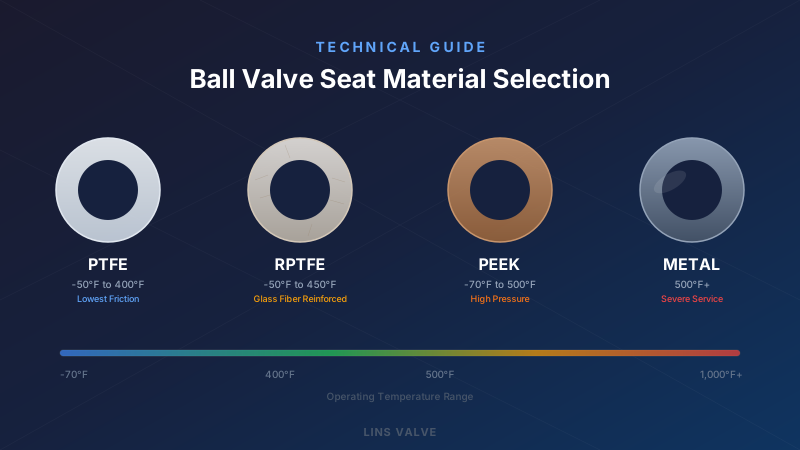
PTFE (Teflon) is the most versatile ball valve seat material, covering -50°F to 400°F (-45°C to 204°C) with near-universal chemical compatibility and the lowest friction of any seat material. RPTFE adds 15-25% glass fiber filler to significantly improve compressive strength and creep resistance, extending the upper limit to 450°F (232°C). PEEK handles higher temperatures (up to 500°F / 260°C) and is commonly used in high-pressure valve designs, but fails with concentrated sulfuric acid and certain highly oxidizing acids. Metal seats are typically used above 500°F and capable of operating beyond 1,000°F (538°C) depending on valve design and coating system.
Why Does Seat Material Matter?
The seat is the sealing element inside a ball valve that makes direct contact with the ball. Seat material determines three things: sealing performance, service life, and operating envelope. A wrong material choice leads to premature seat wear, increased leakage, or outright valve failure in high-temperature or corrosive environments.
Below is a data-driven comparison of the four mainstream seat material categories. Note that actual temperature and pressure ratings depend on overall valve design — including body construction, wall thickness, stem design, end connections, and ASME Class. Seat material is one critical variable, but not the only one. Always refer to the valve manufacturer's P-T rating chart for final selection.
What Are the Properties of PTFE Seats?
Virgin PTFE (polytetrafluoroethylene) is the most widely used ball valve seat material, and for straightforward reasons:
- Chemical compatibility: Resistant to nearly all chemicals, including acids, bases, and solvents. Only molten alkali metals and elemental fluorine will attack it.
- Friction: The lowest of any seat material, which translates directly to lower operating torque and smaller actuator requirements.
- Temperature range: -50°F to 400°F (-45°C to 204°C).
Limitations: PTFE is susceptible to cold flow (creep) under sustained load — the material slowly deforms under pressure, gradually opening gaps in the sealing surface. This limits its service life in high-pressure or high-cycle applications. PTFE is also unsuitable for explosive decompression environments.
How Does RPTFE Improve on Virgin PTFE?
RPTFE (reinforced PTFE) incorporates 15-25% glass fiber filler by weight into the PTFE matrix, significantly improving mechanical properties:
- Creep resistance: Significantly higher compressive strength and creep resistance than virgin PTFE, maintaining seal integrity much longer under high-pressure and high-cycle conditions.
- Temperature range: -50°F to 450°F (-45°C to 232°C) — roughly 50°F higher than virgin PTFE.
- Wear resistance: Glass fiber reinforcement extends seat life in high-cycle applications.
Limitations: Friction is higher than virgin PTFE, which increases operating torque. Critically, RPTFE must not be used with hydrofluoric acid (HF) or strong caustics, as these attack the glass fiber filler.
When Should PEEK Seats Be Specified?
PEEK (polyether ether ketone) is a semi-crystalline engineering thermoplastic with superior mechanical strength and thermal stability:
- Temperature range: -70°F to 500°F (-57°C to 260°C) — the highest of any soft-seat material.
- High-pressure capability: PEEK is often selected for high-pressure applications and is commonly used in valve designs rated up to ASME Class 2500. (Note: pressure class is determined by overall valve design, not seat material alone.)
- Dimensional stability: Virtually no cold flow, maintaining seal integrity under sustained high loads.
Limitations: PEEK is attacked by concentrated sulfuric acid and certain highly oxidizing acids. Cost is also substantially higher than PTFE or RPTFE.
What Are the Advantages of Metal Seats?
When temperatures exceed the limits of all polymer seats, metal seats are the only option. Metal seats are typically used above 500°F (260°C) and capable of operating beyond 1,000°F (538°C) depending on valve design and coating system. Common seat coatings include:
- Stellite (cobalt-based alloy): Excellent mechanical wear and corrosion resistance. The most common hard-facing material for high-temperature ball valve seats.
- Tungsten carbide (WC-Co): Extremely high hardness (micro-hardness up to Rockwell C 72). Handles abrasive slurries and solid-particle-laden fluids.
- Hard chrome plating: Hardness exceeding Rockwell C 67. Used in designs requiring high surface finish quality.
Limitations: Metal-to-metal sealing cannot achieve the bubble-tight shutoff typical of soft-seated valves. Soft-seated ball valves typically achieve bubble-tight shutoff during API 598 seat leakage testing. Leakage classifications such as Class IV-VI are defined under ANSI/FCI 70-2 and are commonly used as reference terminology in the industry. Operating torque is also significantly higher with metal seats.
Seat Material Comparison Table
| Property | PTFE | RPTFE | PEEK | Metal Seat |
|---|---|---|---|---|
| Temperature Range | -50°F to 400°F (-45°C to 204°C) | -50°F to 450°F (-45°C to 232°C) | -70°F to 500°F (-57°C to 260°C) | Typically above 500°F Up to 1,000°F+ |
| Relative Friction | Lowest | Low | Moderate | Highest |
| Chemical Resistance | Excellent (nearly all) | Good (avoid HF, strong caustics) | Good (avoid conc. H2SO4, strong oxidizing acids) | Depends on alloy/coating |
| Creep Resistance | Poor (cold flow) | Good | Excellent | N/A |
| Sealing Performance | Bubble-tight (soft seal) | Bubble-tight (soft seal) | Bubble-tight (soft seal) | Minor leakage permitted (metal-to-metal) |
| Relative Cost | $ (lowest) | $$ | $$$ | $$$$ |
| Typical Applications | Water, gas, general chemicals | Steam, high-cycle, petrochemical | High-temp/high-pressure, nuclear | Refinery, power plants, abrasive media |
How to Choose the Right Seat Material?
Selection depends on three process parameters: temperature, media chemistry, and pressure.
- Temperature ≤ 400°F with general chemicals: PTFE — lowest cost, broadest chemical compatibility, lowest friction.
- Temperature 400-450°F or extended cycle life needed: RPTFE — confirm media does not contain HF or strong caustics.
- Temperature 450-500°F or high-pressure application: PEEK — confirm media does not contain concentrated sulfuric acid or strong oxidizing acids.
- Temperature > 500°F or abrasive/erosive media: Metal seat — accept metal-to-metal sealing characteristics.
Always consult the valve manufacturer's P-T rating chart for final selection, as actual ratings are determined by the complete valve design — body, wall thickness, end connections, and seat material combined.
Frequently Asked Questions
Related Articles
- API 598 Is Three Tests, and Only One Is About Shut-Off
- SS316 Ball Valve OEM Manufacturing in Taiwan
- Ball Valve Pressure Ratings Explained: Class 150 to Class 2500
- SS316 vs SS304 Ball Valve: Material Guide
- Industrial Ball Valve Guide: Types, Selection & Applications
- View LINS Valve SS316 Ball Valve Product Catalog