Is CF8M the Same as 316? What Changes When a Ball Valve Body Is Cast
Key Takeaway
CF8M is the cast counterpart of wrought Type 316, ordered under a different standard with different limits. ASTM A351 puts chromium at 18.0 to 21.0 %, entirely above the 16.0 to 18.0 % of ASTM A240 Type 316; nickel runs 9.0 to 12.0 % against 10.0 to 14.0 %; silicon is allowed to 1.50 % against 0.75 %. Molybdenum, at 2.0 to 3.0 %, is the one element that matches. Those shifts all push the alloy toward ferrite, so a CF8M casting solidifies with delta ferrite in it, commonly reported between 5 and 20 FN. That is why a magnet holds to a stainless valve body, and it is also why the magnet test settles nothing: two heats that both conform to CF8M can land at Schoefer ratios of 1.02 and 1.44, one close to fully austenitic, the other well into ferrite.
Why is a ball valve body cast rather than machined from bar?
The inside of a ball valve body is a set of surfaces a lathe cannot easily reach: the seat pockets, the ball cavity, the shoulder where the cavity meets the end connection, the stem boss. Casting produces that geometry in one operation and leaves machining for the surfaces that carry a tolerance, which is why bodies above the smallest sizes arrive as castings while instrumentation valves, small and mostly straight-bored, are often turned from bar. The forming routes are set out in how ball valves are made.
The consequence for procurement is that the body and the stem in the same valve are usually two different product forms of stainless steel, bought against two different standards.
What do ASTM A351 CF8M and ASTM A240 Type 316 each specify?
Supplier summaries tend to describe the pair as chemically equivalent, sometimes with a figure attached, such as sharing about 97 % of their composition. Read as ranges rather than as point values, that is not what the two standards say.
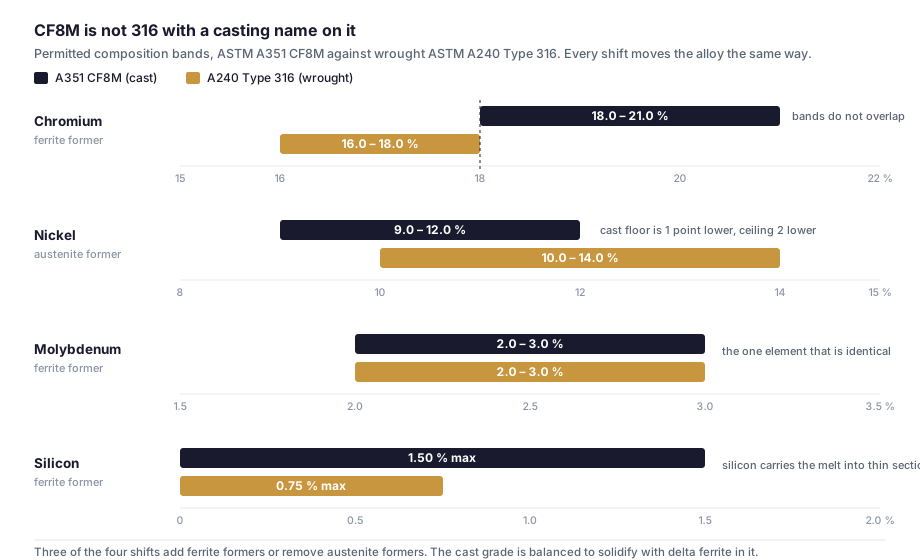
| Element or property | ASTM A351 CF8M (cast) | ASTM A240 Type 316 (wrought) | Direction of the shift |
|---|---|---|---|
| Carbon | 0.08 % max | 0.08 % max | Identical |
| Manganese | 1.50 % max | 2.00 % max | Cast allows less |
| Silicon | 1.50 % max | 0.75 % max | Cast allows double |
| Chromium | 18.0 – 21.0 % | 16.0 – 18.0 % | Bands do not overlap |
| Nickel | 9.0 – 12.0 % | 10.0 – 14.0 % | Cast band sits lower |
| Molybdenum | 2.0 – 3.0 % | 2.0 – 3.0 % | Identical |
| Tensile strength, min | 485 MPa (70 ksi) | 515 MPa (75 ksi) | Cast minimum 30 MPa lower |
| Yield strength, min | 205 MPa (30 ksi) | 205 MPa (30 ksi) | Identical |
One number worth carrying out of that table is the pitting resistance equivalent, taken as Cr + 3.3 Mo. CF8M spans 24.6 to 30.9 across its band; Type 316 spans 22.6 to 27.9. The cast grade sits roughly two points higher, which is the opposite of the assumption behind substitution arguments that treat the pair as interchangeable. Nitrogen is not specified for CF8M under A351, so it is left out of both figures.
What does the name CF8M mean?
The designation predates ASTM's adoption of it and comes from the Alloy Casting Institute system, where each character carries information rather than acting as a serial number.
| Character | What it encodes | In CF8M |
|---|---|---|
| C | Alloy intended for corrosion service. An H in this position marks a heat-resistant alloy, for service above roughly 650 °C. | Corrosion service |
| F | Where the composition sits on the iron-chromium-nickel diagram, advancing through the alphabet as nickel rises relative to chromium. | Standard austenitic balance |
| 8 | Maximum carbon, in hundredths of one per cent. | 0.08 % max |
| M | Molybdenum added to the base alloy. | 2.0 – 3.0 % |
Read that way the family stops needing a lookup table. CF3M is the same alloy at a 0.03 % carbon ceiling; CF8 is the same base without the molybdenum; CF8C carries a columbium stabilising addition. It also removes a common misreading: the digit is a carbon ceiling, not a grade number and not a strength figure, which is why CF8M and wrought Type 316 share a carbon limit while differing on every other element in the table above.
Why does the cast grade carry higher chromium and lower nickel?
Chromium, molybdenum and silicon stabilise ferrite. Nickel, manganese, carbon and nitrogen stabilise austenite. Set the two columns of the table against that division and the pattern is not mixed: the cast grade raises two ferrite formers, lowers one austenite former, and drops the nickel floor by a full point.
Silicon is the element that gives away the reason. A melt carrying more silicon stays fluid longer and fills thin sections and long runners before it freezes, which is a foundry requirement and not a corrosion one. Silicon is also a strong ferrite former, so the fluidity is bought with a microstructural consequence.
The consequence is delta ferrite. Austenitic stainless of this composition does not freeze as austenite; it freezes as primary delta ferrite and transforms toward austenite as it cools, and the transformation does not run to completion. What is left is retained delta ferrite, and it is ferromagnetic.
It is worth being precise about what does not cause this, because the wrong explanation circulates. ASTM A351 requires the castings to be solution heat treated at 1040 °C (1900 °F) minimum and then water quenched or rapidly cooled. Retained ferrite in a conforming casting is therefore not evidence that heat treatment was skipped. It is there because the composition band puts it there.
Why is my stainless steel ball valve magnetic?
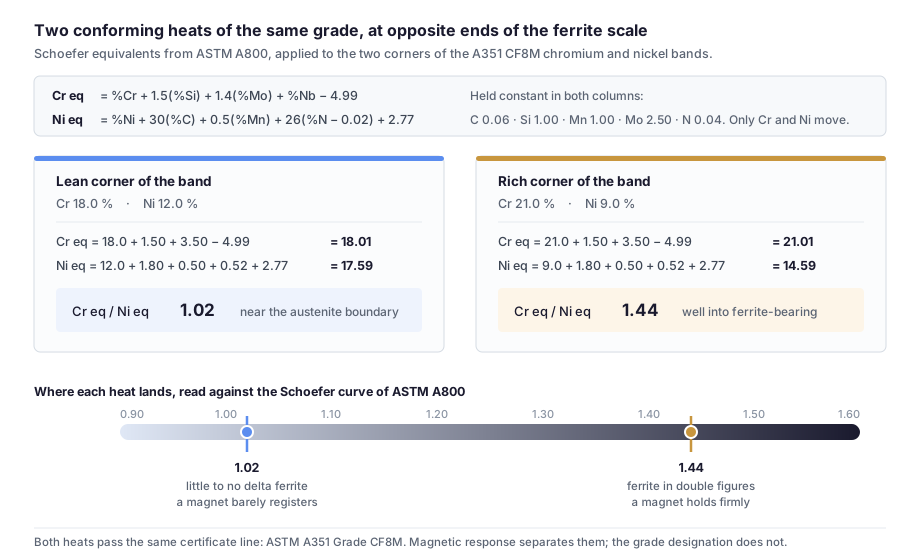
ASTM A800 gives the method for estimating ferrite in a cast austenitic alloy from its chemistry, using the Schoefer equivalents:
- Cr eq = %Cr + 1.5(%Si) + 1.4(%Mo) + %Nb − 4.99
- Ni eq = %Ni + 30(%C) + 0.5(%Mn) + 26(%N − 0.02) + 2.77
Take a heat at carbon 0.06, silicon 1.00, manganese 1.00, molybdenum 2.50 and nitrogen 0.04, and move only chromium and nickel across the A351 band. At the lean corner, chromium 18.0 and nickel 12.0, the equivalents come out at 18.01 and 17.59, a ratio of 1.02. At the rich corner, chromium 21.0 and nickel 9.0, they come out at 21.01 and 14.59, a ratio of 1.44.
Both heats are conforming CF8M. Both would be certified on the same line of the same standard. One is close to the austenite boundary and barely responds to a magnet; the other carries ferrite in double figures and holds one firmly.
The magnet test does not do what it is used for. It cannot separate CF8M from CF8, the cast 304 grade, because both retain ferrite. It cannot separate a cast body from a substituted alloy, because a strong response and a weak one both occur inside the same conforming grade. What a magnet establishes is that ferrite is present, which for a cast austenitic body is the expected condition rather than a finding. Alloying elements are read by XRF or optical emission spectrometry; ferrite is read by a ferritescope calibrated to the magnetic procedure of ASTM A800.
The rejection this causes lands at the receiving end, weeks after shipment, on the strength of a pocket magnet and a rule of thumb learned on wrought sheet metal.
When does delta ferrite stop being an advantage?
The ferrite is useful. A fully austenitic composition is prone to hot tearing as it solidifies and to solidification cracking when a casting is weld repaired, and a few per cent of delta ferrite suppresses both. Three costs come with it, each a question about service conditions rather than about the grade:
- Sigma phase, roughly 540 to 900 °C. Held in this range for long periods, delta ferrite transforms to sigma, an intermetallic that is hard and brittle and that draws chromium and molybdenum out of the surrounding matrix. Toughness and corrosion resistance both fall.
- Ageing embrittlement around 475 °C. Prolonged exposure in this lower window embrittles the ferrite phase itself. The mechanism differs from sigma formation; the practical effect on a valve body is the same loss of toughness.
- Low temperature toughness. Ferrite-bearing material has lower impact toughness at cryogenic temperature than fully austenitic material of the same nominal grade.
For a valve in chilled water, potable water or a room-temperature process line, none of these apply. For a valve on a steam line, in a jacketed service or anywhere the body sits hot for thousands of hours, they decide whether the grade is the right one, and the deciding variable is time at temperature rather than the peak reached.
What separates CF8M from CF3M, and why can XRF not see it?
| ASTM A351 grade | Carbon | Molybdenum | Wrought counterpart |
|---|---|---|---|
| CF8 | 0.08 % max | 0.50 % max | Type 304 |
| CF8M | 0.08 % max | 2.0 – 3.0 % | Type 316 |
| CF3M | 0.03 % max | 2.0 – 3.0 % | Type 316L |
Molybdenum is the same in both, and carbon is the separation. A heat poured to 0.025 % carbon clears the 0.03 % ceiling of CF3M and the 0.08 % ceiling of CF8M at the same time, so it can be certified dual, exactly as 316/316L is in wrought product. Under EN 10213 the corresponding cast grades are 1.4408 for CF8M and 1.4409 for CF3M.
That leaves a gap that shows up on drawings. A body line reading "316L, PMI required" asks for something a handheld XRF analyser cannot supply: carbon is too light an element for the technique to read, so the instrument confirms the chromium, nickel and molybdenum, all of which CF8M also satisfies, and stays silent on the one element that defines the grade. Where the low-carbon grade is genuinely required, the carbon result has to come from the heat analysis on an EN 10204 3.1 certificate. The scope and verification of supplier certificates covers what each document type does and does not cover.
How should a cast stainless body be specified?
- Name the casting standard on the body line. "ASTM A351 Grade CF8M" rather than "316", with the wrought standard named separately for the stem and any bar-turned part. That closes the ambiguity about which composition band and which tensile minimum the design assumed.
- State a Ferrite Number range if ferrite matters. Magnetic response, sustained high temperature and cryogenic service are all ferrite questions that the grade designation does not answer. Give the range and the A800 method, chemical or magnetic.
- Ask for the carbon result rather than a PMI clause. Write CF3M where the low-carbon grade is required and require carbon on an EN 10204 3.1 certificate for the heat supplied.
- Raise sustained service temperature before the grade is fixed. If the body will sit for long periods between 540 and 900 °C, ferrite limits and thermal ageing belong in the conversation with the supplier, not in a later failure investigation.
What varies between two suppliers shipping the same grade?
A ferrite estimate from composition and a ferritescope reading taken on a machined surface can disagree. ASTM A800 provides both routes and treats them as estimates, not as a measurement with a single right answer; the surface condition, the section thickness and the position on the casting all move the reading.
Foundry practice inside the same band also differs, so two suppliers both shipping conforming CF8M can deliver consistently different ferrite. The same limit applies to internal soundness, covered in casting quality and porosity: the grade on the certificate describes chemistry, and chemistry is one of several things that decide how the part behaves.
Frequently Asked Questions
The short version:
Castings are ordered to casting grades. CF8M carries higher chromium, lower nickel and double the silicon allowance of wrought 316, which puts delta ferrite in the microstructure by design. Specify the casting standard on the body line, a Ferrite Number where ferrite matters, and carbon from a heat certificate rather than from a portable analyser.
Related Articles
- API 598 Is Three Tests, and Only One Is About Shut-Off
- Why Does an OEM Ball Valve Carry a Minimum Order Quantity?
- How Ball Valves Are Made: Investment Casting, Forging and CNC
- What Casting Quality Does to a Ball Valve: Porosity and Field Failure
- What Does a Valve Manufacturer's Certification Actually Prove?
- SS316 vs SS304 Ball Valve: Material Selection
- Brass vs Stainless Steel Ball Valve: Where Each Belongs
- Private Label Valve Tooling: Who Owns the Die?
- Stainless Steel Ball Valve OEM Manufacturer in Taiwan: Range, Capacity and Certifications
Referenced standards: ASTM A351/A351M (austenitic steel castings for pressure-containing parts, grades CF8, CF8M, CF3M), ASTM A240/A240M (chromium-nickel stainless plate, sheet and strip, Type 316), ASTM A800/A800M (estimating ferrite content of austenitic alloy steel castings, Schoefer method), ASTM A276 (stainless bars and shapes), EN 10213 (steel castings for pressure purposes, grades 1.4408 and 1.4409), EN 10204 (types of inspection documents), ASME B16.34 (valves, flanged, threaded and welding end). Standard texts are available from ASTM International and CEN; the scope of A800 is published free of charge. For background on the CF family and its ferrite, the Nickel Institute publication Castings: Stainless Steel and Nickel Base (11022) is free to download.
Ferrite Numbers quoted as commonly reported are a typical range for these grades, not a requirement of A351, which does not impose a ferrite limit on CF8M in the base specification. The Schoefer worked examples hold carbon, silicon, manganese, molybdenum and nitrogen at stated values in order to isolate the effect of chromium and nickel; A351 sets no minimum for manganese or silicon and specifies no nitrogen limit for CF8M, so real heats vary along further axes. The sigma phase and ageing temperature windows quoted are approximate and depend on composition and on time at temperature. Chromium and nickel bands are given only where the figures were confirmed against more than one published table; for CF3M only the carbon and molybdenum limits are stated.