Brass vs Stainless Steel Ball Valve: Material Selection Guide
Key Takeaway
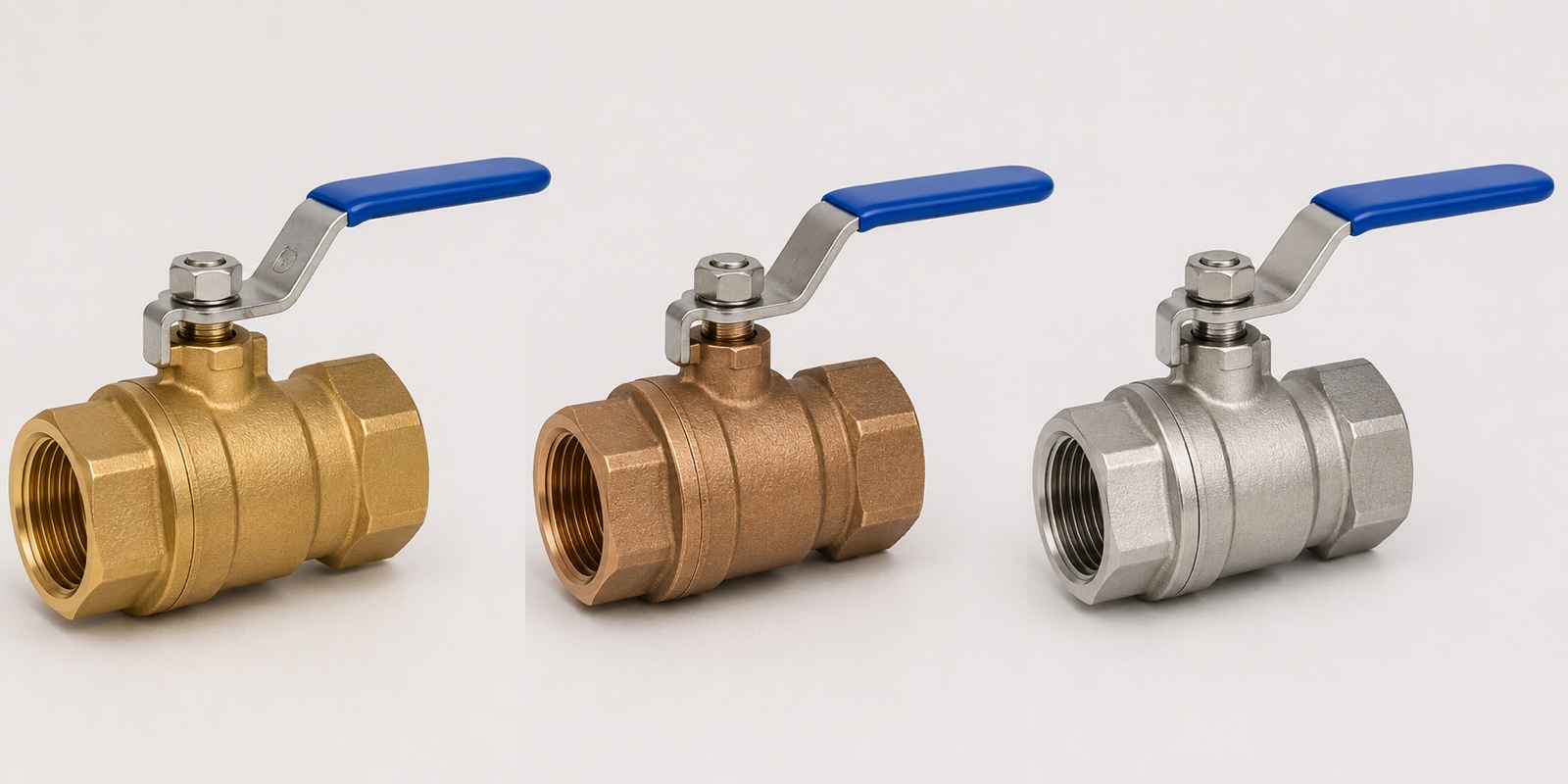
Use brass for potable water, compressed air, and hydronic heating within its rated range — it costs less, machines faster, and performs as well as stainless in clean, low-chloride water. Use SS316 stainless steel when the media contains chlorides, when temperature exceeds the brass valve's rating, or in chemical, marine, food, and pharmaceutical service. The failure mode that settles most disputed cases is dezincification: brasses above roughly 15% zinc can lose zinc selectively in aggressive water, leaving a porous copper skeleton with little strength left. SS316 contains no zinc and is immune to it. Where the water is aggressive but stainless is not justified, the correct middle path is DZR brass or a low-zinc cast bronze such as C83600 — not ordinary C36000.
What Is the Actual Difference Between Brass, Bronze, and Stainless Steel?
The three materials differ in one variable that drives nearly every downstream property: what the base metal is alloyed with.
- Brass is copper alloyed with zinc. The dominant valve grade, C36000 free-cutting brass, runs 61–63% copper, 35–37% zinc, and 2.5–3.5% lead — the lead added purely to break chips during machining.
- Bronze is copper alloyed primarily with tin. Cast valve bronze C83600, covered by ASTM B62, is the classic 85-5-5-5 composition: 85% copper, 5% tin, 5% lead, 5% zinc.
- SS316 is iron-based, alloyed with chromium and nickel plus 2–3% molybdenum. The molybdenum is what buys chloride pitting resistance. Its cast equivalent, used for valve bodies, is designated CF8M.
Most comparison articles treat brass and bronze as interchangeable. They are not, and in water service the difference is the whole story: C36000 carries 35–37% zinc; C83600 carries about 5%. That one number decides whether dezincification is a live risk.
Brass vs Bronze vs SS316: Comparison Table
| Property | Brass (C36000) | Bronze (C83600) | SS316 / CF8M |
|---|---|---|---|
| Base alloy system | Cu-Zn | Cu-Sn | Fe-Cr-Ni-Mo |
| Zinc content | 35–37% | ~5% | None |
| Dezincification risk | Severe (near 35% Zn) | Below threshold | Not applicable |
| Lead content (standard grade) | 2.5–3.5% | ~5% | None intentional |
| Chlorides / seawater | Poor | Fair | Good (Mo-bearing) |
| Typical pressure rating | 600 WOG | Class 150–300 | 1,000–2,000 WOG |
| Typical catalogue temp range | -40°F to 365°F (600 WOG valves) | Per manufacturer chart | -20°F to 450°F (1,000 WOG valves) |
| Ammonia stress corrosion | Susceptible | Lower risk | Resistant |
| Machinability | Rating 100 (the benchmark) | Good (castable) | Substantially harder |
| Lead-free grade available | Yes (C69300, C46500) | Yes (C89833) | Inherently lead-free |
| Relative material cost | Lower | Lower | Higher |
Temperature and pressure figures above are typical catalogue values for common valve series, not standards. Ratings vary by manufacturer, by seat material, and by size — always confirm against the specific valve's pressure-temperature chart before specifying.
Why Does Dezincification Decide Most Brass Valve Failures?
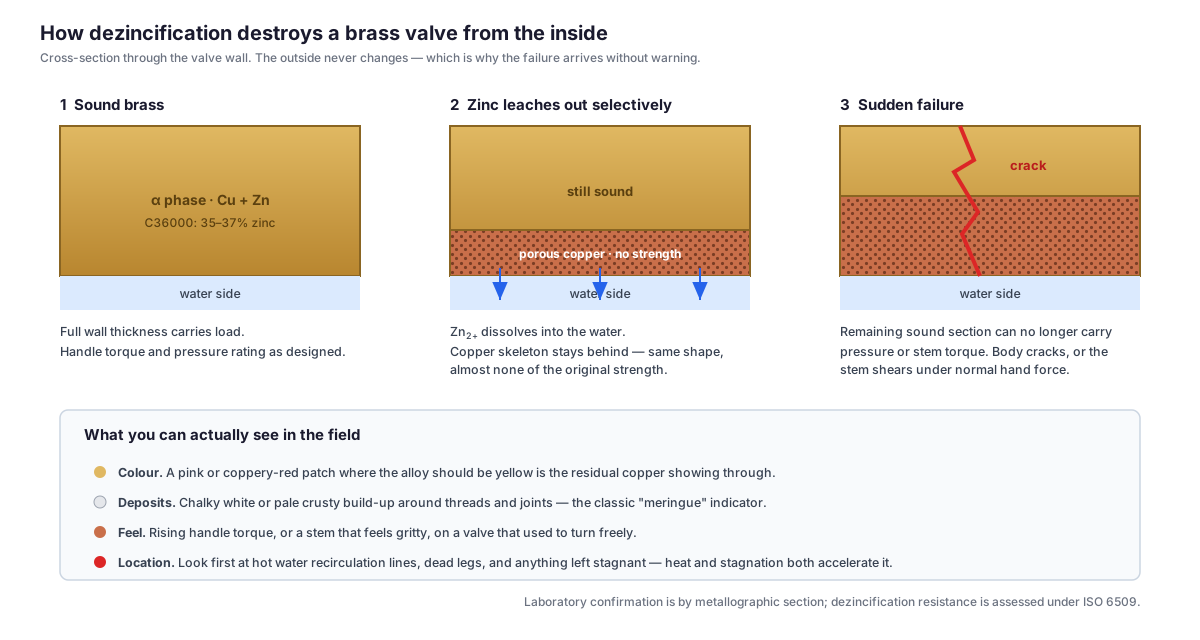
Dezincification is selective corrosion in which zinc dissolves out of the alloy and leaves behind a porous, copper-rich residue. The valve keeps its external shape and often still looks serviceable, which is what makes it dangerous — the remaining material has lost most of its mechanical strength, and failures tend to arrive suddenly as a cracked body or a stem that shears under normal handle force.
Susceptibility tracks zinc content directly. Brasses above roughly 15% zinc are susceptible, and the risk becomes severe as zinc approaches 35% — which is exactly where C36000 sits. Aggressive water chemistry accelerates it: warm, stagnant, low-alkalinity, or high-chloride water are all recognised risk factors, which is why hot water recirculation lines are a classic failure location.
Two mitigations exist, and they work differently:
- DZR brass (dezincification-resistant), such as CW602N. This is worth understanding precisely, because it is widely misdescribed: CW602N still contains 35–37% zinc. It resists dezincification not by removing zinc but by adding an arsenic inhibitor of roughly 0.02–0.15% together with a controlled heat treatment that stabilises the alloy structure.
- Low-zinc cast bronze, such as C83600 at about 5% zinc, which simply sits below the threshold.
How to Tell Whether a Brass Valve Already in Service Is at Risk
Specification prevents the problem. For valves already installed, the question is different and more urgent: is this one failing? Five checks, in order of effort.
- Identify the alloy before anything else. Look for a DZR or CR marking cast or stamped into the body. An unmarked yellow brass fitting in a potable system should be treated as ordinary high-zinc brass until proven otherwise.
- Score the water. The recognised accelerators are warm water, low alkalinity, high chloride and stagnation. A valve on a hot water recirculation line in soft, chlorinated water is in the worst quadrant; a cold mains valve in hard, alkaline water is in the best.
- Look at the colour. A pink or coppery-red patch where the alloy should be yellow is residual copper showing through after the zinc has gone. This is the single most reliable visual indicator.
- Look for deposits. Chalky white or pale crusty build-up around threads and joints — often called "meringue" — is a by-product of the same reaction and frequently appears before any leak.
- Feel the stem. Rising handle torque, or grittiness in a valve that used to turn freely, indicates the stem or its seat is losing sound material. Do not force it — a dezincified stem shears under normal hand force, and it will shear in the open position as readily as the closed one.
One consequence worth planning around: dezincification progresses through a whole population of valves installed at the same time in the same water. Finding one is a reason to survey the rest of that batch, not to replace a single fitting.
How Do Temperature and Pressure Ratings Compare?
Typical 600 WOG brass ball valves are rated approximately -40°F to 365°F (-40°C to 185°C). Typical 1,000 WOG stainless steel ball valves are rated approximately -20°F to 450°F (-29°C to 232°C). In both cases the ceiling is frequently set by the seat material rather than the body — a standard PTFE seat runs out of capability before a stainless body does. Our ball valve seat material guide covers how seat choice moves that limit.
There is a detail in the pressure rating that catches people out. WOG (water, oil, gas) is a cold working pressure — it applies at ambient temperature only. As temperature rises, allowable pressure de-rates. A valve stamped 600 WOG is not approved for 600 PSI at 200°F; you have to read the actual pressure-temperature curve. Specifying from the stamped number alone is one of the more common sourcing errors we see.
On raw pressure capability, the practical gap in small sizes is narrower than the material prices suggest. A residential or light commercial water line running under 150 PSI is far inside both materials' capability. Pressure is rarely the reason to move to stainless. Corrosion and temperature are.
For reference, pressure-temperature ratings for stainless bodies are defined in ASME B16.34; ball valve design and testing requirements are covered by API 608 and ISO 17292; threaded and socket-weld end ball valves are typically built to MSS SP-110.
Which Material Is Required for Drinking Water?
Here the controlling constraint is lead content, not corrosion. The Reduction of Lead in Drinking Water Act was enacted on 4 January 2011 and took effect on 4 January 2014, requiring wetted surfaces of potable water components to contain no more than a 0.25% weighted average of lead. Compliance is verified under NSF/ANSI/CAN 372, with health-effects testing under NSF/ANSI/CAN 61.
That rules out the traditional grades outright. C36000 brass contains 2.5–3.5% lead. C83600 bronze contains about 5%. Both were standard in potable water for decades; neither complies today. The industry response was a family of lead-free alloys — C69300 and C46500 in brass, C89833 and related EnviroBrass grades in castings. C69300 is also documented as having strong dezincification and stress corrosion cracking resistance, so it addresses two problems at once. Stainless steel contains no intentional lead and met the requirement without reformulation, which is one reason SS316 has taken share in potable applications brass historically owned.
If you are sourcing for a North American potable water project, the alloy designation on the drawing is not sufficient evidence of compliance. Ask for the NSF/ANSI/CAN 372 certification listing for the specific valve model.
Why the Cost Gap Is Wider Than the Metal Price
Buyers usually compare brass and stainless on material price per kilogram. That understates the real gap, and the reason is machinability.
Machinability ratings are scaled against C36000 free-cutting brass, the industry benchmark set at 100. Published figures for 316 stainless vary between roughly 36 and 60 — and it is worth knowing why they disagree rather than quoting one number: some sources scale against C36000 brass, others against AISI 1212 free-machining steel. Either way the direction is unambiguous and large. In practice it means slower spindle speeds, heavier tool wear, more frequent insert changes, and longer cycle time per part on the same machine.
The mechanism is the chip. The lead in C36000 exists specifically to break swarf into short curls that clear the tool. Austenitic stainless produces long stringy chips that work-harden as they form, which is what shortens tool life.
Two consequences follow for anyone costing a programme:
- Lead-free brass is not a drop-in substitution. Removing lead to meet NSF 372 also removes the chip-breaking behaviour that made C36000 fast to machine. Converting a legacy brass line to a lead-free grade is a tooling and cycle-time project, not a change of purchase order.
- Stainless economics improve with volume. The machining penalty is largely fixed per part, so it weighs heaviest on short runs and narrows against service life on sustained production.
The practical implication when comparing quotations: a large price gap on a small first order does not predict the gap at production volume, and a supplier quoting stainless at close to brass pricing on a short run is either absorbing the difference or has not costed the machining properly.
How Should You Choose Between Them?
Work down this list. The first condition that applies decides the material.
- Chlorides, seawater, or brackish water present → SS316. The molybdenum is what buys pitting resistance, so SS304 is not an adequate substitute here.
- Temperature above the brass valve's rated ceiling → SS316, and check the seat rating separately.
- Chemical, food, dairy, or pharmaceutical media → SS316, for cleanability and media compatibility.
- Ammonia or ammonia-bearing compounds present → avoid brass, which is susceptible to stress corrosion cracking in ammonia environments.
- Potable water with aggressive chemistry (warm, soft, low alkalinity, high chloride) → DZR brass or a C83600-family bronze, in a certified lead-free grade.
- Potable water with benign chemistry, compressed air, hydronic heating → lead-free brass. Stainless adds cost without adding service life here.
One application deserves a separate note. In data center liquid cooling, SS316 is effectively standard even though loop temperatures are modest, because a closed CDU loop cannot tolerate corrosion products migrating into cold plate microchannels. The driver there is cleanliness and particulate control rather than pressure or temperature. We cover the loop-level requirements in ball valve requirements for data center liquid cooling.
Frequently Asked Questions
The short version:
Chlorides, temperature above the brass rating, or chemical, food and marine service push you to SS316. Aggressive potable water pushes you to DZR brass or a low-zinc bronze — not ordinary C36000. Benign potable water, compressed air and hydronic heating do not justify stainless. And whichever you choose, specify the lead-free grade by designation, not by the word "lead-free".
Related Articles
- SS316 Ball Valve OEM Manufacturing in Taiwan
- SS316 vs SS304 Ball Valve: Material Selection for Corrosive Environments
- Ball Valve Seat Material Guide: PTFE vs RPTFE vs PEEK vs Metal
- Ball Valve Pressure Ratings Explained: ASME Class 150 to 600
- Industrial Ball Valve Guide: Types, Selection & Applications
- Is CF8M the Same as 316? What Changes When a Ball Valve Body Is Cast
Referenced standards: ASTM B62 (composition bronze castings), ASME B16.34 (pressure-temperature ratings), API 608 (metal ball valves), ISO 17292 (metal ball valves for petroleum and petrochemical service), MSS SP-110 (ball valves, threaded and socket-weld ends), NSF/ANSI/CAN 372 and NSF/ANSI/CAN 61 (drinking water lead content and health effects).
Alloy compositions cited from Copper Development Association alloy data. Pressure and temperature figures are typical published valve series ratings and are not substitutes for a specific manufacturer's pressure-temperature chart.