Brass or Stainless in a Glycol Cooling Loop? What the OCP Guideline Says
Key Takeaway
Yes, with conditions. The OCP guidelines for propylene glycol heat transfer fluids, dated 15 September 2026, list brass among the commonly used wetted metals, prefer brass with less than 15% zinc, and ask for an ISO 6509 dezincification check and the material maker’s confirmation above that. They prefer 304L, 316L or higher grades of stainless steel, say stainless steel quick connects should be used, and hold stainless steel to a tighter limit in the corrosion screening test: 0.1 mpy against 0.2 mpy for brass and copper. IBM’s water cooling specification for POWER9 lists brass with more than 15% zinc among the alloys to avoid. Neither document bans brass, and the OCP screening test it prescribes does not address galvanic coupling.
What do the OCP guidelines say about metals in a propylene glycol loop?
They treat copper, brass and stainless steel as commonly used wetted metals, with a different condition for each. The document is “Guidelines for Using Propylene Glycol-Based Heat Transfer Fluids in Liquid Cooled Racks”, Revision 2.0, Version 1.0.0, published by the Open Compute Project on 15 September 2026 and edited by Keegan Yaroch of Dow Inc. It covers inhibited PG25 fluid, which is 25% propylene glycol, in the closed secondary loop between the coolant distribution unit and the cold plates. The facility water system is outside its scope. It describes its tables as representative and not comprehensive, and says additional materials may also be acceptable.
| Wetted metal | What the guidelines say | Screening-test limit |
|---|---|---|
| Copper | Listed, with the copper alloys CDA110, CDA1020, CDA1220 and CDA1100 named | 0.2 mpy and 5 mg weight loss (UNS C11000) |
| Brass | “Brass with <15% zinc is preferred as concentrations >15% zinc is more prone to dezincification of the alloy.” Above 15% zinc, verify dezincification resistance by ISO 6509 “as a first pass” and consult the material manufacturer | 0.2 mpy and 5 mg (UNS C26000). Use caution if a coupon turns copper in colour or shows pitting |
| Stainless steel | “304L, 316L or higher grades preferred”. “Most SS alloys should be acceptable, including 303 and 410” | 0.1 mpy and 2 mg (304L and 316L) |
| Nickel or chromium plated quick connects | Avoid “until these are proven satisfactory”. Quick connects made of stainless steel “should be used” | No limit given |
The reason the guidelines give for avoiding plated quick connects is galvanic. After many uses the plating can wear away and expose the metal underneath, and “the galvanic couple created by the exposed metal with the plating material may increase the corrosion tendency.” They add that brass corrosion would put zinc, and possibly copper, into the fluid, and that the consequences of dissolved zinc on the long-term performance of the copper cold plates have “not been determined at this time”.
Does a glycol loop rule out brass?
No. The OCP table lists brass, and the condition it sets is zinc content. Brass under 15% zinc is preferred. A brass above 15% zinc is not excluded, and the guidelines ask for an ISO 6509 dezincification test as a first pass and for the material maker to confirm that the alloy is acceptable.
IBM’s water cooling specification for POWER9 sets the same line from the other side. It restricts the water-wetted metallurgies to copper alloys and stainless steels and lists “Brass with greater than 15% zinc” among the alloys that “must be avoided in the plumbing system”, along with steels that are not stainless. That page concerns water cooling for IBM systems and not glycol loops in general, and it also says the chemistry of the cooling water must be properly maintained.
The opposite shortcut needs the same care. Stainless steel is the preferred metal in the OCP table, and it has the tighter screening limit, but the guidelines call for stainless quick connects specifically and state that their corrosion testing does not address galvanic coupling. A stainless valve joined to other metals is still a galvanic question.
What does the corrosion screening test measure, and what does it leave out?
It screens fluids and metals for obvious corrosion in a beaker, and it does not predict service life. The OCP guidelines use ASTM D8040-18 (reapproved 2023) with modifications. The test runs at 88°C for two weeks (336 hours) with continuous aeration. Pre-diluted fluids such as PG25 and PG55 are tested without further dilution, with corrosive salts added at 110 mg per litre of sodium chloride, 99 mg per litre of sodium sulfate and 92 mg per litre of sodium bicarbonate. PTFE spacers keep the coupons from touching, so no galvanic couple forms.
The guidelines are plain about the limits. The method “primarily serves as a screening tool” and its results “do not guarantee long-term service performance”. For copper and brass the authors consider 0.2 mpy, which is 5 mg of coupon mass loss, the limit of what the test can discriminate, so it cannot tell 0.1 mpy from 0.2 mpy. They say that concern does not apply to stainless steel alloys. Testing is expected on the materials of concern unless the component maker or the fluid maker has provided corrosion data for them.
What about the seats and seals?
The same guidelines list the polymers, and the choice of EPDM grade matters. Table 4 lists EPDM, FKM, FEP, PTFE, polypropylene, HDPE and PEEK as commonly used. For EPDM it recommends peroxide-cured rubber and warns that sulfur-cured EPDM “can introduce sulfate into the heat transfer fluid over time, leading to issues with corrosion”. A ball valve has a PTFE-type seat and often EPDM or FKM O-rings, so the seal materials belong on the order as well as the metals.
The guidelines add that the typical operating temperature of a closed loop is 17 to 66°C (63 to 151°F), and that above that range the wetted materials list needs review, “particularly elastomers and plastics”. They also say elastomers and plastics vary with catalysts, curing agents and additives, and strongly recommend confirming suitability with the material supplier.
How should a valve for a glycol loop be specified?
Eight lines make the order checkable against the guidelines.
- Name the fluid, its maker and its concentration, such as inhibited PG25.
- List every wetted metal, the body, ball and stem among them, each with its grade.
- For brass, give the alloy and its zinc content, and the ISO 6509 result if the zinc is above 15%.
- For stainless steel, give the grade. The guidelines prefer 304L, 316L or higher, and for a cast body the cast grade should be named. Is CF8M the Same as 316? explains how cast and wrought grades differ.
- List the seat, packing and O-ring materials, and say whether any EPDM is peroxide cured. Ball Valve Seat Material Guide covers the seat polymers.
- Avoid nickel or chromium plated wetted parts, or ask for the evidence that the plating has been proven satisfactory.
- Ask for corrosion data from the valve maker or the fluid maker, or for a modified ASTM D8040 test on the materials of concern.
- Check the galvanic couples with neighbouring metals as a separate step.
What do these documents not settle?
The OCP document is a guideline, and it says that project owners and engineers must verify its use for specific projects. It covers propylene glycol, and the text read does not discuss ethylene glycol, so a loop on ethylene glycol needs the fluid maker’s own compatibility statement. The screening test is short and does not cover galvanic coupling, fluid ageing or inhibitor depletion. The guidelines also state that work on the list of acceptable wetted materials is continuing in an OCP workstream, so materials not listed today may be accepted later.
For how valves sit in these loops, Why AI Data Centers Choose 3-Piece Ball Valves Over 2-Piece and Why Are Coolant Loops Adopting Sanitary Piping Rules? cover the layout side, and Brass vs Stainless Steel Ball Valve: Material Selection Guide covers dezincification in general.
Frequently Asked Questions
Can brass valves be used with propylene glycol coolant?
The OCP guidelines list brass among the commonly used wetted metals for inhibited PG25 fluid, with conditions: brass with less than 15% zinc is preferred, and an alloy above 15% zinc should be verified as dezincification resistant by ISO 6509 as a first pass, with the material manufacturer consulted. The guidelines call their list representative, not comprehensive.
What zinc content does the OCP guideline prefer in brass?
Less than 15% zinc. The table gives the reason as “concentrations >15% zinc is more prone to dezincification of the alloy”.
Which stainless steel grades do the OCP guidelines prefer?
304L, 316L or higher grades. The table adds that most stainless steel alloys should be acceptable, including 303 and 410, and a note says quick connects made of stainless steel should be used.
What corrosion limits does the OCP screening test set?
In the modified ASTM D8040 test, the maximum acceptable rates are 0.2 mpy and 5 mg weight loss for copper (UNS C11000) and brass (UNS C26000), and 0.1 mpy and 2 mg for 304L and 316L stainless steel.
Do the OCP guidelines cover ethylene glycol?
In the text read, the guidelines cover propylene glycol-based fluids, specifically inhibited PG25, with PG55 also named, and they do not discuss ethylene glycol.
Does the OCP corrosion test cover galvanic corrosion?
No. The metals testing section states that it does not address risks associated with galvanic coupling, and it uses PTFE spacers so that the coupons are not galvanically coupled.
What operating temperature do the guidelines assume?
A typical operating temperature of 17 to 66°C (63 to 151°F). Above that range the wetted materials list, particularly elastomers and plastics, needs review.
Related Articles
- Why AI Data Centers Choose 3-Piece Ball Valves Over 2-Piece
- Why Are Coolant Loops Adopting Sanitary Piping Rules?
- Brass vs Stainless Steel Ball Valve: Material Selection Guide
- Is CF8M the Same as 316? What Changes When a Ball Valve Body Is Cast
- Ball Valve Seat Material Guide: PTFE vs RPTFE vs PEEK vs Metal
- Why Are Data Center Cooling Valves Electric Rather Than Pneumatic?
- What Happens When a Ball Valve Fails in a Data Center Cooling Loop?
- Stainless Steel Ball Valve OEM Manufacturer in Taiwan
- Your Drawing Says Belimo. Is That Enough to Order Actuated Ball Valves for Data Center Cooling?
- How Many Valves Go Into a 1 GW Liquid-Cooled Data Center?
Referenced sources: OCP, Guidelines for Using Propylene Glycol-Based Heat Transfer Fluids in Liquid Cooled Racks, Revision 2.0, Version 1.0.0, IBM, Water cooling system specification and requirements (POWER9).
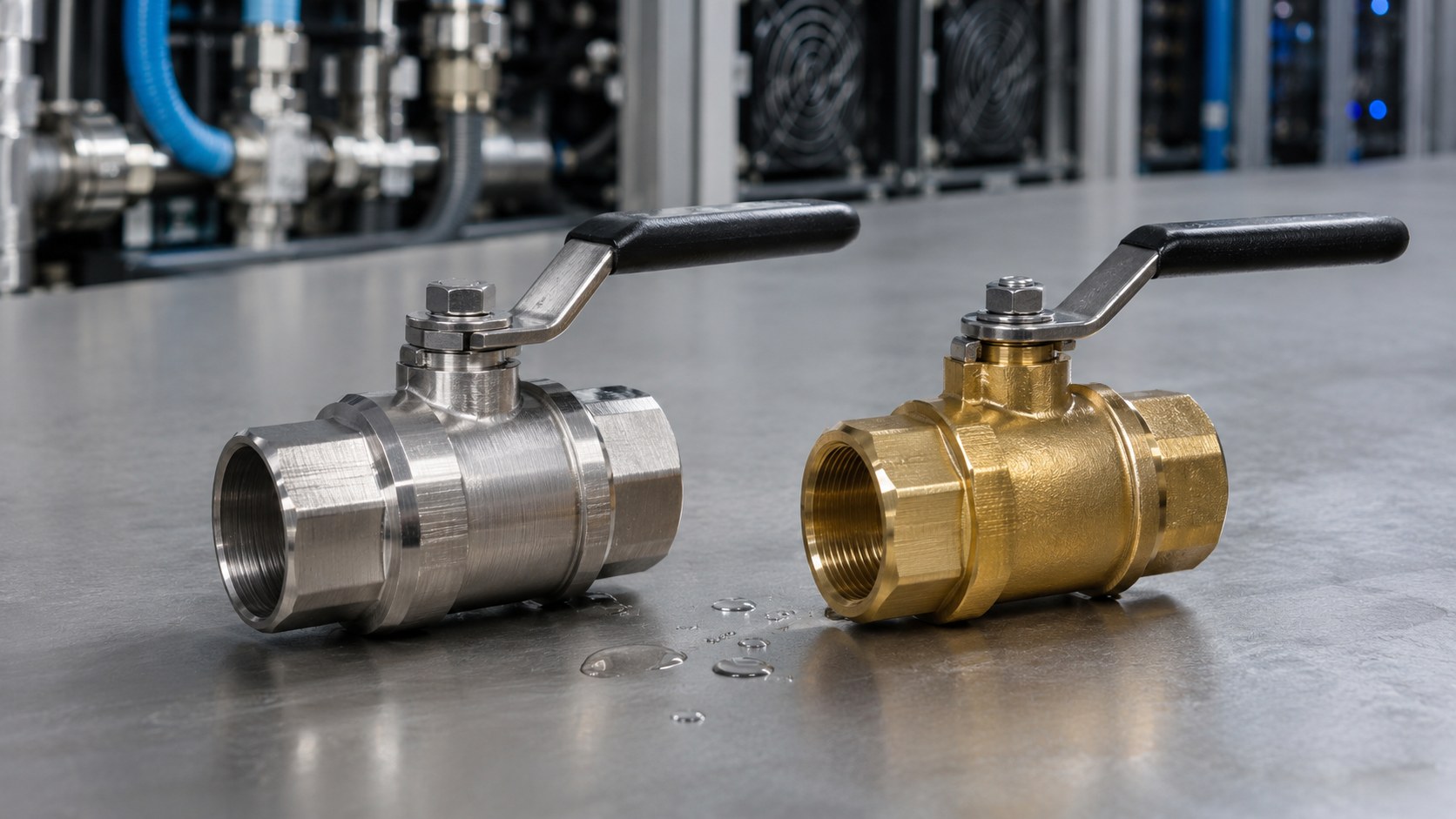
The OCP quotations are from the published PDF, read from its text layer, and the table cells were reassembled from that text, so check them against the document before relying on a figure. ASTM D8040 and ISO 6509 are named in the OCP document and were not read. The IBM page concerns water cooling for IBM systems. Quoted guidelines are not a certification, and the author does not state that any valve meets them. The cover image is a generated illustration, not a photograph of a particular product.