Your Drawing Says Belimo. Is That Enough to Order Actuated Ball Valves for Data Center Cooling?
Key Takeaway
Not quite. A Belimo name tells you who makes the actuator and the controls. It does not tell you the valve body metal, the seals, the valve’s job or the ship date. Belimo’s 2025 report says data centers were slightly less than half of its sales growth, so you will see the name often. Ask six questions before you order, listed below.
Why is Belimo growing so fast in data centers?
Belimo’s 2025 annual report says data center cooling made up slightly less than half of its sales growth. Three facts from it:
- Sales rose 23.3% to CHF 1,120.8 million.
- Control valves were 53% of sales and grew 31.3%.
- The company lists “industry leading lead times” as a strength.
These are the company’s own statements and we have not tested them. For you, the point is simple: it is a sensible brand to name. But an order is placed for a model number, and the name alone leaves six things open.
What does the Belimo name not tell you?
- Is it a control valve or an on/off ball valve? A control valve shapes flow when it is part-open. An on/off ball valve opens or closes a line, for example to isolate a rack. They are different valves, and most loops need both. Ask: which job each position does.
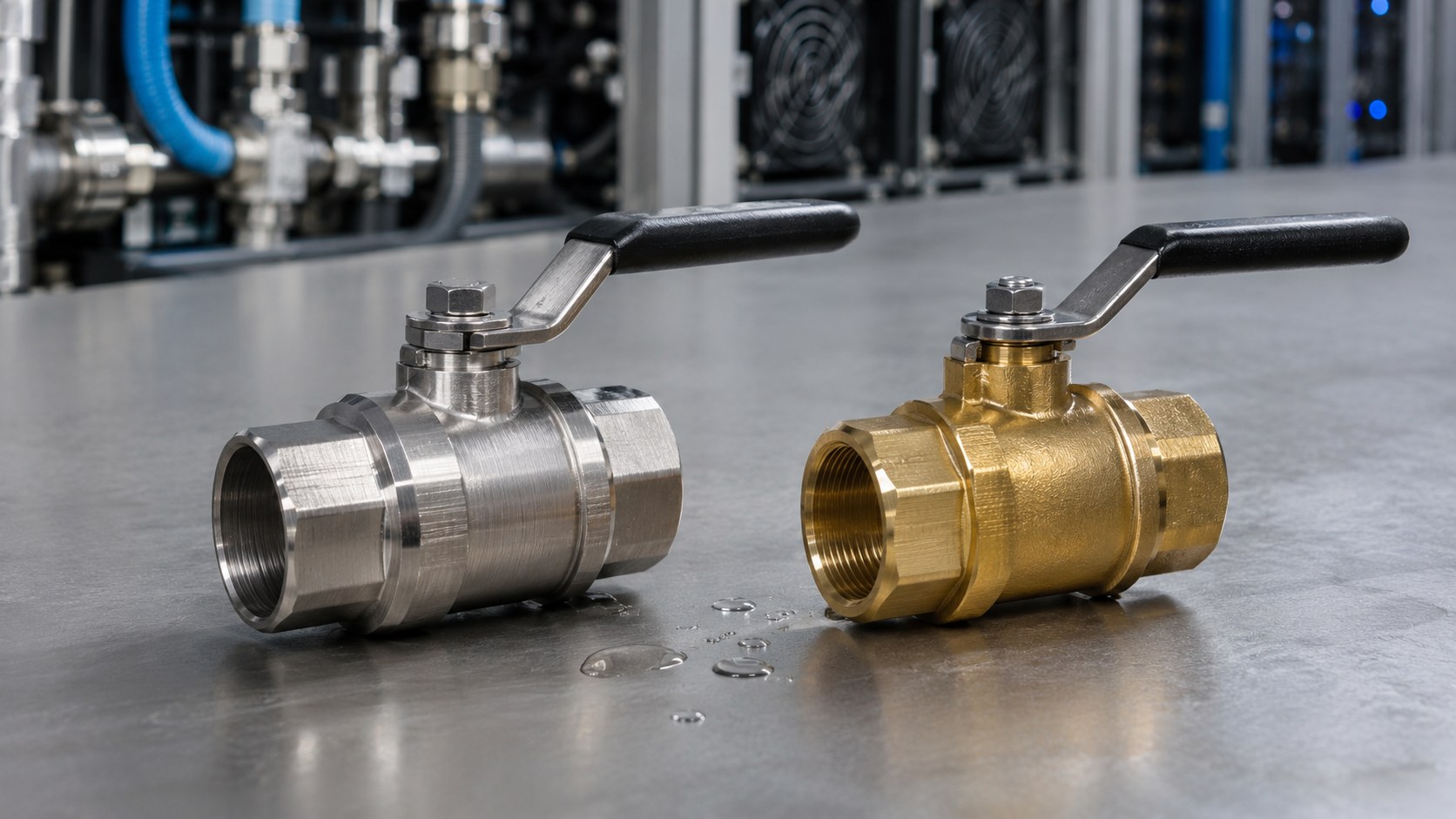
- Is the body brass or stainless steel? In the datasheets we read, the two control valves have nickel-plated brass bodies and the two ball valves have 316 stainless steel bodies. Ask: the exact model and its body metal.
- Is it approved for your coolant? The datasheets say “up to 60% glycol”. That is a limit, not an approval for your fluid. Ask: the valve maker or the coolant maker for a compatibility statement.
- Are the seals right? The datasheets name the seat and O-ring but not how the rubber is cured. Ask: whether any EPDM is peroxide cured.
- Can you change the actuator later? The datasheets list only Belimo actuators and do not mention ISO 5211, the standard mounting pad. Ask: whether the interface must be open.
- When will it ship? A general statement is not a date. Ask: for a confirmed ship date in writing, and what it depends on.
What do the four datasheets say?
The table uses only datasheets we opened. Their dates and sizes differ, so check the maker’s current sheet for your valve. All four list a fluid temperature range that covers 17 to 66°C, the typical range in the OCP cooling guideline.
| Datasheet | Body | Ball and stem | Seat | Fluid and temperature | Body rating |
|---|---|---|---|---|---|
| B209, 0.5″ control valve (created 2016-10-07) | Forged brass, nickel plated | Stainless steel | PTFE | Chilled or hot water, up to 60% glycol, -18 to 120°C | 600 psi (about 41 bar) |
| B215HT073, 0.5″ control valve (2023-12-07) | Nickel-plated brass (DZR) P-CuZn35Pb2 | Stainless steel | ETFE | Up to 60% glycol, 16 to 130°C | 600 psi (about 41 bar) |
| B2050VSS-15, 0.5″ ball valve (2022-01-12) | Stainless steel A351-CF8M 316 | 316 stainless steel | RPTFE | Up to 60% glycol, -30 to 148°C | 2000 psig WOG (about 138 bar) |
| B249VSS, 2″ ball valve (created 2018-02-23) | A351-CF8M 316 stainless steel | 316 stainless steel | Reinforced PTFE | Up to 60% glycol, -30 to 148°C | 1500 psig WOG (about 103 bar) |
For your engineer: the brass question in the OCP guideline
The OCP guideline for propylene glycol coolant prefers brass under 15% zinc. Above 15% zinc it asks for an ISO 6509 dezincification check and the material maker’s confirmation.
The datasheet designation P-CuZn35Pb2 names a brass of about 35% zinc, and DZR means dezincification resistant. So this is a document to request from the valve maker, not a verdict against the valve. Also ask whether the nickel plating reaches the wetted surfaces, and whether the EPDM seal is peroxide cured, since the guideline cautions against sulfur-cured EPDM. The OCP corrosion test is a screening method whose results “do not guarantee long-term service performance”, which is why a compatibility statement for the real fluid matters. Details: Brass or Stainless in a Glycol Cooling Loop? What the OCP Guideline Says.
When does a buyer look for a stainless steel ball valve manufacturer?
Usually when the spec calls for a 316 stainless steel body, an open ISO 5211 actuator pad, or a customised OEM or ODM valve. We have made valves in Taichung, Taiwan since 1969, and build stainless steel ball valves for OEM and ODM customers. Examples are the 2-piece direct mount ball valve (1/4 to 3 inch) and the 3-piece direct mount clamp ball valve (1/4 to 4 inch), in AISI 316 (A351-CF8M) as listed on the product pages. They are on/off isolation valves, not characterized control valves. More on the supplier side: Stainless Steel Ball Valve OEM Manufacturer in Taiwan. For how the actuator interface works, see ISO 5211 Flange Dimensions and Why Are Data Center Cooling Valves Electric Rather Than Pneumatic?.
What does this article not cover?
It reads one annual report and four datasheets. We did not test any valve or contact the company. The datasheets date from 2016 to 2023, cover only the sizes named, and are distributor copies, so the maker’s current sheet governs. We make no claim about market share, price or quality. The publisher is not affiliated with Belimo, and Belimo is a trademark of its owner.
Frequently Asked Questions
Is a Belimo name on the drawing enough to place an order?
No. The brand does not tell you the body metal, the seal materials, whether the valve modulates or opens and closes, or the ship date. Order by exact model number and ask the six questions in this article.
Why is Belimo growing so fast in data centers?
Its 2025 annual report shows 23.3% sales growth in local currencies, to CHF 1,120.8 million. It says data center cooling made up slightly less than half of that growth.
What are Belimo control valve bodies made of?
In the datasheets read here, the two control valves have nickel-plated brass bodies with a stainless steel ball and stem. Belimo also lists stainless steel body valves (B2050VSS-15 and B249VSS) with A351-CF8M 316 bodies.
What does up to 60% glycol on a datasheet mean?
It is a limit on concentration. It does not name the glycol type or the inhibitor package, so ask the fluid maker or the valve maker for a compatibility statement for your actual coolant.
Is a control valve the same as an electric actuated ball valve?
No. A control valve shapes flow and is used to modulate. An ISO 5211 ball valve has a standard actuator mounting pad and usually opens or closes a line.
What is an electric actuated ball valve used for in data center cooling?
It opens or closes a line, for example to isolate a branch, a rack or a pump. An electric actuator turns the ball, and an ISO 5211 mounting pad lets the project choose the actuator brand.
Does the OCP guideline allow brass in a PG25 loop?
Yes, with conditions. Brass under 15% zinc is preferred. Above 15% zinc, the guideline asks for an ISO 6509 dezincification check and the material maker’s confirmation.
Who makes stainless steel ISO 5211 ball valves for OEM projects?
LINS Valve, in Taichung, Taiwan, makes 2-piece and 3-piece ISO 5211 direct mount ball valves in AISI 316 (A351-CF8M) for OEM and ODM customers, as listed on its product pages.
What should I ask any supplier about lead time?
Ask for a confirmed ship date in writing for the exact model and quantity, and what it depends on. A general statement about lead times is not a delivery date.
Related Articles
- Brass or Stainless in a Glycol Cooling Loop? What the OCP Guideline Says
- Why Are Data Center Cooling Valves Electric Rather Than Pneumatic?
- Why a Tighter-Sealing Ball Valve Takes More Torque to Turn
- ISO 5211 Flange Dimensions
- What Happens When a Ball Valve Fails in a Data Center Cooling Loop?
- Data Center Valve Market to 2035
- Stainless Steel Ball Valve OEM Manufacturer in Taiwan
Referenced sources: Belimo Annual Report 2025, Management Report, B215HT073 data sheet, B209 data sheet, B2050VSS-15 data sheet, B249VSS data sheet, OCP, Guidelines for Using Propylene Glycol-Based Heat Transfer Fluids in Liquid Cooled Racks, Version 1.0.0.
The annual report was read on 19 November 2026. The datasheets are copies hosted by distributors and were read by text recognition, so check figures against the manufacturer’s current sheet before relying on them. The statement that the datasheets do not mention ISO 5211 refers only to the four sheets read. The cover image is a generated illustration, not a photograph of a particular product.