Who Owns the Tooling in a Private Label Valve Programme?
Key Takeaway
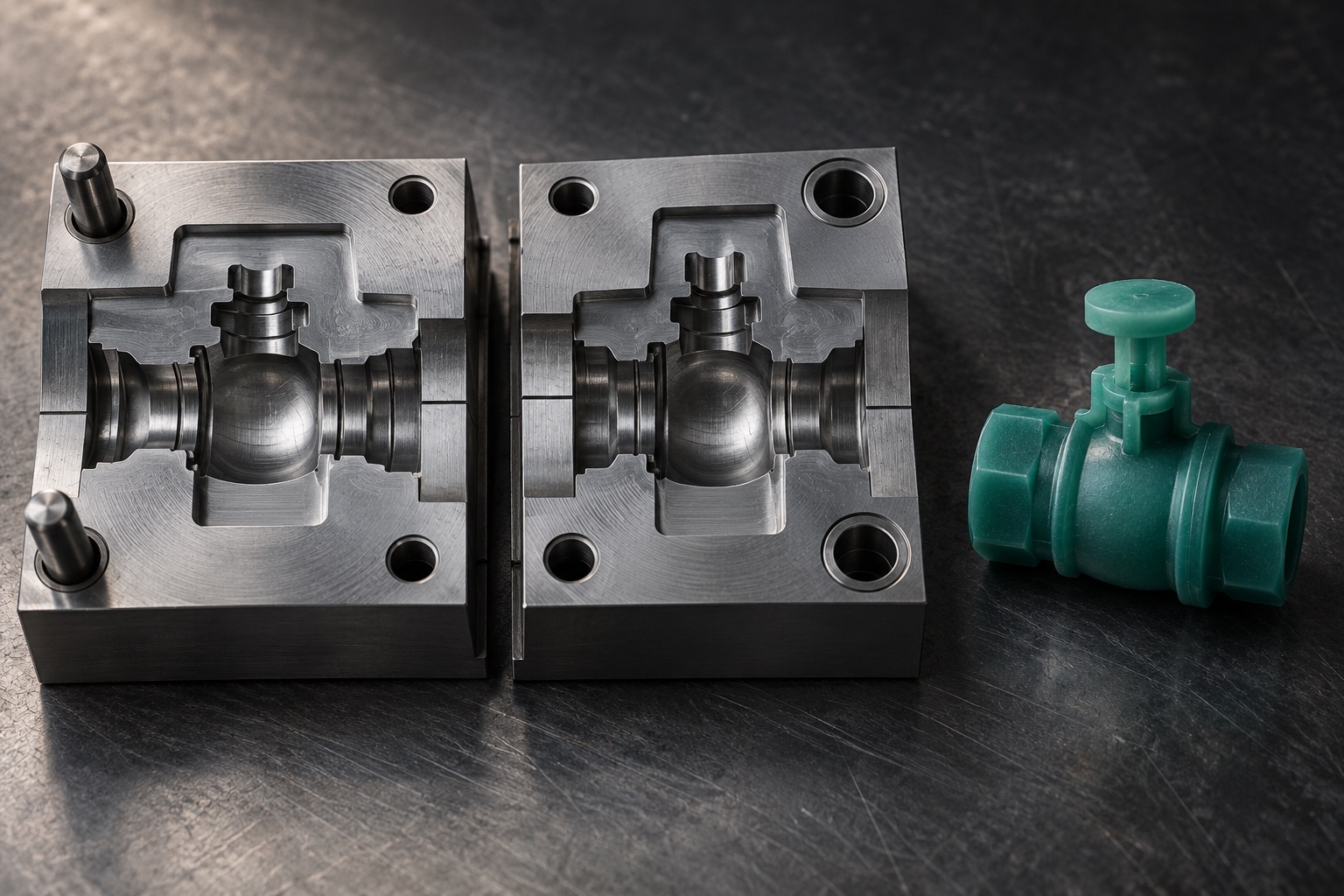
A brand name on a cast valve body is a tooling question. The lettering is cut into the wax injection die, which fixes it before any metal is poured and puts it beyond reach on a finished casting. So the die turns into an asset both sides care about, and two things need settling: who pays for it, and who owns it. Those are separate questions. Paying the full cost transfers nothing unless the agreement says it does, and the party who built the tool keeps it in their building either way. Of the three ways tooling normally gets paid for, an upfront charge with written ownership terms is the cleanest, and amortising it into the unit price works where the recovery schedule is documented. Tooling offered at no charge is the one that costs most. The money is still being paid, it is buried in every unit indefinitely, and it usually buys no ownership at all.
What tooling means on a cast valve
The word covers different objects depending on the process, and the distinction matters when an agreement refers to it.
In investment casting, which is how most stainless ball valve bodies are produced, the tool is a metal die that injects wax. It produces a wax pattern, the pattern is assembled onto a cluster and dipped in ceramic slurry to build a shell, the wax is melted out, and metal is poured into the cavity that remains. Of everything in that sequence only the die survives to be used again.
In sand casting the pattern itself is the durable asset, a reusable shape that forms the cavity in the sand. When a contract drafted for one process gets applied to the other, the word pattern can mean the thing that survives or the thing that is destroyed. An agreement is better off naming the object than the category.
| Term | In investment casting | In sand casting |
|---|---|---|
| Tool or die | The metal die that injects wax. Durable, reused. | Not usually the term used |
| Pattern | The wax replica. Consumed every cycle. | The reusable shape that forms the sand cavity. Durable. |
| Mould or shell | The ceramic shell. Broken off the casting. | The bonded sand. Broken out of the flask. |
| What a buyer is paying for | The die | The pattern |
The word pattern is the one that causes trouble. It names the durable asset in sand casting and the consumed one in investment casting, so a clause written around it can mean the opposite of what a party assumed.
Why a brand name means new tooling
Markings on a cast valve body are raised rather than stamped. They are cut into the die as recesses, so every wax pattern comes out with the lettering already standing proud, and every casting made from those patterns carries it.
A brand name therefore cannot be added to an existing casting without machining or some secondary process, and changing the name on a running line means cutting a new die. This is why the branding question reaches the quotation stage with a tooling cost and a lead time already attached to it.
What tooling costs, in order of magnitude
Numbers vary by part size, cavity count and complexity, and a supplier quoting a specific body will give a specific figure. Published ranges are still worth knowing, because they show which line items on a quotation are worth arguing about.
| Process | Typical tooling cost | What that buys |
|---|---|---|
| Investment casting, wax injection die | Around 2,000 to 10,000 USD, reaching 20,000 for larger or more complex tools | A die with a typical life around 50,000 pieces |
| Aluminium tooling | The lower end of that range | Faster to produce, suited to prototype and lower volume work |
| Die casting, single cavity production tool | Around 25,000 to 80,000 USD | Included for contrast; it is a different process with a different economic shape |
Tooling for a valve body is usually a four figure decision, which is small against the value of a private label programme running for several years. The ownership terms are worth more than the price. A buyer who negotiates hard on the tooling quote and leaves the ownership clause blank has optimised the wrong variable.
Three ways tooling gets paid for
Every arrangement is a version of one of these, and each one leaves the buyer in a different position.
| Structure | How it works | Ownership position |
|---|---|---|
| Paid upfront | A one-time charge before tooling is cut | Clearest, provided the agreement states that ownership passes to the buyer |
| Amortised into unit price | The cost is recovered across production volume | Workable, but it requires documentation showing when the cost is fully recovered and what happens then |
| No charge | No tooling line on the quotation | Usually none. The cost sits in the unit price and continues after it has been recovered |
The second structure carries a specific trap. Where a tooling charge is framed as a deposit that is amortised into unit pricing rather than as a purchase, the buyer can reach the end of a multi-year programme having paid the full cost several times over without ever having owned the tool. Documentation closes it. Put the total in writing, set out the recovery schedule, and say what the ownership position is on the day the cost is recovered.
Free tooling is the expensive option
A quotation with no tooling line reads as a concession, and it is offered because it works as one. It takes a capital item out of a budget that has to go up for approval, which makes a first order easier to place.
The cost has not gone anywhere. It has moved into the unit price, where it is paid on every piece for as long as the programme runs. A tool costing a few thousand dollars is recovered early in a production relationship of any size, and after that the same increment carries on being paid. Nothing stops it, because nothing was ever labelled as tooling in the first place.
The ownership side is worse. Where nothing was paid for tooling there is nothing to claim, so the arrangement quietly removes the option of moving production later. The trade is a lower barrier to starting against a higher unit price and no way out, which can be worth taking on a first order or a market test and rarely is on a programme meant to run for years.
Payment does not transfer ownership
This one is covered in detail outside the valve industry, in the contract commentary that deals with tooling disputes. Paying the full cost of a tool does not by itself transfer ownership unless the agreement says so. A supplier who built the tool may retain possession and may assert rights over it even after the cost has been paid in full.
Two clauses close the gap and both go missing regularly. One states that ownership belongs to the buyer. The other states what the supplier may not do with it, which means running it for other customers, transferring it, or holding it against a commercial dispute. Write the first without the second and the tool legally belongs to one party while sitting in the building of another.
Where the tool physically sits
Tooling stays in the factory, because that is the only place it is useful. A wax injection die is mounted in a press that is set up for it, and it has no function anywhere else until another foundry is running the same part.
The realistic question is what has to be in place before a tool can move at all. Three things: a written ownership position, a tool identified by a number that appears on documents, and a transfer clause covering who removes it and who pays to ship it. A programme with those can change supplier. A programme holding a paid invoice and nothing else usually cannot.
What a heat number actually covers
A separate question arrives with private label work, because a branded part is usually also a part with documentation requirements.
A material certificate ties back to a melt lot, and a melt lot is a pour rather than an order. Furnace capacity follows the weight of that pour. Downstream operations do not necessarily batch the same way, and a single heat treat lot can cover several melt lots. So traceability follows how the parts were made, not how many were ordered.
Which makes the useful question a structural one. If a certificate has to carry a heat number, what does that number cover, and do the parts in one shipment come from a single melt lot or several? Both answers can be acceptable. They produce different documents, and a traceability requirement that does not say which one is being asked for will be met with whichever the process already produces.
What belongs in the agreement
These items are cheap to write and expensive to add later.
- Identify the tooling by number and by the part it produces, so that the thing being discussed is a specific object rather than a category.
- State the total cost and the payment structure, and where it is amortised, state the recovery schedule.
- State that ownership passes to the buyer, and state on what date or at what recovery point.
- State what the supplier may not do with it: run it for other customers, transfer it, or withhold it.
- State who maintains it, who replaces it at end of life, and who pays. A die has a finite life, and the replacement is a new tool with the same ownership question.
- State the transfer mechanics: notice period, who removes it, who ships it, and in what condition it is handed over.
- State what happens to the brand marking if the programme ends, since a die carrying a customer name has no value to anyone else and its disposal is worth agreeing in advance.
The tool and the drawing are separate assets
Negotiations tend to treat these as one thing. They separate cleanly. The tool is an object; the design is the drawing it was cut to, and buying the first does not deliver the second. Which of them a buyer actually holds is what decides whether production can move.
| Body drawn by the supplier | Body drawn by the buyer | |
|---|---|---|
| Who can own the tool | Either, by agreement | Either, by agreement |
| Who holds the design | The supplier | The buyer |
| Can the buyer have it made elsewhere | Not on the strength of owning the tool | Yes, subject to the agreement |
| What the tool is worth to the buyer alone | Little, since the design cannot travel with it | The cost of not cutting a new one |
The left-hand column describes most private label programmes, where a brand puts its name on a supplier's existing body. The tooling in that case carries the customer name and the supplier design, which is why owning it is worth less than it appears and why the marking clause matters as much as the ownership clause.
What this does not settle
The distinction above is commercial rather than legal. Which position applies to a given programme is a question for the agreement and for a lawyer in the relevant jurisdiction rather than for a foundry.
The cost figures quoted here are published ranges for investment casting tooling generally. They indicate order of magnitude rather than the price of any particular valve body, which depends on size, cavity count and complexity.
Nothing here is legal advice. The clauses described are the ones that recur in tooling disputes across manufacturing industries, and how they should be drafted is a question for counsel.
Frequently Asked Questions
Related Articles
- What Do the Markings on a Ball Valve Body Mean?
- How Ball Valves Are Made: Investment Casting, Forging and CNC
- Ball Valve Casting Quality: Porosity and How It Fails
- Is CF8M the Same as 316? What Changes When a Body Is Cast
- Sourcing Ball Valves from Taiwan: What Differs Between Factories
- What Does a Valve Manufacturer's Certification Actually Prove?
- Stainless Steel Ball Valve OEM Manufacturing in Taiwan
Sources: Tooling cost ranges and die life are published figures from investment casting tooling cost guides, quoted as orders of magnitude rather than as a quotation for any particular body. The distinction between paying for a tool and owning it, the retention of possession by the party that built it, and the amortised deposit problem are set out in manufacturing law commentary on molds and tooling in international manufacturing and in international sourcing guidance on mold ownership, where they recur across industries rather than being specific to valves. Furnace capacity and melt lot relationships are from investment casting process references.
This article describes commercial mechanics rather than law. Ownership, design rights and transfer are governed by the agreement between the parties and by the jurisdiction it is written under, and both are questions for counsel.