Sourcing Ball Valves from Taiwan: What Differs Between Factories, and How to Check
Key Takeaway
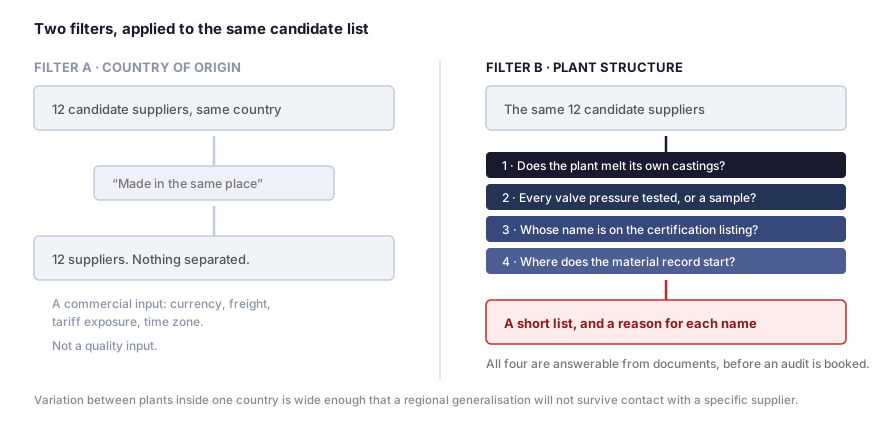
Country of origin is a weak predictor of valve quality. Plant structure is a strong one, and it varies as much within a country as between countries. Four structural facts predict more than any regional generalisation: whether the plant melts its own castings or buys them, whether pressure testing is applied to every valve or to a sample, whose name is on the certification listing, and where the material record begins. All four are verifiable in a single audit day or, in most cases, from a document request. What follows sets out how to check each one, what a weak answer sounds like, and what Taiwan's valve industry is structurally, including the parts of the sourcing question that geography does not solve.
What does the region actually determine?
Less than the sourcing literature suggests, once the product is a machined stainless steel valve rather than an assembled consumer good.
The cost of a machined stainless valve is driven by the casting route, alloy input cost, scrap and rework rate, tooling amortisation across the order quantity, and how much inspection and testing throughput the plant carries. A region influences these indirectly, through wage levels, industrial clustering and access to foundry capacity, but it fixes none of them.
The practical consequence is that two plants in the same industrial park can produce valves that behave differently in service, and a buyer who selects on country has not yet made a selection at all.
Four structural facts that do predict quality
1. Does the plant melt its own castings, or buy them?
This is the single largest structural difference in the valve industry and it is rarely stated on a company website. A valve maker with an in-house foundry controls alloy chemistry, pouring practice and thermal control. A valve maker that buys castings is auditing someone else's foundry, at one remove, usually without visibility of the melt.
Neither arrangement is disqualifying. Plenty of capable valve makers buy castings and manage their suppliers well. What changes is where the material record starts and how far a defect can be traced without a third party's cooperation. When a body shows porosity in service, the in-house case ends in the same quality system that shipped the valve; the bought-in case ends at a gate.
2. Is pressure testing applied to every valve, or to a sample?
API 598 defines the shell and seat test, including the test pressures and hold times. What the phrase does not carry is a rate. "Tested per API 598" is therefore compatible with both 100 percent testing and lot sampling, and the two produce very different escape rates for a similar quotation. The question has to be asked explicitly rather than inferred from the standard reference.
The follow-up question is capacity: how many test positions the plant has relative to its assembly lines. A plant that tests every valve needs test throughput matched to production throughput, and that is visible on a walk round in a way a written policy is not.
3. Whose name is on the certification listing?
Certification marks are held by an organisation for a defined product scope, not by a country and not by an industry. ISO 9001:2015 certifies a quality management system, which is a different claim from a product listing under CSA, ASSE, WRAS or UL. A supplier can hold ISO 9001 and hold no product listings at all, and both statements can be made truthfully in the same sentence.
Ask for the certificate, the listing number, and the product scope it covers. Then check the number against the certifying body's own register rather than the copy supplied. This takes a few minutes and it is the step that separates a certificate from a claim about a certificate.
The same distinction applies to inspection documents. Under EN 10204, a 3.1 certificate is issued by the manufacturer and validated by an inspection representative independent of the manufacturing department. A 3.2 certificate is countersigned by an independent inspector or the purchaser's representative. Both are called mill certificates in conversation; only one involves a second party.
4. Where does the material record begin?
A mill test report to EN 10204 3.1 certifies a heat of steel. It does not certify that the casting in front of you came from that heat. Positive material identification with a portable spectrometer on the finished body closes that gap, and the substitution it detects is the one with an economic motive behind it.
The numbers are unambiguous. Under ASTM A351, CF8M is specified with molybdenum at 2.0–3.0 percent; CF8, the cast equivalent of 304, allows a maximum of 0.50 percent. A spectrometer separates them in seconds. The eye cannot: the two alloys are visually identical, and a body changed to the cheaper one passes every other incoming check.
How to verify each claim
| Claim | How to verify | A weak answer sounds like |
|---|---|---|
| "We have our own foundry" | Ask to see the melt log and charge records for a specific heat number on a delivered valve | Photographs of a foundry, with no melt records offered |
| "100% pressure tested" | Count test positions against assembly lines; ask for test records tied to serial or lot | A policy statement with no records and no throughput figure |
| "ISO 9001 certified" | Certificate number checked against the certifying body's register; ask what scope it covers | A scanned certificate, expired or scope unstated |
| "CSA / ASSE / WRAS / UL listed" | Listing number checked on the issuing body's public register, matched to the model | Marks shown on a brochure without listing numbers |
| "Full material traceability" | Request EN 10204 3.1 for a shipped lot, then PMI the part and compare | A certificate of conformity in place of a test report |
| "We can scale to your volume" | Ask for current monthly output on the specific product family, not total plant capacity | A single plant-wide capacity number with no product breakdown |
Every item in that table is answerable with documents. A supplier who can produce them quickly has a quality system that is in use; a supplier who needs weeks is describing one that exists on paper.
What Taiwan's valve industry is, structurally
Setting aside the question of whether it is the right choice, these are the structural facts a buyer is dealing with.
Valve manufacturing in Taiwan is clustered, concentrated heavily around Taichung, alongside the machine tool and precision machining industries that supply it. The cluster is built on investment casting, which suits stainless steel valve bodies because it produces complex internal geometry close to net shape. It is export-oriented rather than domestically driven, so documentation practice, MTR provision and dimensional reporting have been shaped by North American and European customer requirements over a long period.
Certification coverage is broad, because the export markets required it. ISO 9001 is common; CSA, ASSE, WRAS and UL listings appear where suppliers serve regulated water markets. Coverage being common does not mean any given supplier holds the listing you need, which returns to the verification step above.
What the region does not solve
Three things, and they are worth stating plainly because sourcing material rarely does.
Geography does not fix a weak plant. The variation between factories within Taiwan is wide. A buyer who substitutes country for supplier qualification has moved the risk, not reduced it.
Concentration is a risk as well as an advantage. The clustering that produces short supply chains and dense subcontractor networks also means a regional disruption reaches many suppliers at once. A dual-sourcing strategy that places both suppliers inside the same cluster has bought less independence than it appears to.
Ceiling on single-product volume is real. A programme that will ramp to very high volumes on one SKU may outgrow a medium-scale plant, and that is a legitimate reason to look elsewhere or to split the programme. Capacity headroom on the specific product family is the figure to ask for, and it is a different number from total plant capacity.
Where this fits in a qualification process
The four structural questions belong at the shortlist stage, before an audit is scheduled, because all four can be answered from documents. An audit day is then spent confirming what the documents claimed and looking at the things paper cannot show: how parts are handled between operations, whether test records are being written in real time, whether work instructions at the station match the revision in the document control system.
Country of origin belongs in the same conversation as currency, freight, tariff exposure and time zone. It is a commercial input. It is not a quality input, and treating it as one is how a qualification process ends up confident and wrong.
Frequently Asked Questions
The short version:
Stop selecting on country and start selecting on plant structure. Ask four questions before an audit is scheduled: does the plant melt its own castings, is every valve pressure tested or a sample, whose name is on each certification listing, and does the material record start at the melt or at a supplier's gate. All four are answerable from documents, and a supplier who produces them quickly is running a quality system rather than describing one. Taiwan's cluster offers investment casting depth, export-shaped documentation practice and medium scale; it does not offer immunity from a weak plant, independence from regional disruption, or an unlimited ceiling on single-SKU volume.
Related Articles
- API 598 Is Three Tests, and Only One Is About Shut-Off
- Why Does an OEM Ball Valve Carry a Minimum Order Quantity?
- Who Owns the Tooling in a Private Label Valve Programme?
- Ball Valve OEM and Private Label Manufacturing
- What Do ISO 9001, CSA, ASSE, WRAS & UL Certifications Mean for Ball Valves?
- How Ball Valves Are Made: Investment Casting, Forging & CNC — Stainless Steel, Bronze & Brass
- SS316 vs SS304 Ball Valve: The Material Mistake That Causes Premature Corrosion
- Floating vs Trunnion Ball Valve: Design, Torque and Selection
- How to Choose the Right Industrial Ball Valve (Without Over-Specifying or Under-Specifying)
- What Happens When a Ball Valve Fails in a Data Center Cooling Loop?
- Is CF8M the Same as 316? What Changes When a Ball Valve Body Is Cast
- What Should You Check When You Audit a Ball Valve Factory?
Referenced standards: API 598 (valve inspection and testing, shell and seat test procedure and acceptance), EN 10204 (types of inspection documents, including the 3.1 mill test report), ISO 9001:2015 (quality management systems), ASME B16.34 (pressure-temperature ratings), and the product listing schemes operated by CSA Group, ASSE International, WRAS and UL. Also ASTM A351 (castings, austenitic, for pressure-containing parts, defining CF8 and CF8M composition ranges). Publisher pages: API, ASME, ASTM.
On the claims in this article: the structural description of Taiwan's valve industry, its clustering around Taichung, its investment casting base and its export orientation, is a description of industry structure and not a quality claim. This article deliberately avoids regional cost comparisons and quality rankings, because the figures circulated for those vary widely by scope and are rarely traceable to a published methodology. Where an earlier version of this page carried such figures, they have been removed rather than re-sourced. Certification coverage varies by supplier and must be verified per supplier and per product scope.