Data Center Cooling Explained: Air, Liquid & Immersion — What's the Difference?
Quick Summary
Data centers use three cooling methods: air cooling (fans and cold air), direct liquid cooling (coolant piped to CPU/GPU cold plates), and immersion cooling (servers submerged in dielectric fluid). Air cooling maxes out around 15 kW per rack. Liquid cooling handles 30–55+ kW. Immersion handles 100+ kW. As AI pushes rack densities higher, liquid and immersion systems are becoming the new standard — and both require precision ball valves at every connection point.
Why Is Data Center Cooling a Big Deal?
A single NVIDIA B200 GPU operates at 1,200W. One rack full of these chips can exceed 120 kW.
That's not a computer generating heat. That's a furnace.
In 2026, average rack density hit 27 kW — a 69% increase over the previous year. And it's still climbing.
If the cooling system fails, servers overheat within minutes. Data is lost. Hardware is damaged. Downtime costs $7,000–$10,000 per minute for a major cloud provider.
Cooling isn't optional. It's the backbone of every data center.
Method 1: Air Cooling
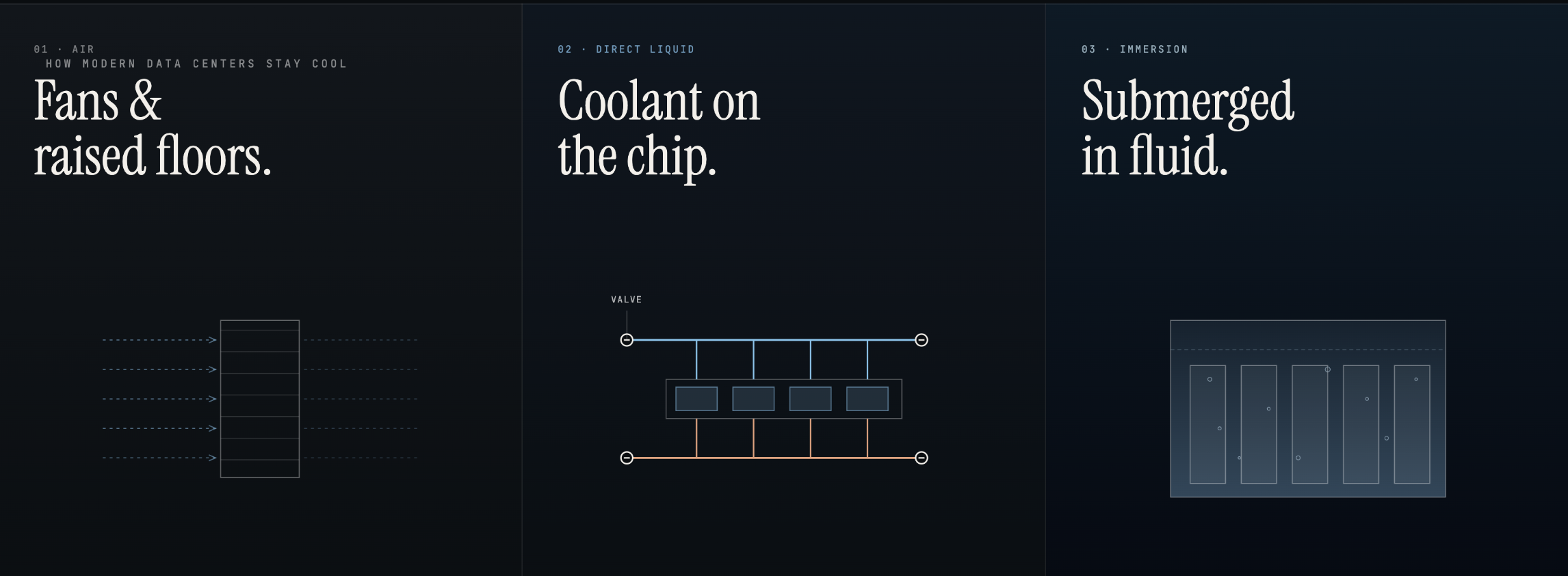
Air cooling is the traditional approach. It pushes cold air through server rooms using fans, raised floors, and precision air conditioning units.
How it works:
- Cold air flows from under the floor or overhead ducts
- Air passes through server racks and absorbs heat
- Hot air returns to the cooling unit, gets chilled, and recirculates
Best for: Low-density deployments under 15 kW per rack — web hosting, storage, general enterprise IT.
| Spec | Value |
|---|---|
| Max rack density | ~15 kW |
| PUE | 1.5–1.8 |
| Cooling efficiency | Low |
| Footprint | Large |
| Valve requirements | Minimal |
Air cooling has worked for decades. But AI changed the math. When a single GPU draws more power than an entire legacy server, fans alone can't keep up.
Method 2: Direct Liquid Cooling (DLC)
Direct liquid cooling sends a water-glycol mixture through cold plates mounted directly on CPUs and GPUs. Liquid carries up to 4,000 times more heat than air — making it far more efficient at the chip level.
How it works:
- A Coolant Distribution Unit (CDU) pumps coolant through supply and return lines
- Cold plates sit directly on processors, absorbing heat at the source
- Warm coolant returns to the CDU, transfers heat to the facility water loop, and recirculates
Best for: AI training clusters, high-performance computing, GPU-dense racks at 30–55+ kW.
| Spec | Value |
|---|---|
| Max rack density | 30–55+ kW |
| PUE | 1.1–1.3 |
| Cooling efficiency | High |
| Footprint | 40–60% smaller than air |
| Valve requirements | High — every CDU, manifold, rack needs isolation valves |
This is the 2026 standard for enterprise AI deployment. Every major cloud provider is adopting DLC.
Method 3: Immersion Cooling
Immersion cooling submerges entire servers in a tank of dielectric fluid — a non-conductive liquid that absorbs heat from every component simultaneously.
Single-phase: The fluid stays liquid. It absorbs heat, circulates to a heat exchanger, cools down, and returns.
Two-phase: The fluid boils at the chip surface, absorbing enormous heat through phase change. Vapor rises, condenses, and drips back down.
Best for: Next-generation AI infrastructure at 100+ kW per rack, edge deployments where space is limited, or facilities where noise reduction is critical.
| Spec | Value |
|---|---|
| Max rack density | 100+ kW |
| PUE | 1.02–1.08 |
| Cooling efficiency | Highest |
| Footprint | 50–75% smaller than air |
| Valve requirements | Critical — fluid loops, heat exchangers, drain/fill systems |
At 64-rack scale, the 10-year total cost of ownership is $28 million — versus $42 million for air cooling.
Side-by-Side Comparison
| Feature | Air Cooling | Direct Liquid | Immersion |
|---|---|---|---|
| Max rack density | ~15 kW | 30–55+ kW | 100+ kW |
| PUE | 1.5–1.8 | 1.1–1.3 | 1.02–1.08 |
| 10-year TCO (64 racks) | $42M | ~$33M | $28M |
| Physical footprint | Large | 40–60% smaller | 50–75% smaller |
| Valve requirements | Minimal | High | Very high |
| Setup complexity | Low | Medium | High |
| AI-ready | No | Yes | Yes |
| Noise level | High (fans) | Medium | Silent |
What Does This Mean for Valves?
The shift from air to liquid cooling is creating massive demand for precision ball valves.
The data center liquid cooling valve market is projected to reach $1.8 billion by 2032 — growing at 30.8% per year.
Ball valves already hold 25% of the data center valve market because they deliver what cooling systems need:
- Zero-leakage shut-off — one leak in a server rack means millions in damage
- Quarter-turn operation — fast isolation during maintenance
- Full-port flow — minimal pressure drop in coolant loops
- 3-piece design — in-line maintenance without draining the system
- SS316 stainless steel — corrosion resistant to glycol, deionized water, and dielectric fluids
Every time a new data center chooses liquid cooling over air, thousands more ball valves are needed.
Frequently Asked Questions
Related Articles
- Stainless Steel Ball Valve OEM Manufacturer in Taiwan
- Ball Valve Requirements for Data Center Liquid Cooling Systems
- Why AI Data Centers Choose 3-Piece Ball Valves Over 2-Piece
- SS316 vs SS304 Ball Valve: Material Selection for Corrosive Environments
- Why Global Brands Are Sourcing Ball Valves from Taiwan for Data Centers