Why Does a Stainless Steel Ball Valve Rust? Pitting, Crevices and Iron on the Surface
Key Takeaway
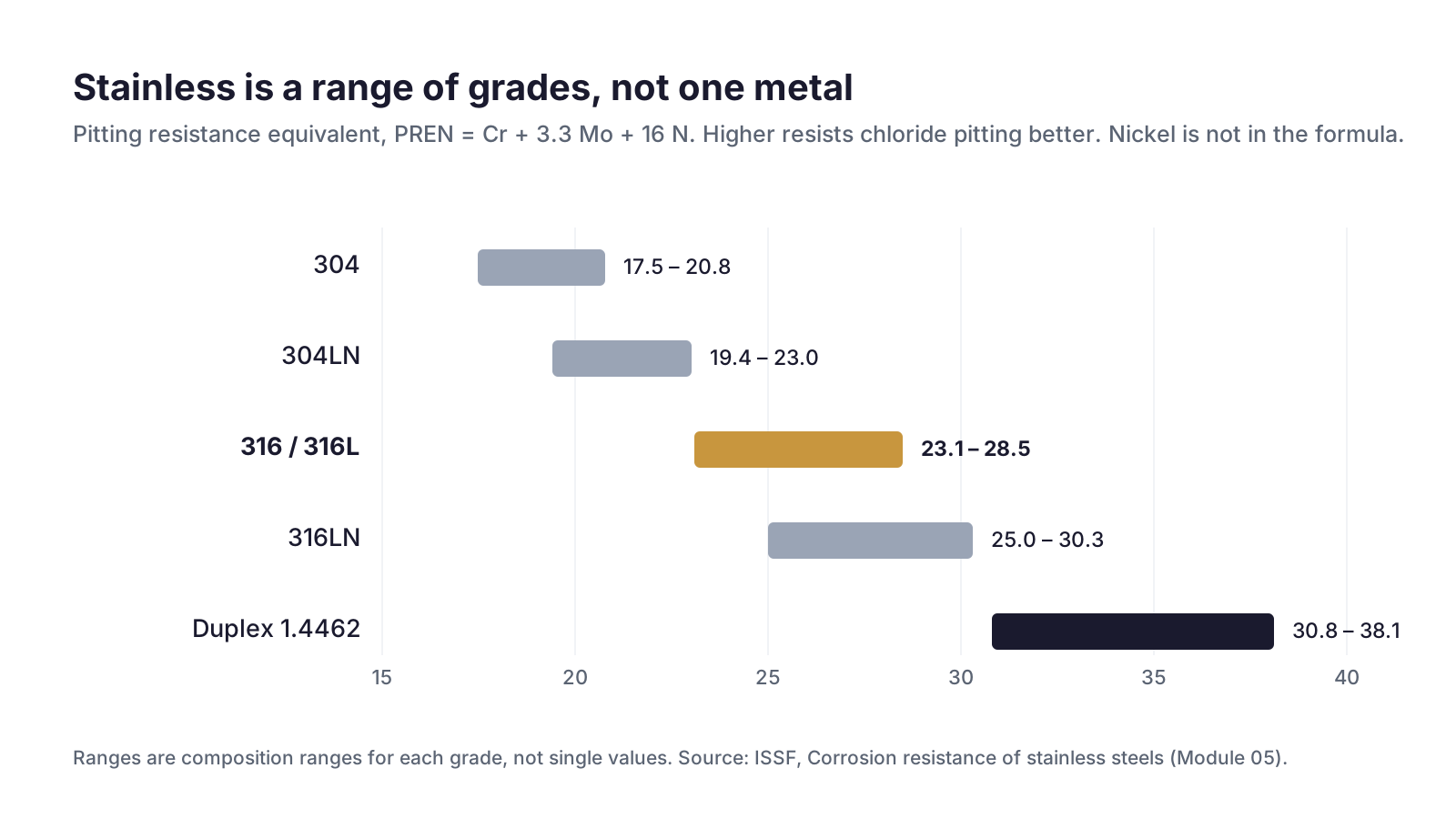
Stainless steel is protected by a film of iron and chromium oxy-hydroxides 2 to 3 nm thick, and on a ball valve three different things take that film away. Chloride pitting is set by the alloy: PREN = Cr + 3.3 Mo + 16 N runs 17.5 to 20.8 for 304 and 23.1 to 28.5 for 316, with nickel absent from the formula. Crevice attack is set by geometry, and a ball valve is assembled from crevices at the packing, the seats, the gasketed joints and the threads. The third cause is not corrosion of the alloy. Iron from carbon-steel tools, abrasives and spatter sits on the surface and rusts, and passivation removes it. The marks look different, and each is answered by a different decision.
What protects stainless steel, and what takes it away?
The protection is a passive film: oxy-hydroxides of iron and chromium, 2 to 3 nm thick, transparent, adherent and self-repairing. A paint system is 20 to 200 µm thick, can peel, and does not repair itself. That comparison is from the International Stainless Steel Forum (ISSF) training module on corrosion resistance, and it explains why a scratch on stainless heals and a scratch on a coating does not.
Self-repair needs oxygen at the surface. Hold on to that, because it is what goes wrong in a crevice.
When the film is lost across the whole surface the metal corrodes evenly. ISSF notes that on stainless steel this typically takes immersion in acids. The attack that matters on a valve is local, and on a ball valve three kinds are in play.
How does chloride pitting start, and what does PREN tell you?
Pits start at very small surface irregularities or at non-metallic inclusions. They keep growing when the reactions inside the pit stop the film from re-forming. Two conditions push it along: higher temperature, which ISSF says reduces pitting resistance drastically, and higher chloride concentration, where resistance falls with the logarithm of the chloride level.
The alloy side is summarised by the pitting resistance equivalent number, PREN = Cr + 3.3 Mo + 16 N, with each element as a weight percent. Molybdenum counts 3.3 times per percent, nitrogen 16 times.
| Grade | EN number | PREN range |
|---|---|---|
| 304 | 1.4301 | 17.5 – 20.8 |
| 304LN | 1.4311 | 19.4 – 23.0 |
| 316 / 316L | 1.4401 / 1.4404 | 23.1 – 28.5 |
| 316LN | 1.4406 | 25.0 – 30.3 |
| Duplex | 1.4462 | 30.8 – 38.1 |
| CF8M, cast (ASTM A351 limits, nitrogen not specified) | 1.4408 family | 24.6 – 30.9 (calculated) |
These are ranges because each grade is a composition band. Neighbouring grades touch: 304LN reaches 23.0 where 316 starts at 23.1. The CF8M row is calculated here from the ASTM A351 chromium and molybdenum limits, as set out in the CF8M article, and leaves nitrogen out because A351 does not specify it for this grade. On that same basis, without nitrogen, wrought 316 calculates to 22.6 to 27.9.
ISSF adds a caution that applies to every row: PREN alone cannot be used to predict whether a particular grade will suit a particular application. It ranks grades. It does not give a safe chloride level or a safe temperature, and no table on this page does either.
Does more nickel mean better corrosion resistance?
For pitting, no. Nickel is not in the PREN formula, and ISSF states that resistance to pitting does not depend on nickel content. What buys chloride resistance is chromium, molybdenum and nitrogen. Nickel is what keeps the structure austenitic.
The cast grade makes the point. CF8M is allowed less nickel than wrought 316, 9.0 to 12.0 % against 10.0 to 14.0 %, yet its calculated PREN band sits above 316's. A valve judged by a nickel reading and not by chromium and molybdenum is being judged on the wrong element.
Why is a ball valve full of crevices?
ISSF defines crevice corrosion as attack in confined spaces where access of the surrounding fluid is limited. Its examples are gaps and contact areas between parts, spaces under gaskets or seals, cracks and seams, and spaces filled with deposits or sludge.
The mechanism runs on the oxygen point from earlier. Inside the crevice the oxygen is used up. Reactions there raise the chloride concentration and lower the pH until the film can no longer re-form, and the metal in the crevice corrodes. The laboratory measure for it is the critical crevice temperature, a companion to the critical pitting temperature.
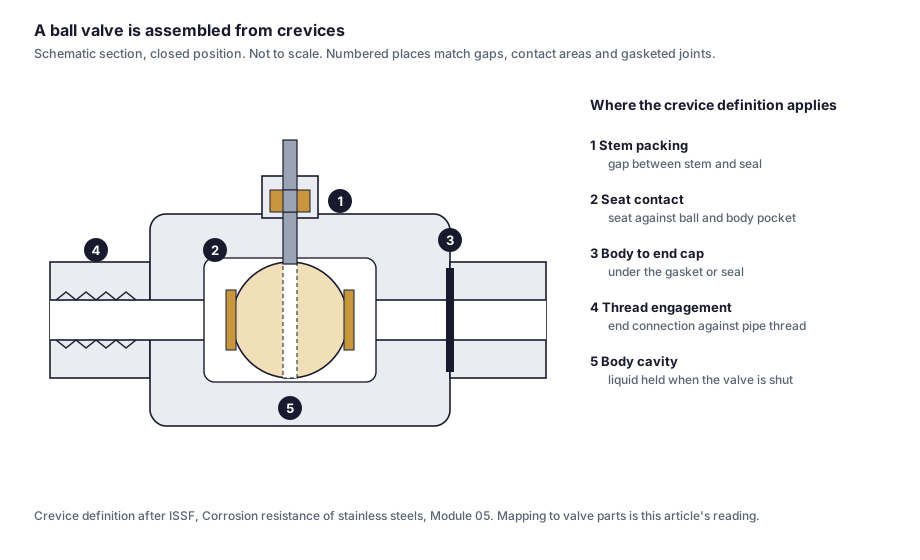
| No. | Location | What forms the crevice |
|---|---|---|
| 1 | Stem packing | Gap between the stem and the seal around it |
| 2 | Seat contact | Seat rings pressed against the ball and the body pocket |
| 3 | Body to end cap | The joint under the gasket or seal |
| 4 | Thread engagement | End connection thread against the pipe thread |
| 5 | Body cavity | Liquid held around the ball when the valve is shut |
ISSF lists three ways to avoid crevice corrosion: design the part so there are no crevices and it drains fully, clean deposits out, and select a grade that resists it. The first is already decided by the time a valve is bought, because packing, seats and gasketed joints are what make it a ball valve. What remains with the buyer and the user is the grade and what is allowed to sit in the gaps. A valve left shut and full of stagnant liquid, with deposit settling in the cavity, is the condition the mechanism describes.
Sanitary valves treat the cavity as a design problem in its own right; the Tri-Clamp article covers that side, and the surface finish article covers how finish enters it.
Why does a new valve show rust when the grade is right?
Because the rust may not be the alloy. The Australian Stainless Steel Development Association (ASSDA) calls embedded and loose iron the most frequently encountered fabrication problem, and says the particles rapidly rust and initiate corrosion. Its listed sources are abrasives previously used on carbon steel, carbon steel wire brushes, grinding dust and weld spatter from carbon steel operations.
A stainless valve is cast, ground, machined and handled before it ships, and any of those steps can bring it into contact with the sources on that list. A chemistry certificate reports what the metal is made of. It says nothing about what landed on the surface afterwards.
The remedies differ in what they take off:
| Treatment | What it removes | Effect on the surface |
|---|---|---|
| Passivation | Free iron. Not iron oxide. | No marked change in appearance |
| Pickling, usually nitric-hydrofluoric acid | Embedded iron, heat tint and some other contaminants | Removes the dark oxide film and a thin layer of metal beneath it |
| Electropolishing | Same class of contaminants as pickling | Removes the same layers in a controlled way, leaving a clean, defect-free surface |
Passivation is dilute nitric acid, as a bath or a paste. It takes off free iron and leaves the appearance alone. If the contamination is iron oxide, or the part carries heat tint or embedded iron, passivation is not the tool, and ASSDA points to pickling or electropolishing instead.
The word "passivated" on a drawing tells a supplier little. ASTM A967 covers nitric acid immersion, citric acid immersion and electrochemical treatment. It also lists the practices for checking the result: water immersion, high humidity, salt spray, copper sulfate, potassium ferricyanide-nitric acid, damp cloth and boiling water immersion, plus a free iron test. A purchase line that names the method and the test is something a supplier can be held to.
What if the corrosion is on the bolts, or beside a weld?
Two other causes show up in the field and have nothing to do with chloride.
Galvanic corrosion appears when two metals with very different potentials touch in the presence of an electrolyte, and humidity is enough. The less noble metal is attacked. ISSF's own example is a stainless plate bolted with mild steel bolts: the bolts corrode and the stainless is untouched. Its basic rules are to avoid dissimilar metals in contact, and where they must touch, to give the less noble metal the much larger area.
Intergranular attack comes from chromium carbides forming at grain boundaries and robbing the surrounding metal of chromium. ISSF places it in the heat-affected zone of a weld when carbon is high and the steel is not stabilised. The lower carbon cap of CF3M against CF8M, 0.03 % against 0.08 %, addresses exactly that.
How do you tell the causes apart?
What the damage looks like gives a first reading. It is a hypothesis, and confirming it takes a laboratory examination.
| What you find | Likely mechanism | What changes it |
|---|---|---|
| Surface rust you can trace to a carbon-steel tool, abrasive, wire brush or weld spatter source | Free iron contamination | Clean and passivate; keep carbon-steel tooling away from the parts |
| Small pits or holes on wetted surfaces in chloride-bearing media | Pitting | Higher PREN grade; lower temperature or chloride level |
| Attack concentrated under packing, at seat contact, under a gasket, in a thread, or where liquid sits | Crevice corrosion | Higher PREN grade; remove deposits. The crevices themselves are the design |
| Corroded fasteners next to stainless parts that are untouched | Galvanic corrosion | Stainless fasteners; avoid dissimilar-metal contact |
| Attack along grain boundaries beside a weld | Intergranular corrosion | Lower-carbon or stabilised grade |
What belongs on the purchase order?
Specification lines that close the gaps this page has covered, written the way a drawing would carry them:
- Body: ASTM A351 grade CF8M. Stem and bar-turned parts: the wrought standard named separately, as set out in the CF8M article.
- Service: the chloride content and the temperature range of the medium, stated to the supplier. A PREN comparison needs both.
- Surface: passivation to ASTM A967, with the method (nitric or citric immersion) and the acceptance test named, not the word alone.
- Fasteners and gland hardware: stainless, with the material stated.
- Process: which abrasives, brushes and tooling touch stainless parts, using ASSDA's list of contamination sources as the questions.
What does this page not settle?
It gives no chloride limit and no temperature limit for any grade, because the sources used here give none and PREN is not built to. The ISSF module is a training document, and its crevice and PREN content is general, not specific to valves. ASSDA's passivation text is a summary of practice. ASTM A967's scope and test list were read from its published scope; the standard's full text is paid and was not read, so the method details inside it are not quoted. The five crevice locations are an application of a general definition to valve parts.
Frequently Asked Questions
The short version:
Pitting follows the alloy, so read chromium, molybdenum and nitrogen and ignore nickel. Crevice attack follows the design, so the grade and cleanliness are the only levers left. Rust on a new valve may be iron on the surface, which passivation removes. Write the method and the test on the order.
Related Articles
- SS316 vs SS304 Ball Valve: Material Selection
- Is CF8M the Same as 316? What Changes When a Ball Valve Body Is Cast
- Industrial Ball Valve Failure Causes
- Brass vs Stainless Steel Ball Valve: Where Each Belongs
- What Casting Quality Does to a Ball Valve: Porosity and Field Failure
- Sanitary Valve Surface Finish: Ra and SF Grades
- Ball Valve Leaking: Causes and Prevention
- Stainless Steel Ball Valve OEM Manufacturer in Taiwan: Range, Capacity and Certifications
Sources read: International Stainless Steel Forum, Corrosion resistance of stainless steels, Module 05 (passive film, pitting, PREN table, crevice corrosion, galvanic and intergranular corrosion). ASSDA, Stainless Steel Fabrication (embedded iron, passivation, pickling, electropolishing). ASTM International, A967/A967M, Chemical Passivation Treatments for Stainless Steel Parts (scope and test practices). Related standards: ASTM A351/A351M (CF8M, CF3M castings), ASTM A276 (stainless bars).
PREN ranges for 304, 304LN, 316, 316LN and duplex 1.4462 are the ranges printed in the ISSF table. The CF8M figure is calculated from the A351 chromium and molybdenum bands (Cr + 3.3 Mo, nitrogen omitted). The ISSF table lists further grades that are left out here. The Nickel Institute publications on marine environments and on cleaning and descaling stainless steel were not readable at the time of writing and are not cited.