What Should a Fire-Safe Test Report for a Stainless Steel Ball Valve Show?
Key Takeaway
A fire-safe claim on a ball valve points to one test on one valve: burned for 30 minutes under a named edition of API 607 or ISO 10497 and measured for leakage during and after the fire. It reaches other valves only through the qualification rules of that edition. In a published 2024 certificate, a test on an NPS 2 Class 150 valve covers sizes up to NPS 4 and Class 150 and 300, provided the seat, stem and body seals use the same nonmetallic materials. Three public reports from 2001, 2015 and 2024 state their burn pressure, temperature condition and leakage limits differently, so the edition, the laboratory, the tested configuration and the full report say more than the words fire-safe on a datasheet. For stainless steel valves there is one more question: the 2024 test valve had a carbon steel body, so the body material needs its own answer.
What does fire-safe mean on a ball valve?
It means one valve passed a fire type test, and the words refer to the report of that test. Fire-safe is not a material grade or a design name. The abstract of API 607 gives the purpose of the standard as confirming the pressure-containing capability of quarter-turn valves, with nonmetallic or metallic seats, under pressure during and after a fire test.
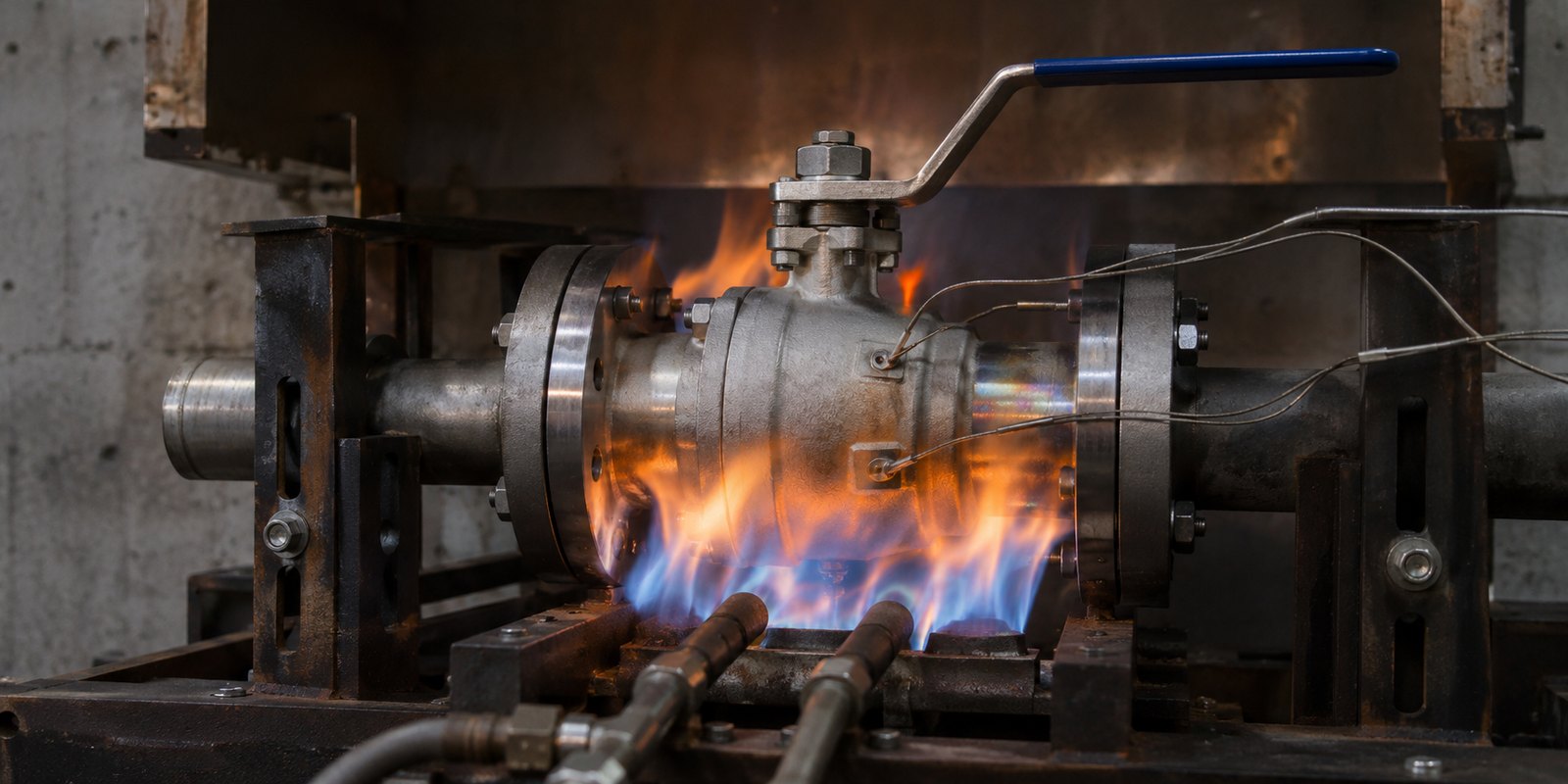
A 2024 report on a soft-seated NPS 2 valve shows the sequence. The valve and the system upstream of it are full of water, the downstream side is empty, and the upstream pressure is held at 0.2 MPa. The burners are lit and the flame reaches 750°C within two minutes. The burn runs for 30 minutes while leakage through the seat and to the outside is measured. Shower nozzles then cool the valve below 100°C, which took five minutes in that test. The valve is checked again at 0.2 MPa for leakage through the seat, cycled fully open and fully closed, and finally held at 1.47 MPa while leakage from the outside is collected for five minutes. Every stage has a numeric limit printed next to the measured value.
So a datasheet line that says fire-safe is a summary of a document, and the meaning sits in the document.
Does fire-safe mean the valve comes through the fire intact?
No. A fire test qualifies how much the valve leaks during and after the fire, and it does not certify what is left of the valve. The confusion is common enough that explainers carry the correction in their titles, as one does with “Fire-Safe, Not Fireproof”. The three reports quoted below show what is actually measured: through-seat and external leakage against limits, in mL/min. For the NPS 2 valve in 2024 the flame band was 750 to 1000°C, the through-seat limit during the burn was 200 mL/min or less, and 38 mL/min was recorded.
Neither a metal body nor a datasheet line such as “API 607 6th Edition, fire safe approved” is evidence of that result. The line carries an edition and nothing else: no laboratory, no date, no tested size or range for the buyer to check.
Which standards does a fire-safe claim point to?
Two, mostly: API 607 and ISO 10497, each in a specific edition. API 607 is titled Fire Test for Quarter-turn Valves and Valves Equipped with Nonmetallic Seats. Its eighth edition was published on 20 October 2022 and supersedes the 2016 edition, according to the Intertek listing. ISO 10497:2022 was published on 27 October 2022. Its scope is soft- and metal-seated isolation valves with one or more obturators, and it sets the measurement and assessment criteria for through-seat leakage, external leakage, cavity overpressure relief of double-seated valves, and operability. ISO lists ISO 10497:2010 as withdrawn.
One test can serve both. The cover of the 2015 report in the table below names ANSI/API 607 6th edition (2010) and ISO 10497:2010 together.
Editions matter because reports age. The three reports quoted in this article were written under the fourth edition (1993), the sixth (2010) and the eighth (2022). ISO 10497:2022 deals with the problem directly. Reports on valves tested to previous editions are acceptable when submitted with the full and compliant report as per clause 6.7 of the edition under which the valve was tested, and any data that clause requires but the report lacks is accepted or rejected at the purchaser’s discretion. A buyer can accept an older report. The decision belongs to the buyer, and it belongs in the purchase specification.
How far does one fire test reach?
A fire test reaches other valves only through the qualification rules of the edition, and the certificate should state the range it claims. The ISO 10497 scope includes the rules for extending a fire-type-testing qualification to untested sizes, pressure ratings and materials of construction of the same basic design type. API 607 has its own tables for the same purpose.
A TÜV SÜD certificate dated 15 March 2024 shows what a stated range looks like. The test valve was a soft-seated NPS 2, Class 150 ball valve with an ASTM A216 WCB body, and a TÜV SÜD inspector witnessed the test on 11 March 2024 at the Dongying Industrial Product Inspection and Metrology Verification Center. The certificate lists the qualified pressure ratings as Class 150 and Class 300 (API 607 Table 4) and the qualified sizes as NPS 2 and below, 2½, 3 and 4 (Table 3). Valve mass must be greater than the test valve or not less than 75% of it (paragraph 7.1 e). Then it adds a condition: other valves are covered only if they are of the same basic design and construction as the test valve and use the same nonmetallic materials for the seat-to-closure member seal, seat-to-body seal, stem seal and body joint seal.
Two details in that certificate matter to a buyer of stainless steel valves. The first is the seals. The range is tied to the same nonmetallic seal materials, so a change in seat or stem seal material is a question for the laboratory or the certifier before it is a question for the datasheet. The second is the body. The test valve was carbon steel, and the certificate refers qualified valve material to API 607 paragraph 7.2, which is in the paid text of the standard. A buyer of CF8M or 316 valves should ask the supplier to name the clause it relies on for the body material, and to put the answer in writing.
The report also says the test valve was chosen at random by the manufacturer in its workshop and submitted to the laboratory. The configuration section is therefore the part to read closely, because a production valve inherits the result only if it matches the tested one.
How different can fire test reports look?
Three public reports, from 2001, 2015 and 2024 and written under three editions, show how much the phrase can hide.
| Report | Edition named | Valve tested | Burn pressure | Temperature condition | Limit, through seat during burn | Limit, external leakage |
|---|---|---|---|---|---|---|
| Southwest Research Institute, 12 Sep 2001 | API 607, 4th edition (1993) | NPS 2, Class 150, downstream-sealing ball valve | 30 psig nominal | Average flame temperature of 1400°F (760°C) reached in 0.67 min, then 30 min burn | 100 mL/min per NPS | 25 mL/min per NPS |
| Yarmouth Research and Technology, 10 Feb 2015 | ANSI/API 607, 6th edition (2010), and ISO 10497:2010 | NPS 8, Class 300, metal-seated ball valve | Average 555 psig during the burn (valve rated 740 psig at 100°F) | 30 min burn, with calorimeter blocks above 650°C for 21.8 min, minimum allowed 15.0 min | 3,200 mL/min | 800 mL/min |
| TÜV SÜD witnessed, Dongying Industrial Product Inspection and Metrology Verification Center, 11 Mar 2024 | API 607, 8th edition (Oct 2022) | NPS 2, Class 150, soft-seated ball valve | 0.2 MPa | Flame 750 to 1000°C required, 800 to 900°C recorded, 30 min burn | 200 mL/min or less | 50 mL/min or less |
Read the table as three documents rather than a comparison of editions. The valves differ in size, class and seat type. The metal-seated NPS 8 valve was burned at an average of 555 psig and the other two valves at about 30 psig, and the reports do not say why. What the table does show is that the temperature condition is written three ways: an average flame temperature in 2001, calorimeter blocks held above a temperature for a minimum time in 2015, and a flame band in 2024. For the two NPS 2 valves the burn-leakage limits agree. The 2001 limit of 100 mL/min per NPS is 200 mL/min for an NPS 2 valve, the same figure as in 2024, and 25 mL/min per NPS gives the same 50 mL/min for external leakage.
That agreement holds for those two reports. Other valve types or editions can carry different limits, so the limits belong next to the measured values in the report you hold.
What should the report you receive contain?
The full report, and not only the certificate. In the 2024 example the certificate (no. 304764) lists the test valve, its materials and the qualified range, and refers to a separate test report (no. 304763) that holds the measured values. The 2001 report from Southwest Research Institute carries a notice that a report distributed outside the client’s organisation must be used in its entirety unless the laboratory approves a summary.
The Yarmouth report includes an information sheet that shows what a laboratory records about the valve before the burn: size, pressure class, body and bonnet material, trim, seat, stem seal, body seal and bolting materials, whether the valve is considered soft-seated, nameplate and casting markings, and the assembly drawing number with its revision. That last item is how a production valve is tied to the tested one. If the drawing number on the report does not match the drawing the factory builds from, the report may be describing a different valve.
The same sheet asks which valve manufacturer name is to be printed on the report. For an OEM or private-label programme the practical question is whose name is on the report, and whether that company makes the valve being shipped. Ball Valve OEM, ODM or Private Label? covers how certification follows the applicant.
What does a fire-safe report not promise?
Anything beyond what was tested. The burn in all three reports lasts 30 minutes, and that is the only exposure a report speaks to.
A tested actuator. ISO 10497 excludes the fire testing of actuators other than manually operated gearboxes. An actuated valve needs its own answer. Manual, Pneumatic, or Electric? sets out the actuator types.
A replacement for production testing. The 2024 report records that the inspector reviewed the test valve’s records for the hydrostatic shell test, the hydrostatic seat test and the steam backseat test, the kind of production testing described in API 598 Is Three Tests, and Only One Is About Shut-Off. A fire test sits alongside those tests and does not stand in for them.
What belongs in the RFQ?
- The edition or editions accepted, for API 607 and for ISO 10497, and whether reports written under earlier editions are acceptable with the complete report.
- The complete test report and the certificate, not a datasheet line or a summary page.
- The laboratory, the test date, and who witnessed the test.
- The tested configuration: size, class, body and trim materials, seat and seal materials, and the assembly drawing number and revision, compared against the drawing of the valve being quoted.
- The qualified range by size, class and material, with the clause or table relied on for each.
- What triggers a repeat test, for example a change in seat, stem seal or body seal material.
- For actuated valves, a separate statement on the actuator, and whose name is printed on the report.
Put these in the specification section of the request so they travel with the order. What Should an RFQ for OEM Stainless Steel Ball Valves Contain? has the rest of the document set, and What Does a Valve Manufacturer’s Certification Actually Prove? covers how to read the scope of a certificate before relying on it.
Frequently Asked Questions
Is fire-safe the same as fireproof?
No. The three reports quoted here each burn the valve for 30 minutes and each allows leakage up to a stated limit. Fire-safe describes a valve that passed that type test.
Is API 607 the same as ISO 10497?
They are separate documents with different scope wording. API 607 covers quarter-turn valves with nonmetallic or metallic seats and other operated valves with nonmetallic seating. ISO 10497 covers soft- and metal-seated isolation valves with one or more obturators. One test can be reported against both, as the 2015 report cover shows with API 607 6th edition and ISO 10497:2010.
Does a fire test on one size cover other sizes?
It can, within the edition’s rules. The 2024 certificate takes a test on an NPS 2 Class 150 valve and lists Class 150 and 300 and sizes NPS 2 and below, 2½, 3 and 4, for valves of the same basic design with the same nonmetallic seal materials.
Is a report written under an older edition still usable?
ISO 10497:2022 says reports on valves tested to previous editions are acceptable when submitted with the full and compliant report as per 6.7 of the edition used, and that data missing from what 6.7 requires is accepted or rejected at the purchaser’s discretion.
Does the fire test include the actuator?
ISO 10497 excludes the fire testing of actuators other than manually operated gearboxes, so an actuated valve needs a separate statement on the actuator.
What is the difference between the certificate and the test report?
In the 2024 example, certificate no. 304764 is a short document listing the test valve, its materials and the qualified range. It refers to test report no. 304763, which holds the measured leakage values.
Does a fire test on a carbon steel valve cover a stainless steel one?
The 2024 certificate tested a valve with an ASTM A216 WCB body and refers qualified valve material to API 607 paragraph 7.2, which is in the paid text of the standard. Ask the supplier to name the clause it relies on for the body material.
Related Articles
- What Does a Valve Manufacturer’s Certification Actually Prove?
- What Does an EN 10204 3.1 Certificate Prove on a Ball Valve?
- API 598 Is Three Tests, and Only One Is About Shut-Off
- How Do You Approve a Stainless Steel Ball Valve Sample From a New Supplier?
- What Should an RFQ for OEM Stainless Steel Ball Valves Contain?
- Ball Valve OEM, ODM or Private Label?
- Floating vs Trunnion Ball Valve: Design, Torque and Selection
- Stainless Steel Ball Valve OEM Manufacturer in Taiwan
Referenced sources: TÜV SÜD certificate and test report, 2024, Southwest Research Institute fire test report, 2001, Yarmouth Research and Technology fire test report, 2015, ISO 10497:2022 publisher listing, API STD 607 eighth edition publisher listing, Industrial Monitor Direct explainer, API 607 Soft-Seated Valves: Fire-Safe, Not Fireproof.
API 607 and ISO 10497 are sold by their publishers. Scope wording is taken from the publisher listings, and every leakage limit quoted here is the figure printed in one of the three reports, which are PDF files published on valv.com and cranecpe.com. The 2001 and 2015 reports were scanned documents and were read by text recognition. Check the tables of the edition named in the specification before writing a limit into a purchase order. The cover image is a generated illustration, not a photograph of a particular test rig or product.