Manual, Pneumatic, or Electric? How to Match Your Actuator to Your Process
Quick Summary
Choose pneumatic when you need sub-second response (0.5-1 sec), fail-safe spring-return, or explosion-proof operation — it delivers 1,000,000+ cycles and dominates chemical plants, oil & gas, and safety-critical data center isolation valves. Choose electric when you need precise 0-100% flow modulation, SCADA/BMS integration, or sites without compressed air — it provides 250,000+ cycles and leads in HVAC and building automation. Choose hydraulic only for extreme torque on valves 8" and larger. Choose manual for infrequent isolation duties with no automation requirement. Size any actuator by calculating breakaway torque: T = K × ΔP × D³ with a 1.5× safety factor. All actuators mount via ISO 5211 flanges ensuring cross-brand interchangeability.
The actuator is what turns a passive ball valve into an automated system component. Choose wrong, and you get an actuator that can't open the valve under pressure, responds too slowly for an emergency, or costs three times what the application requires.
After 55 years of supplying actuated ball valve packages to OEM clients including Fortune 500 companies, we've seen every failure mode that comes from mismatched actuators. This guide shares what we've learned — including field data that doesn't appear in generic spec sheets.
How Do the Four Actuation Types Compare?
The best ball valve actuator for most industrial applications is pneumatic, because it offers the fastest response time (0.5-1 second), highest cycle life (1,000,000+), and inherent fail-safe capability at moderate cost. The best actuator for building automation is electric, because it provides native digital integration and precise proportional control without compressed air infrastructure.
| Specification | Manual | Pneumatic | Electric | Hydraulic |
|---|---|---|---|---|
| Power Source | Human force | Compressed air (3-8 bar) | 24VDC / 120V / 230V | Hydraulic fluid pump |
| Response Time | 5-30 sec | 0.5-1 sec | 2-90 sec | 1-5 sec |
| Cycle Life | Unlimited | 1,000,000+ | 250,000+ | 500,000-1M |
| Temp. Range | Valve limit only | -20 to +80°C (std) | -30 to +70°C | -20 to +60°C |
| Position Control | Open/Close | On/Off (modulating w/ positioner) | 0-100% proportional | On/Off or proportional |
| Fail-Safe | Manual lockout | Spring-return (standard) | Spring-return (optional, larger) | Accumulator-based |
| SCADA / BMS | No | Via solenoid + I/P | Native (Modbus, HART) | Via electro-hydraulic |
| Hazardous Area | Yes | Yes (inherently safe) | Needs ATEX enclosure | Yes |
| Relative Cost | 1× | 3-5× | 5-10× | 8-15× |
When Should You Choose a Pneumatic Actuator?
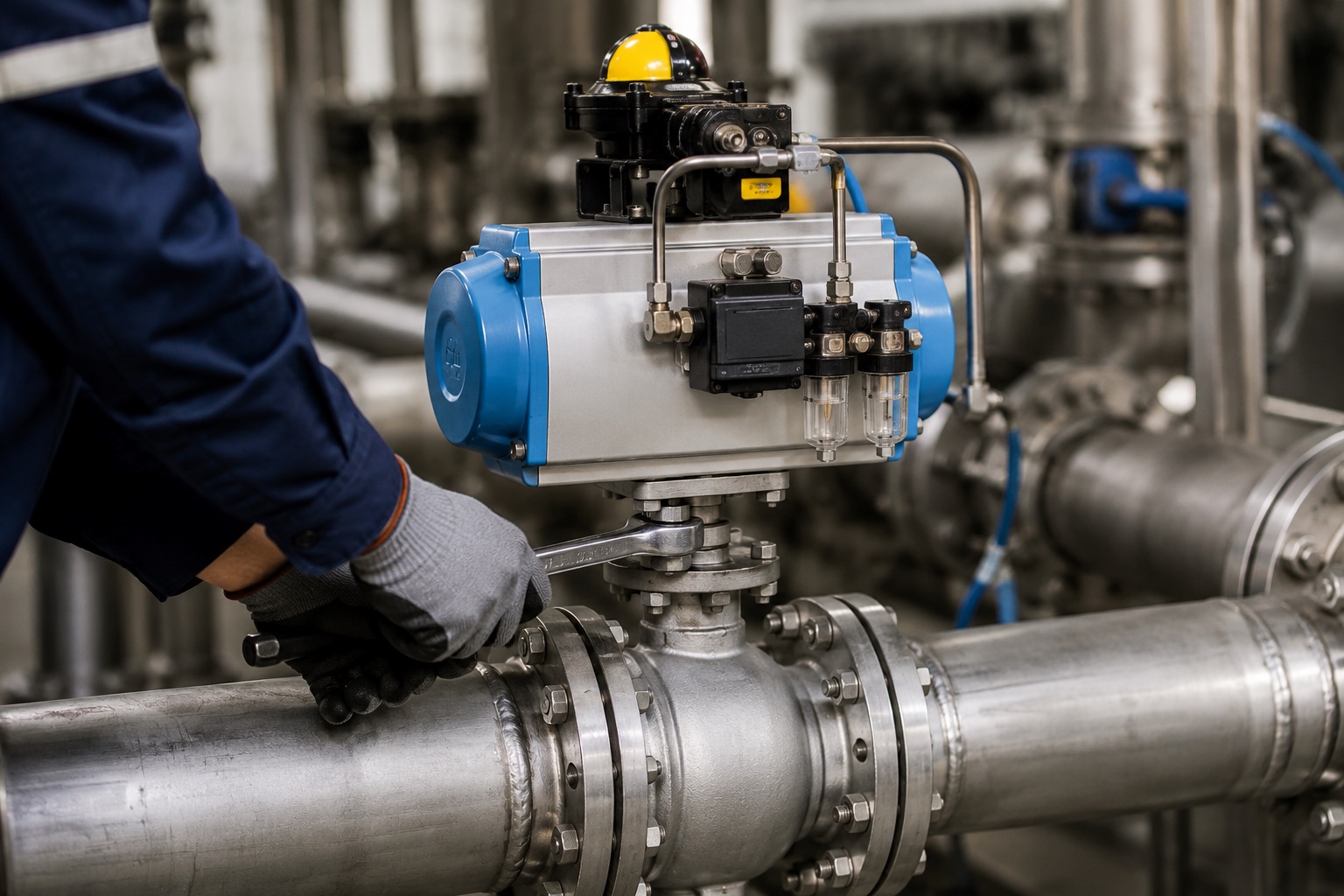
Choose a pneumatic actuator when your application requires sub-second response, high cycle frequency, or fail-safe closure without electrical power. Pneumatic actuators close a ball valve in 0.5-1 second, last over 1,000,000 cycles, and are inherently explosion-proof because they contain no electrical components in the drive mechanism.
Pneumatic actuators use compressed air at 3-8 bar (40-120 PSI) to drive a piston or rack-and-pinion mechanism that rotates the ball 90 degrees. They come in two configurations:
- Double-acting — air pressure drives both open and close directions
- Spring-return (single-acting) — air drives one direction; a compressed spring returns the valve to its fail-safe position when air is lost
| Parameter | Value |
|---|---|
| Supply Pressure | 3-8 bar (40-120 PSI), typical: 6 bar |
| Response Time | 0.5-1 second (small-medium); up to 30 sec (largest) |
| Cycle Life | 1,000,000+ cycles |
| Temp. Range (NBR seals) | -20°C to +80°C (-4°F to +176°F) |
| Temp. Range (Viton seals) | -20°C to +120°C (-4°F to +248°F) |
| Temp. Range (EPDM seals) | -40°C to +80°C (-40°F to +176°F) |
| Torque Range (ISO 5211) | F03: 32 Nm — F25: 8,000 Nm |
The main trade-off: pneumatic actuators require compressed air infrastructure — compressor, dryer, filter, and distribution piping. Air compression is energy-intensive, consuming roughly 7-8 kW of electrical input per 1 kW of pneumatic output. If your facility already has compressed air, pneumatic is almost always the most cost-effective choice. If not, electric may be more practical.
In our experience supplying actuated valve packages to North American OEM clients, pneumatic spring-return is specified on over 90% of safety-critical isolation valves in chemical and process plants. The reason is simple: when a facility loses electrical power, pneumatic spring-return valves still close. Electric fail-safe actuators exist, but they're physically larger and 2-3× more expensive for the same torque output — and the spring mechanism has a shorter track record in harsh chemical environments.
When Should You Choose an Electric Actuator?
Choose an electric actuator when your application requires precise proportional flow control (0-100%), native SCADA/BMS integration, or automation at sites without compressed air. Electric actuators provide real-time position feedback and communicate natively via Modbus, HART, or Profibus — capabilities that pneumatic actuators only achieve with expensive add-on components.
| Parameter | Value |
|---|---|
| Power Input | 24VDC, 120VAC, or 230VAC |
| Response Time | 2-3 sec (small); 6-90 sec (medium-large) |
| Cycle Life | 250,000+ cycles |
| Temperature Range | -30°C to +70°C (-22°F to +158°F) |
| Position Control | 0-100% proportional (4-20mA / 0-10V) |
| Torque Range | 34-2,034 Nm (300-18,000 in-lb) |
| Feedback | Limit switches + potentiometer / 4-20mA output |
The main trade-off: electric actuators are 4× slower than pneumatic (6-90 seconds vs. 0.5-1 second) and have 4× shorter cycle life (250K vs. 1M+). They also require certified ATEX/FM enclosures for hazardous areas, adding cost and lead time. But for applications where speed is not critical and integration is — electric is the clear winner.
One pattern we see repeatedly in OEM projects: engineers spec electric actuators for everything because their controls team is comfortable with 4-20mA signals. Then they discover that a 3" electric actuated ball valve costs $2,800-$3,500 while the equivalent pneumatic package (actuator + solenoid valve) costs $900-$1,200. For on/off isolation duties where proportional control isn't needed, switching to pneumatic saves 60-70% per valve position — across a 200-valve CDU installation, that's a $300K+ savings.
When Should You Choose a Hydraulic Actuator?
Choose a hydraulic actuator only when you need extreme torque output on valves 8" (DN200) and larger, or for specialized marine, subsea, and offshore applications. Hydraulic actuators deliver up to 100,000+ in-lb of torque — far beyond what pneumatic or electric actuators can achieve in a comparable size.
For most industrial applications below 8", pneumatic or electric actuators are more practical, more cost-effective, and require far less infrastructure.
| Parameter | Value |
|---|---|
| Power Source | Hydraulic power unit (electric or engine-driven) |
| Response Time | 1-5 seconds |
| Cycle Life | 500,000-1,000,000 cycles |
| Torque Range | Up to 100,000+ in-lb |
| Relative Cost | 8-15× manual (most expensive) |
Drawbacks: highest cost, requires dedicated hydraulic power unit, fluid maintenance (filtering, viscosity monitoring), environmental spill risk, and complex installation with hoses, fittings, reservoir, and relief valves.
When Is Manual Actuation Sufficient?
Manual actuation — a lever handle or gear operator — is sufficient when the valve is operated less than once per day, no remote operation is needed, and the valve is 4" (DN100) or smaller. Above 4", the torque required to overcome seat friction under pressure exceeds comfortable human output. Above 8", a gear operator (multi-turn handwheel) is required but adds 30-60 seconds of operation time.
Manual valves remain essential as emergency override on automated systems — even fully actuated valve packages should have a manual override mechanism per most industrial piping codes.
How Do You Size a Ball Valve Actuator?
The actuator must produce enough torque to overcome the breakaway torque of the ball valve — the peak force needed to initially unseat the ball from the seat under full differential pressure. An undersized actuator fails to open. An oversized actuator wastes capital and may damage the valve.
Torque Calculation
T = K × ΔP × D³
| Variable | Definition | Values |
|---|---|---|
| T | Required torque (in-lb) | — |
| K | Valve seat coefficient | PTFE: 0.01-0.05 / PEEK: 0.05-0.10 / Metal: 0.05-0.15 |
| ΔP | Differential pressure (PSI) | Per system design |
| D | Valve diameter (inches) | Per valve size |
Three torque values exist during operation: breakaway torque (highest — used for sizing), running torque (~50% of breakaway), and seating torque (~75% of breakaway).
Worked Example
4" SS316 ball valve, PTFE seat, 100 PSI differential:
- T = 0.03 × 100 × 4³ = 0.03 × 100 × 64 = 192 in-lb
- With 1.5× safety factor: 192 × 1.5 = 288 in-lb minimum actuator torque
The most common actuator sizing mistake we encounter in OEM projects is using catalog torque values instead of actual breakaway torque. Catalog values assume clean, new valves at ambient temperature. In real service — especially with glycol coolant, chemical media, or high-temperature steam — breakaway torque can be 30-50% higher than catalog. We always recommend our OEM clients use a 1.5× minimum, 2.0× for critical applications. The cost difference between a correctly sized and slightly oversized actuator is 10-15%. The cost of an undersized actuator that fails in service is shutdown + emergency replacement + lost production.
What Is ISO 5211 and Why Does It Matter?
ISO 5211 is the international standard that defines mounting flange dimensions for part-turn actuators on ball valves. Any ISO 5211-compliant actuator mounts to any ISO 5211-compliant valve, regardless of manufacturer — enabling field-swappable actuators without valve replacement or bracket modification.
| ISO Size | Flange Ø | Drive Square | Max Torque | Typical Valve Size |
|---|---|---|---|---|
| F03 | 46 mm | 6 × 6 mm | 32 Nm | ½" - ¾" |
| F05 | 65 mm | 10 × 10 mm | 125 Nm | 1" - 1½" |
| F07 | 90 mm | 14 × 14 mm | 250 Nm | 2" - 3" |
| F10 | 125 mm | 16 × 16 mm | 500 Nm | 3" - 4" |
| F16 | 200 mm | 20 × 20 mm | 2,000 Nm | 6" - 8" |
| F25 | 300 mm | 25 × 25 mm | 8,000 Nm | 10" - 12" |
Which Actuator Type Is Best for Each Industry?
The best actuator for data center CDU liquid cooling is a hybrid approach — pneumatic spring-return on isolation valves for sub-second fail-safe closure, and electric with 4-20mA feedback on modulating valves for BMS integration. Both should be paired with SS316 3-piece ball valves for in-line serviceability in glycol-water loops.
The best actuator for chemical plants is pneumatic spring-return, because it closes in under 0.8 seconds, requires no electrical power (inherently explosion-proof), and has demonstrated a 33% reduction in emergency incidents compared to manual-only systems in documented facility studies.
The best actuator for HVAC and building automation is electric, because it integrates natively with BMS controllers, supports energy-efficient scheduling, and requires no compressed air infrastructure in commercial buildings.
The best actuator for oil & gas is pneumatic with API 607 fire-safe certification, ensuring fail-safe closure even if soft seats burn through — the secondary metal-to-metal seal maintains acceptable leakage limits during a fire event.
| Industry | Best Actuator | Why | Key Certification |
|---|---|---|---|
| Data Center CDU | Pneumatic + Electric hybrid | Speed + monitoring | NEMA 4X |
| Chemical Plants | Pneumatic spring-return | Speed + explosion-proof | ATEX, SIL |
| HVAC / Building | Electric | BMS integration | Energy code |
| Oil & Gas | Pneumatic fire-safe | Fail-safe + fire rating | API 607, API 6D |
| Water Treatment | Electric or Pneumatic | Low cycle, remote | NSF/ANSI 61 |
| Offshore / Marine | Hydraulic | Extreme torque | DNV, Lloyd's |
How to Choose — 5 Question Decision Framework
- How fast must the valve close?
Under 1 second → Pneumatic. 2-10 seconds acceptable → Electric or Pneumatic. Speed not critical → Any. - Is it a hazardous (explosive) area?
Yes → Pneumatic (inherently safe). Electric requires ATEX enclosure ($$$). - Do you need proportional 0-100% control?
Yes → Electric (native). Pneumatic needs positioner + I/P converter (adds $500-$1,000). - Is compressed air available?
Yes → Pneumatic is most economical. No → Electric avoids compressor infrastructure. - Is fail-safe required?
Yes → Pneumatic spring-return (simplest, most field-proven). Electric spring-return works but is larger and costlier.
Frequently Asked Questions
Related Articles
- Why data center cooling valves are electric rather than pneumatic
- OEM Ball Valve Manufacturer: Range, Capacity and Certifications
- Ball Valve Pressure Ratings: Class 150-600 Reference
- Industrial Ball Valve Guide: Types, Selection & Applications
- Ball Valves for Data Center Liquid Cooling Systems
- 2-Piece vs 3-Piece Ball Valve: Design Comparison
- Common Failure Causes in Industrial Ball Valves
Need actuated ball valve packages for your OEM project? LINS Valve supplies ISO 5211-compliant SS316 ball valves with pneumatic and electric actuator integration — pre-assembled and pressure-tested at our facility. 55+ years of OEM experience. ISO 9001:2015 certified. Request a Quote