2-Piece vs 3-Piece Ball Valve: When the Cost Savings Aren't Worth It
Key Takeaway
A 2-piece (2PC) ball valve consists of two body halves joined together, offering a cost-effective solution for applications that don't require in-line maintenance. A 3-piece (3PC) ball valve has a center body with two removable end caps, allowing the valve internals to be serviced without disconnecting the pipeline. Choose 2PC when cost is the priority and the valve won't need repair. Choose 3PC when you need in-line serviceability, frequent maintenance, or long-term cost efficiency. Both are available in full port SS316 stainless steel configurations and are widely used in data center liquid cooling, HVAC, chemical processing, and industrial fluid control systems.
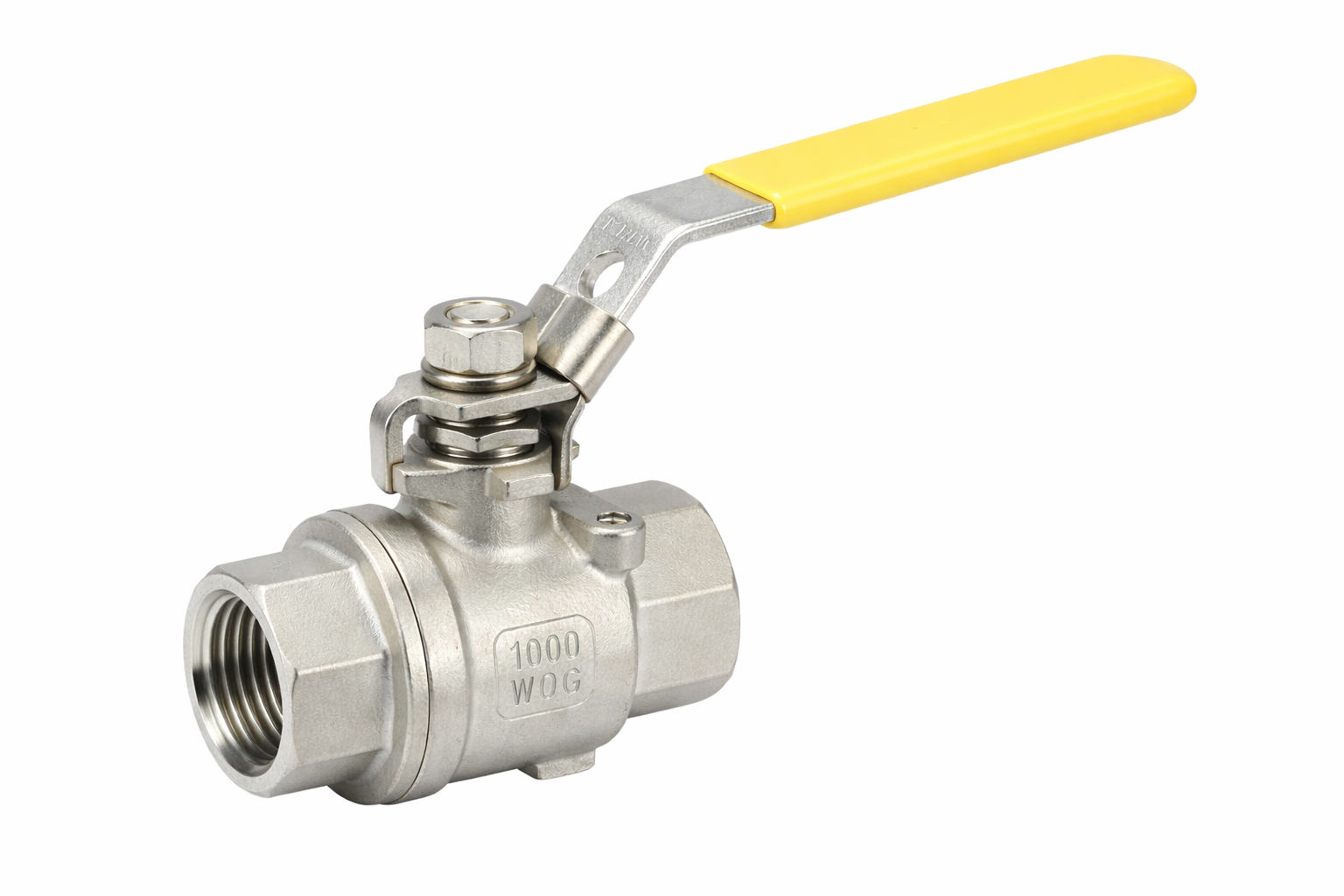
SS316 2-Piece Ball Valve
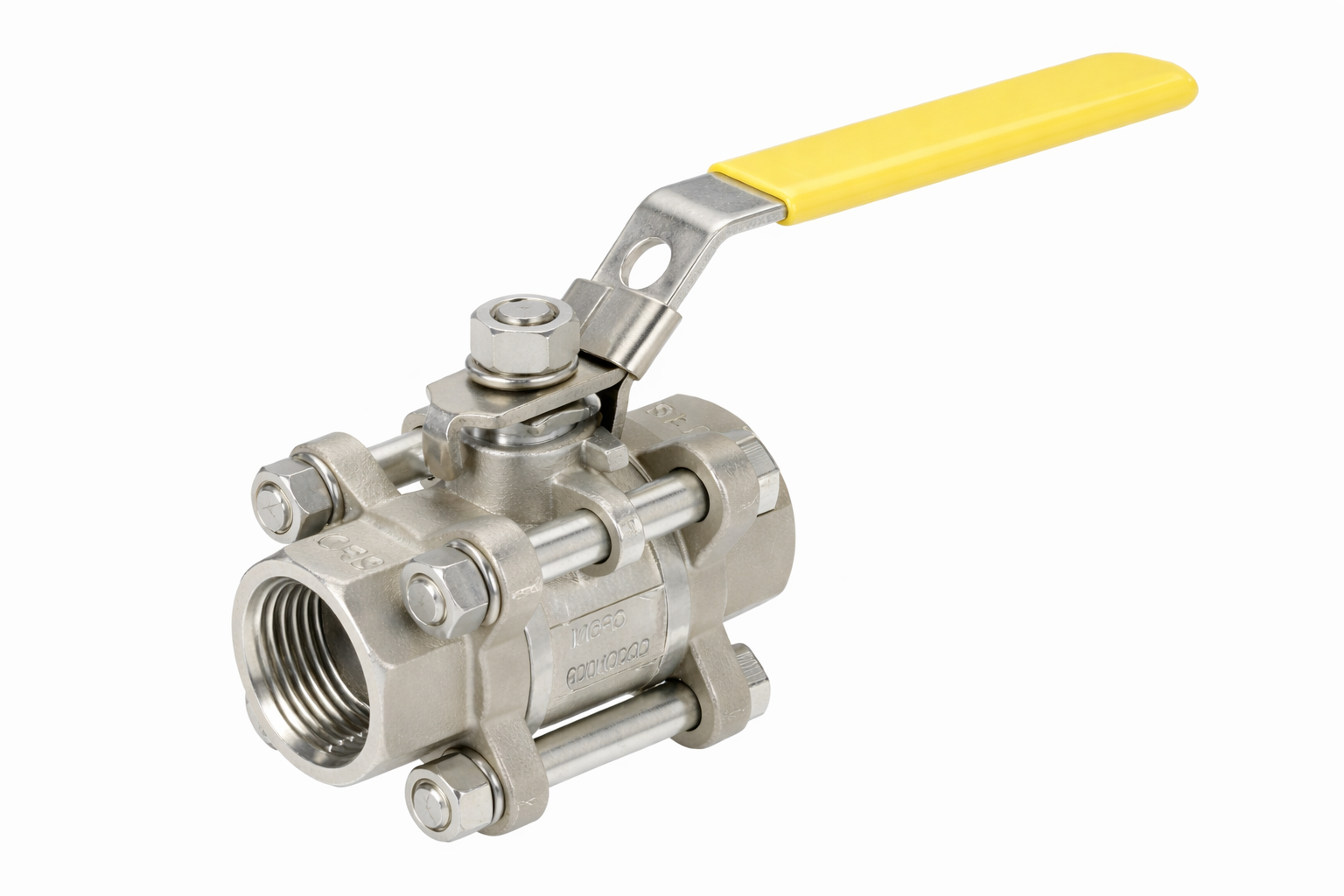
SS316 3-Piece Ball Valve
What Is a 2-Piece Ball Valve?
A 2-piece ball valve is constructed from two body sections — a main body and an end piece — joined together by threads or bolts. The ball, seats, and stem are assembled into the main body before the second piece is attached to close the assembly.
Because the two halves are tightened together during manufacturing, the valve is generally not designed to be disassembled in the field. Once installed with threaded (NPT or BSP) connections, removing a 2PC valve can cause thread galling, which compromises the metal-to-metal seal integrity.
2-piece ball valves are the most common design in general industrial applications due to their lower cost and reliable performance in standard-duty service.
What Is a 3-Piece Ball Valve?
A 3-piece ball valve consists of three independent components: a center body containing the ball and trim, and two end caps (connectors) — one on each side. The end caps are typically threaded, welded, or flanged to the pipeline, while the center body is bolted between them.
This design allows the center body to be unbolted and removed for inspection, cleaning, or replacement of internal components (ball, seats, seals, stem) without disturbing the pipeline connections. The end caps remain attached to the pipe, significantly reducing maintenance downtime.
What Are the Key Differences Between 2PC and 3PC Ball Valves?
| Feature | 2-Piece Ball Valve | 3-Piece Ball Valve |
|---|---|---|
| Construction | Two body halves joined by threads/bolts | Center body + two removable end caps |
| In-Line Maintenance | Not possible — must remove entire valve | Yes — remove center body while end caps stay in pipeline |
| Repairability | Replace entire valve when worn | Replace individual components (ball, seats, seals) |
| Upfront Cost | 20–40% lower | Higher initial investment |
| Lifetime Cost | Higher (full replacement needed) | Lower (only replace worn parts) |
| Downtime for Service | Full line shutdown required | Minimal — end caps remain connected |
| Port Options | Full port and reduced port | Full port and standard port |
| Dead Leg | Minimal | Slightly larger due to bolt flanges |
| Best For | Low-cycle, standard-duty, cost-sensitive | High-cycle, critical-process, long-term service |
When Should You Choose a 2-Piece Ball Valve?
A 2-piece ball valve is the right choice when:
- Budget is a priority — 2PC valves cost 20–40% less than equivalent 3PC models, making them ideal for large installations with many valve points.
- Maintenance is infrequent — In systems where valves are rarely cycled (less than 100 cycles/year), the valve will likely outlast the system without needing repair.
- The application is non-critical — Branch lines, utility connections, and secondary loops where a brief shutdown for valve replacement is acceptable.
- Space is limited — 2PC valves have a slightly more compact profile due to fewer bolted joints.
When Should You Choose a 3-Piece Ball Valve?
A 3-piece ball valve is the better investment when:
- In-line maintenance is required — Process lines that cannot be fully drained or disconnected for valve service. The center body can be removed while end caps stay welded or threaded in place.
- High-cycle applications — Systems with frequent valve operation (1,000+ cycles/year) will wear seats and seals faster. Replacing these components is far cheaper than replacing the entire valve.
- Critical process points — CDU manifolds, chemical reactor feeds, and main isolation points where valve failure would cause significant production loss.
- Long-term cost matters — Although the initial cost is higher, a 3PC valve's total cost of ownership is lower over a 15–25 year service life because only worn internals need replacement.
- Sanitary/clean applications — Food, beverage, and pharmaceutical systems where the valve must be periodically disassembled for cleaning and inspection (CIP/SIP).
How Does Construction Affect Performance?
Pressure Ratings
Both 2PC and 3PC ball valves are available in the same pressure classes. A standard SS316 threaded ball valve in either configuration typically handles:
- WOG (Water, Oil, Gas): 1,000 PSI at ambient temperature
- Saturated Steam: 150 PSI
- ASME Class 150: 285 PSI at 100°F
The number of body pieces does not inherently affect the pressure rating — both designs are hydrostatically tested to the same standards per API 598 or EN 12266.
Flow Characteristics
Both 2PC and 3PC ball valves are available in full port configurations, providing unrestricted flow equal to the pipe diameter. The Cv (flow coefficient) values are identical for the same nominal size and port type. However, 3PC valves may have a slightly larger cavity between the ball and body, creating a marginally larger dead leg — a consideration in sanitary applications where fluid stagnation must be minimized.
What About 1-Piece Ball Valves?
For completeness, here's how 1-piece ball valves compare:
| Feature | 1-Piece | 2-Piece | 3-Piece |
|---|---|---|---|
| Body Construction | Single cast body | Two halves joined | Center body + 2 end caps |
| Repairability | None (disposable) | Very limited | Fully serviceable |
| Port Size | Reduced port only | Full or reduced port | Full or standard port |
| Cost | Lowest | Medium | Highest |
| Typical Use | Utility, low-cost shutoff | General industrial | Critical process, high-cycle |
1-piece ball valves are sometimes called "throwaway valves" because they cannot be repaired and offer only reduced port flow. They are rarely used in industrial or data center applications where flow efficiency and reliability are critical.
Which Design Is Best for Data Center Liquid Cooling?
In data center liquid cooling systems, both 2PC and 3PC ball valves play important roles:
| Location in System | Recommended Type | Reason |
|---|---|---|
| CDU Manifold (Main Isolation) | 3-Piece SS316 | Critical point — needs in-line serviceability |
| Server Rack Supply/Return | 2-Piece SS316 | Cost-effective for multiple valve points |
| Coolant Fill/Drain | 2-Piece SS316 | Low-cycle, standard duty |
| Bypass Lines | 3-Piece SS316 | May need service without system shutdown |
| Rear-Door Heat Exchanger | 2-Piece SS316 | Compact installation, standard duty |
SS316 (CF8M) is the standard material for both types in cooling applications due to its superior resistance to pitting corrosion from glycol-based coolants. For more on material selection, see our guide on Industrial Ball Valve Types & Selection.
Frequently Asked Questions
Related Articles
- API 598 Is Three Tests, and Only One Is About Shut-Off
- Why Two Ball Valves of the Same Size Are Different Lengths
- Stainless Steel Ball Valve OEM Manufacturer in Taiwan
- Industrial Ball Valve Guide: Types, Selection & Applications
- View LINS Valve SS316 Ball Valve Product Catalog
- Learn About Our OEM/ODM Manufacturing Services