What Does Made in Taiwan Mean on a Stainless Steel Ball Valve?
Key Takeaway
Made in Taiwan is a legal conclusion about where a valve was made, and each importing country reaches it with its own test. In the US customs rulings read for this article, origin followed the valve body, because assembling a valve was judged too simple to change it. A Taiwan address, or final assembly in Taiwan, does not settle origin. Ask the supplier where the body was cast or forged and where it was machined, and get the answer in writing.
What does Made in Taiwan legally mean on a ball valve?
It is a conclusion about where the valve was made, reached with the origin rule of the country the valve is entering. It is not a statement about where the company has its office. A valve is built from a body, a ball, a stem, seats, seals and a handle, and those parts can come from several countries. Each importing country has a rule for choosing one of them. Buyers who rely on the marking should know which rule is behind it. For why the country is a weak guide to quality, see Sourcing Ball Valves from Taiwan: What Differs Between Factories. This article is about something narrower, the legal meaning of the mark.
What test do the US, the EU and Taiwan use?
All three look for the place where the goods were last substantially changed, but each writes the test differently.
| Authority | What decides origin | Where it is written |
|---|---|---|
| United States | The country of manufacture, production or growth. Work in another country counts only if it is a substantial transformation, meaning the article emerges with a new name, character or use. The facts as a whole are weighed. | 19 CFR 134.1(b) and CBP rulings |
| European Union | Goods made in one country are wholly obtained there. Goods made in several countries take the origin of the last substantial transformation. Listed goods have binding list rules, and a residual rule applies if the list rule is not met. | Union Customs Code Article 60, Annex 22-01 of the delegated act |
| Taiwan | Either the first six digits of the tariff number change between the materials and the product, or they do not change and the value-added rate exceeds 35 per cent, or the product meets a process announced by the authority. Packaging and relabelling do not count. | Regulations Governing Certificates of Origin and Certificates of Processing, Articles 3 and 5 |
Taiwan’s rule is the only one of the three built on a number, a value-added rate, but it is also the only one read here through a secondary source. The three tests ask different questions. Nothing in them guarantees the same answer for the same valve.
Which part of a ball valve decides its origin?
In the US customs rulings read for this article, the body decided it. In ruling N355399 of 20 November 2025, CBP wrote that it has relied on the origin of the valve body, the essential component of a valve, because assembling a valve is rather simple. It described assembly as inserting, pressing and screwing components together. The same reasoning appears in rulings N339513 and N338713 of 2024.
Ruling N355399 concerned a lined ball valve. The body, flange and stemmed ball came from India. In Hungary they were cleaned, sand-blasted, coated with PFA, deburred and painted, then the ball and a German seat were fitted and the valve was tested and packed. CBP found these steps did not turn the body into a new article, and ruled the origin of the ball valve to be India. In the same ruling a butterfly valve with a body from China, machined and coated in Hungary, took China as its origin.
Ruling N339513 reached the same result from the other direction. An angle valve had a brass body forged, cut and machined in Thailand from rod, chrome-plated in China and assembled in China. CBP ruled the origin Thailand “for origin and marking purposes”. A companion ruling, N338713, had found Thailand for the same valve when it was assembled in Thailand. In N339513 CBP added that the valve was therefore not subject to duties associated with Section 301 trade remedies, which is why buyers take an interest in the answer.
Why can a valve assembled in Taiwan carry another origin?
Because CBP treated valve assembly as too simple to change the origin of the body. A Taiwan address, a Taiwan assembly line and a Taiwan test bench describe where the last steps took place. If the body was cast or forged elsewhere and the later steps are the simple ones in the rulings above, the US test points to the body. Taiwan’s own test is a separate question, since a value-added rate above 35 per cent, if the valve reaches it, can establish Taiwanese origin for a Taiwan certificate. I found no ruling that compares the two for one valve.
False origin marking is also an enforcement matter in Taiwan. A report of 7 January 2026 describes a fine of NT$600,000 imposed by the Ministry of Economic Affairs’ International Trade Administration for a false origin mark, under Articles 17 and 28 of the Trade Act.
What about a casting made in one country and machined in another?
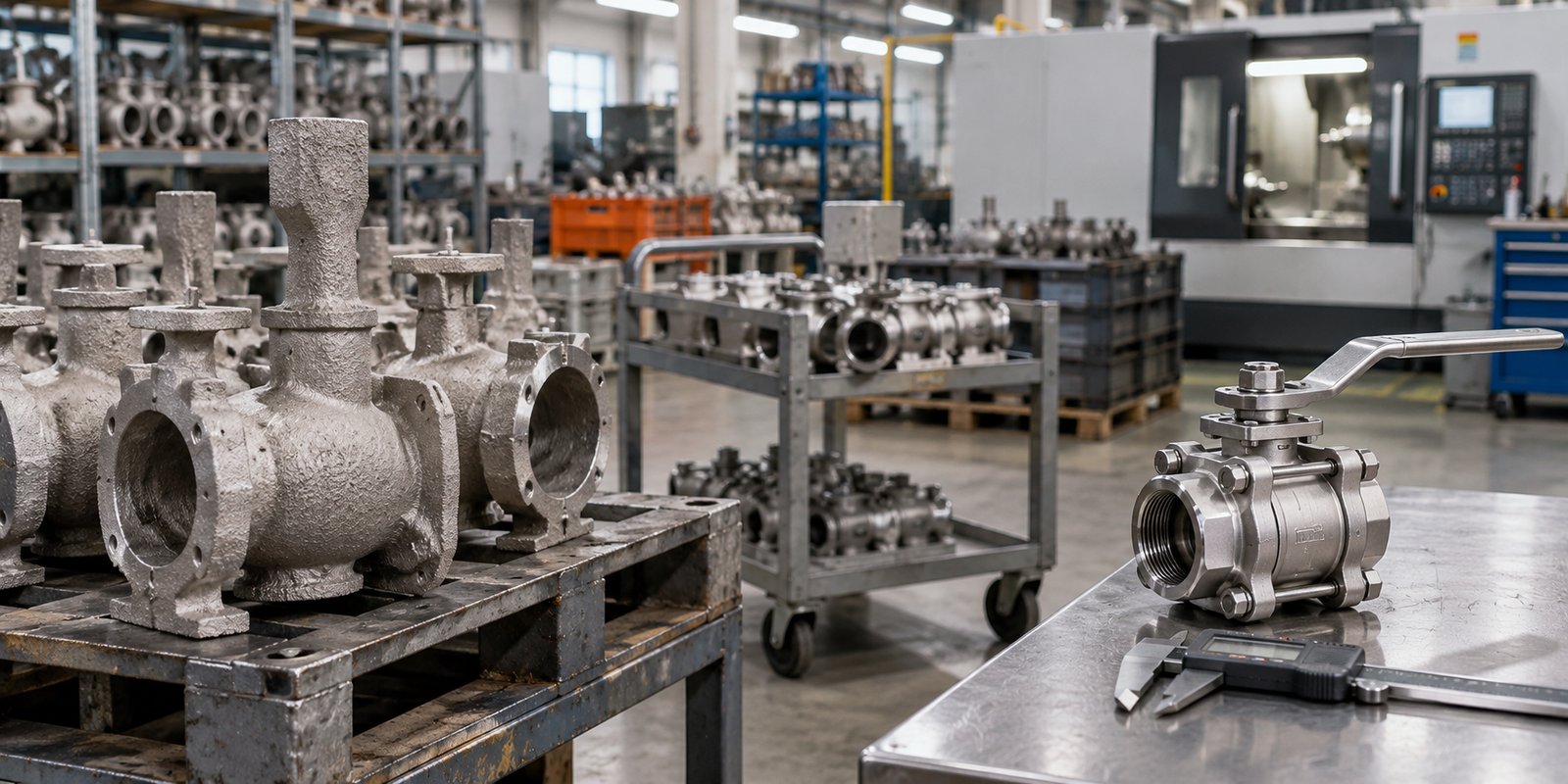
The rulings read here do not answer it. Their valve bodies were forged or cast as shaped parts and then finished or coated. A rough casting machined into a finished body in a second country is a different set of facts, and CBP states that each ruling applies only to the facts submitted. How machining a casting is treated needs its own ruling or a customs broker’s advice. The casting is also the part a finished valve shows least about, which is why casting quality belongs in the audit.
Why does origin matter to a buyer?
It decides the mark the importer must apply and the country-specific duties that apply. US law requires every article of foreign origin to be marked to show its country of origin to the final purchaser in the US, and 19 CFR 134.1 defines that person as generally the last person in the United States who will receive the article. A valve sold under a brand’s name still has to show the origin of the article. How brand, maker and body marking fit together is covered in Ball Valve OEM, ODM or Private Label?
Origin can also change without anyone changing the drawing. If the casting source moves, the origin the importer relies on may move with it. That is one more reason to read how a second source is requalified before approving one.
How is the origin mark applied?
The US rule asks for a mark that is legible, indelible and permanent. 19 CFR 134.41 says the mark must remain on the article until it reaches the final purchaser, must survive normal distribution and handling, and must be easy to find and read. It adds that marking worked into the article at the time of manufacture generally meets the requirement best. The origin mark is a legal duty of the importing country, separate from the body markings that a valve standard prescribes, which What Do the Markings on a Ball Valve Body Mean? sets out.
How do you verify where a valve was made?
- Ask where the body was made. Where the casting or forging was produced, by the supplier's own foundry or a bought-in one, and in which country.
- Ask what happened to it afterwards. Machining, plating or coating, assembly, testing and packing, each with the country where it takes place.
- Ask which origin rule the answer assumes. The importing country's customs test, the Taiwan test for a certificate of origin, or both. The two can differ.
- Read the marking on the valve and the carton. Whether the origin mark is legible, permanent and placed where the end buyer will see it.
- Get the answer in writing, per model. A written statement for each valve model, repeated when the casting source or any process moves.
- Check the first lots against it. Compare the paperwork with what the audit and the first shipments show, including the foundry named.
What belongs in the supplier questionnaire and the contract?
An origin claim can only be checked against what was asked. The items that settle it:
- Country and site where the body casting or forging is produced
- Whether that foundry belongs to the valve maker
- Country of each later step: machining, coating, assembly, testing, packing
- The origin the supplier states, and the rule that statement relies on
- How a change of casting source, or of any process location, is notified before shipment
- Where the origin mark sits on the valve and on the carton
A supplier that casts its own bodies can answer the first two lines directly. One that buys castings can still answer them, and the audit in What Should You Check When You Audit a Ball Valve Factory? shows how to see the foundry it names.
What does this not settle?
It does not tell you whether a given valve is Taiwanese in the eyes of your own customs authority. That needs the facts of the valve and, for a binding answer, a ruling from the authority or the advice of a customs broker. It does not cover the UK, Canada or other importing countries. It does not say anything about quality: a valve made from a casting in one country can be sound or poor, and the origin mark does not distinguish them. And it rests on three CBP rulings and two secondary readings of Taiwan’s rule, so the rules should be rechecked before a purchase depends on them. Buyers of a stainless steel ball valve from a Taiwan OEM can use the questions above as a starting point.
Frequently Asked Questions
What does Made in Taiwan mean on a ball valve?
It states a legal conclusion that the valve was made in Taiwan under the origin rule of the country it is entering. It does not follow from the maker's address, and in the US customs rulings read for this article it followed the origin of the valve body.
Is a valve assembled in Taiwan from imported castings Made in Taiwan?
It depends on the rule applied and the facts. US customs rulings treated valve assembly as too simple to change the origin of the body. Taiwan's own test asks about a change of tariff heading, a value-added rate above 35 per cent or a process announced by the authority. The two tests ask different questions, so they can give different answers.
Does the casting country decide the origin of a valve?
In several US customs rulings on valves the body decided it, because the body was treated as the essential component. Those rulings concerned valves whose bodies were made in one country and assembled in another. None of the rulings read here covers a rough casting machined in a second country, which needs its own answer.
Why does the origin of a ball valve matter to a buyer?
Because origin decides the marking an importer must apply and which country-specific duties apply. In ruling N339513, CBP found Thailand to be the origin of an angle valve and noted it was therefore not subject to duties associated with Section 301 trade remedies.
How is a valve's country of origin marked?
US rules require the mark to be legible, indelible and permanent, to survive normal distribution, and to be easy for the final US purchaser to find. The regulation says marking worked into the article at manufacture is generally best.
What does the EU use to decide origin?
Article 60 of the Union Customs Code. Goods made in one country are wholly obtained there. Goods made in several take the origin of the last substantial transformation. Annex 22-01 sets binding rules for listed goods.
What does a buyer put in the contract?
The country of the body casting, the country of each later process, a written origin statement per model, and notice before any of those changes.
Related Articles
- Sourcing Ball Valves from Taiwan: What Differs Between Factories, and How to Check
- What Casting Quality Does to a Ball Valve: Porosity, Inclusions and Field Failure
- Ball Valve OEM, ODM or Private Label?
- Changing Valve Supplier: What Has to Be Re-Qualified
- What Should You Check When You Audit a Ball Valve Factory?
- What Do the Markings on a Ball Valve Body Mean?
- Stainless Steel Ball Valve OEM Manufacturer in Taiwan
Referenced rules and rulings: 19 CFR 134.1 (definitions of country of origin and ultimate purchaser) and 19 CFR 134.41 (methods of marking), both on eCFR; US Customs and Border Protection rulings N355399 (20 November 2025), N339513 (6 May 2024) and N338713 (3 April 2024); the European Commission’s page on non-preferential rules of origin; and, for Taiwan’s test, a Commercial Times report of 7 January 2026 that quotes the Regulations Governing Certificates of Origin and Certificates of Processing.
The CBP rulings were read in a mirrored copy of the CROSS database, and the link above points to the CROSS record. Each ruling applies only to the facts submitted with the request, and CBP states that in the text. Taiwan’s regulation was read as quoted in the news report, not from the regulation itself. Annex 22-01 of the EU delegated act was not consulted for the tariff heading of valves, so no EU rule for valves is stated here. This article does not cover the UK, Canada or other importing countries, and it is not legal advice: a customs broker or trade lawyer should confirm origin for a specific product. The cover image is a generated illustration, not a photograph of a particular workshop or product.