What Does ASTM A967 Specify When a Stainless Steel Ball Valve Is Called Passivated?
Key Takeaway
In ASTM A967, passivation is a chemical treatment that removes free iron and other foreign matter from stainless steel. It is generally not effective on heat tint or oxide scale. Pickling removes those, and a fully pickled surface needs no separate passivation. The protective chromium film is not applied by the acid; it forms in air on a clean surface. A967 leaves the choice of acid bath to the seller unless the buyer names one, and it leaves the choice of test to the buyer. So “passivated” on a drawing or certificate is not yet a specification. To make it one, name the standard and its edition, the test practice, the lot and the report.
What does passivation remove, and what does it leave alone?
A967 defines the word before it uses it, because the trade applies it to more than one thing. In the standard, passivation is treating stainless steel with a mild oxidant, such as a nitric acid solution, to remove free iron or other foreign matter. The same clause says the treatment is generally not effective on heat tint or oxide scale. On grades with sulfur added for machinability it may also take sulfides off the surface.
The protective film is a separate matter. The standard says it forms spontaneously in air or any oxygen-containing environment once the surface is free of scale and foreign matter. An oxidising bath can speed that up. Sodium dichromate is the standard’s own example, and it is classed as a post-cleaning treatment, apart from the treatments that remove iron.
A passivated valve part has therefore not been coated. And a part that still carries scale or heat tint has not been repaired by passivation.
How does pickling differ, and which does a valve part need?
Pickling is the harsher treatment. A967 describes it as able to remove heat tint and oxide scale and to dissolve the stainless steel itself. It says a pickled surface is free of scale, free iron and foreign matter and needs no separate passivation. The preparation clause repeats the point: if the final pretreatment pickles the entire surface of a part, no further passivation is required before testing unless the purchaser specifies it. Electropickling and electropolishing are placed in the same group.
The two answer different surface conditions. A part that leaves the machine with no scale, and with a risk of tool iron on it, is a passivation case. A part with scale has to be descaled first. A967 sends pretreatment, mechanical or chemical, to ASTM A380 (section 5.3.1), and section 5.3.2 asks for a surface substantially free of oil, grease, rust, scale and other foreign matter before the passivation bath. Passivating over scale does not remove the scale.
Where does the iron on a stainless valve part come from?
A967 lists the sources in a non-mandatory appendix. Forming, machining, tumbling and lapping can smear iron or other foreign particles over the surface of a stainless part or embed them in it, and the particles later show up as rust spots or stains. The definitions add free iron from contact with steel tooling. A machined body, end cap, ball or stem is in that first group by the nature of the process.
The appendix has a rule about proof as well. A test specimen stands in for the parts only if it has been through the same processing, such as machining, grinding, heat treating and welding. A bar coupon dropped into the bath beside the valve parts shows that the bath is working. It does not stand in for a machined surface that has met a steel tool.
What do the A967 treatments specify?
Sections 6 and 7 list five nitric acid treatments and five citric acid treatments. Four nitric and three citric are fixed recipes. The other three are open: any concentration, temperature and time, with or without accelerants, inhibitors or proprietary additives, that produces parts passing the specified tests.
| Treatment | Bath | Temperature | Minimum time |
|---|---|---|---|
| Nitric 1 | 20 to 25 vol% nitric acid, plus 2.5 ± 0.5 wt% sodium dichromate | 120 to 130 °F (49 to 54 °C) | 20 min |
| Nitric 2 | 20 to 45 vol% nitric acid | 70 to 90 °F (21 to 32 °C) | 30 min |
| Nitric 3 | 20 to 25 vol% nitric acid | 120 to 140 °F (49 to 60 °C) | 20 min |
| Nitric 4 | 45 to 55 vol% nitric acid | 120 to 130 °F (49 to 54 °C) | 30 min |
| Nitric 5 | Other combinations, with or without other chemicals | Open. Parts must pass the tests | |
| Citric 1 | 4 to 10 wt% citric acid | 140 to 160 °F (60 to 71 °C) | 4 min |
| Citric 2 | 4 to 10 wt% citric acid | 120 to 140 °F (49 to 60 °C) | 10 min |
| Citric 3 | 4 to 10 wt% citric acid | 70 to 120 °F (21 to 49 °C) | 20 min |
| Citric 4 | Other combinations, with or without other chemicals | Open. Parts must pass the tests | |
| Citric 5 | As Citric 4, bath controlled at pH 1.8 to 2.2 | Open. Parts must pass the tests | |
The figures are from the 2005 edition, which was read in full. Processor and chemical-supplier pages that describe the standard today list the same numbers for Nitric 1 to 4 and Citric 1 to 3.
The standard does not rank the baths. Section 1.3 says it makes no recommendation on the suitability of any grade, treatment or acceptance criterion for a particular application, and section 5.1 puts effectiveness in the result: a treatment works for a grade if the treated parts pass. Where the buyer names no treatment, the seller picks one from the list (section 4.2). The argument over nitric against citric is not settled by A967.
Two details are easy to miss. The final rinse uses water with no more than 200 ppm total solids, and the reaction has to be stopped by rinsing, with or without a neutralising step. And the appendix closes the door on some parts. A carburised surface cannot be passivated, a nitrided surface should not be because the treatment corrodes the nitrided case, and a high-strength grade such as 440C can suffer hydrogen embrittlement or intergranular attack in acid, so the appendix recommends mechanical or other chemical cleaning for it. If a valve contains a hardened or surface-treated part, ask how that part was cleaned.
How is a passivated surface proven?
A967 does not leave it to inspection by eye. It gives test practices that look for the same thing, free iron and other anodic contaminants on the surface.
| Practice | Condition (2005 edition) | Restriction in the standard |
|---|---|---|
| A. Water immersion | 1 h in distilled water, 1 h drying in air, repeated at least 12 times | None stated |
| B. High humidity | 97 ± 3 % humidity at 100 ± 5 °F (38 ± 3 °C) for at least 24 h, after solvent cleaning | None stated |
| C. Salt spray | ASTM B117, 5 % salt solution, at least 2 h | Can give positives unrelated to free iron on some lesser-alloyed martensitic or ferritic steels |
| D. Copper sulfate | Solution swabbed on and kept wet at least 6 min; copper deposit means failure | Not for martensitic 400 series, or ferritic 400 series under 16 % Cr. Not for food-processing parts |
| E. Potassium ferricyanide–nitric acid | Swabbed on; dark blue within 30 s means metallic iron | For very small amounts of iron on austenitic 200 and 300 series. Not for 400 series. Not for food-processing parts |
| F. Free iron (wet pad) | Wet cloth pad on the surface for at least 60 min, over at least 20 in² (130 cm²), part at 50 °F (10 °C) or warmer | Meant for large parts that do not fit practice A or B |
Copper sulfate and potassium ferricyanide–nitric acid carry the same sentence in the text: they shall not be applied to parts to be used in food processing (sections 17.1 and 18.1). For a sanitary valve that leaves water immersion, humidity, salt spray and the wet-pad test, and the order should say which. The Tri-Clamp article covers the rest of what a sanitary three-piece valve has to specify.
Tests apply only when the purchase order specifies them (section 13.3). One test per lot is sufficient unless the order asks for more. The processor may define a lot as similar parts pretreated and passivated within one day, as one size from one heat in one shipment, or as the whole run when few parts are involved. A failed lot may be passivated again, with or without new pretreatment, and is then retested on twice the original number of samples.
Edition matters. The 2005 text has six practices, A to F. ASTM’s summary of the 2017 edition names five tests, which are water immersion, high humidity, salt spray, copper sulfate and potassium ferricyanide–nitric acid, plus two optional ones, damp cloth and boiling water immersion. Read the edition the certificate cites.
What should an order and a certificate say?
“Passivated” on a drawing names a family of treatments and no result. The standard’s own ordering data shows what turns it into a requirement:
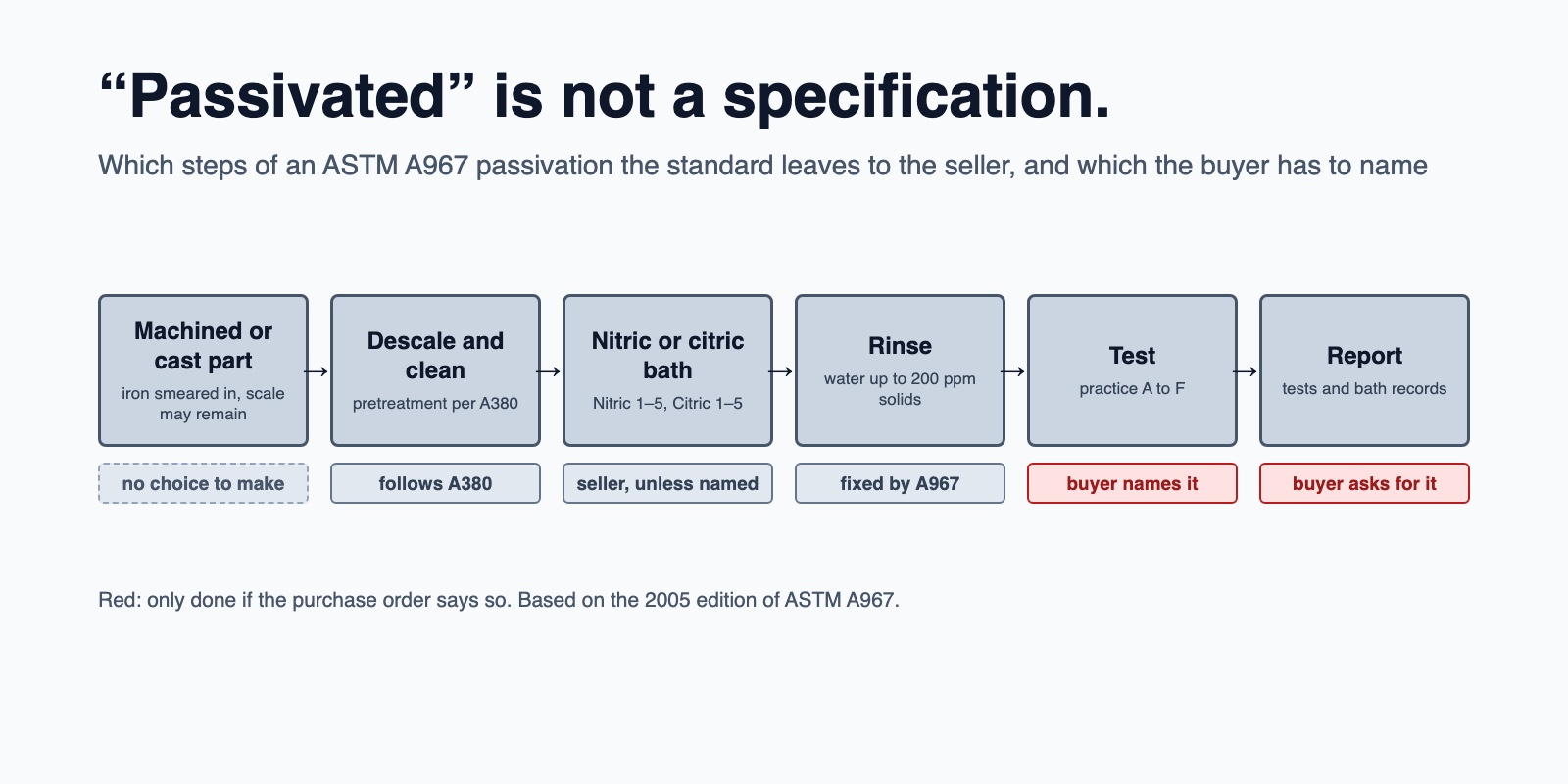
- The standard and its date. ASTM A967/A967M with the year. The edition decides which tests exist.
- The material of each part by type and product specification.
- The treatment, only if it matters. Otherwise the seller chooses (section 4.2).
- The test practice, by letter. Section 4.1 makes that the purchaser’s choice, and tests are run only when the order calls for them.
- The lot, if the processor’s definition does not suit the order.
- The documents. A report of the practice and tests used (section 22.1), and the bath concentration and temperature records the processor must keep for each lot, available when the order asks for them (section 5.2.2).
A certificate that says only “passivated” or “passivated per ASTM A967” names a treatment standard and no test. That does not mean the work was poor. It means the certificate cannot show that the surface was tested, or to which practice. The factory audit checklist covers the heat-number side of the same paperwork.
What does this not settle?
Passivation deals with the condition of the surface. Whether a stainless ball valve rusts in service also depends on the grade and the environment, and A967 itself declines to say which treatment suits which application. The rust article covers pitting, PREN and crevices, the SS316 vs SS304 article covers grade, and the CF8M article covers what changes when the body is cast. How electropolishing leaves a surface, and the passivation that has to follow it, is in the sanitary finish article.
The treatment parameters, test conditions and clause numbers above come from the 2005 edition and may be numbered differently in later ones. Check a clause against the edition on your order before relying on it.
Frequently Asked Questions
Do stainless steel ball valves need to be passivated?
A967 says the passive film forms by itself in air once the surface is free of scale and foreign matter, and that its treatments are meant to improve the corrosion resistance of stainless parts by removing the iron that processing leaves behind. Whether a particular valve was treated, by which method and to which test, has to come from the maker’s documents.
Is passivation the same as pickling?
No. In A967, passivation removes free iron and is generally not effective on scale or heat tint. Pickling removes scale and heat tint and dissolves the stainless steel itself, and a pickled surface needs no separate passivation.
Is nitric or citric acid better for passivation?
A967 lists both and ranks neither. It says effectiveness is shown by the parts passing the specified tests, and if the buyer names no treatment the seller chooses one from the list.
What does “passivated per ASTM A967” on a certificate prove?
It names a treatment standard. Because A967 applies tests only when the purchase order specifies them, the phrase alone does not show that any test was run. The order has to name the test practice and ask for the report.
Which A967 tests can a sanitary valve use?
The 2005 text says the copper sulfate and potassium ferricyanide–nitric acid tests shall not be applied to parts to be used in food processing. Water immersion, high humidity, salt spray and the wet-pad free iron test carry no such restriction, though the standard notes that salt spray can give misleading positives on some lesser-alloyed martensitic or ferritic steels.
Can a hardened or nitrided valve part be passivated?
The appendix to A967 says a carburised surface cannot be passivated and a nitrided surface should not be, because the acid attacks the nitrided case. It says 440C and similar high-strength grades are subject to hydrogen embrittlement or intergranular attack in acid and recommends mechanical or other chemical cleaning for them.
Related Articles
- SS316 vs SS304 Ball Valve: The Material Mistake That Causes Premature Corrosion
- Is CF8M the Same as 316? What Changes When a Ball Valve Body Is Cast
- What Surface Finish Does a Sanitary Valve Need?
- How Do You Specify a Tri-Clamp Sanitary 3-Piece Ball Valve So It Actually Fits?
- What Should You Check When You Audit a Ball Valve Factory?
- Why Does a Stainless Steel Ball Valve Rust? Pitting, Crevices and Iron on the Surface
Sources: ASTM International’s published abstracts for A967/A967M-17 (treatments covered, tests, statement that the standard makes no suitability recommendation) and A380/A380M-17 (scope and contaminants addressed); and a chemical supplier’s citric acid passivation page, which prints the Citric 1 to 3 figures.
The 2005 edition of A967 was read in full, from a copy circulated by a processor, and every treatment figure, test condition and section number above comes from it. The current edition of A967 and ASTM A380 are sold by ASTM and were not read in full. Verify against the edition on your order.
The cover image is a generated illustration, not a photograph of a particular workshop or product.