What Makes a Stainless Steel Ball Valve Food Grade? The Wetted Parts and the Rule Behind Each
Key Takeaway
“Food grade” is not one standard and not one certificate. A ball valve touches the product through several parts, and each part has its own legal route. In the US, PTFE seats fall under 21 CFR 177.1550 and repeated-use rubber seals under 21 CFR 177.2600. In the EU the framework is Regulation (EC) 1935/2004, plastics have Regulation (EU) 10/2011, and stainless steel is not among the materials the Commission’s legislation page names as having a specific EU measure. FDA puts the responsibility for establishing status on the manufacturer. So “FDA compliant” on a datasheet describes at most one part. Ask for the parts list, the material of each, and the basis stated for each polymer part. Whether the valve can be cleaned is a separate question, covered in the linked articles on ferrules and surface finish.
What does “food grade” actually cover on a ball valve?
Two questions get run together. The first is whether every material the product can reach has a stated basis for food contact. The second is whether the valve can be cleaned, which depends on cavities, bore, surface finish and the end connection. This article is about the first. The second is in the Tri-Clamp article, where the body cavity is one of the points, and in the surface finish article.
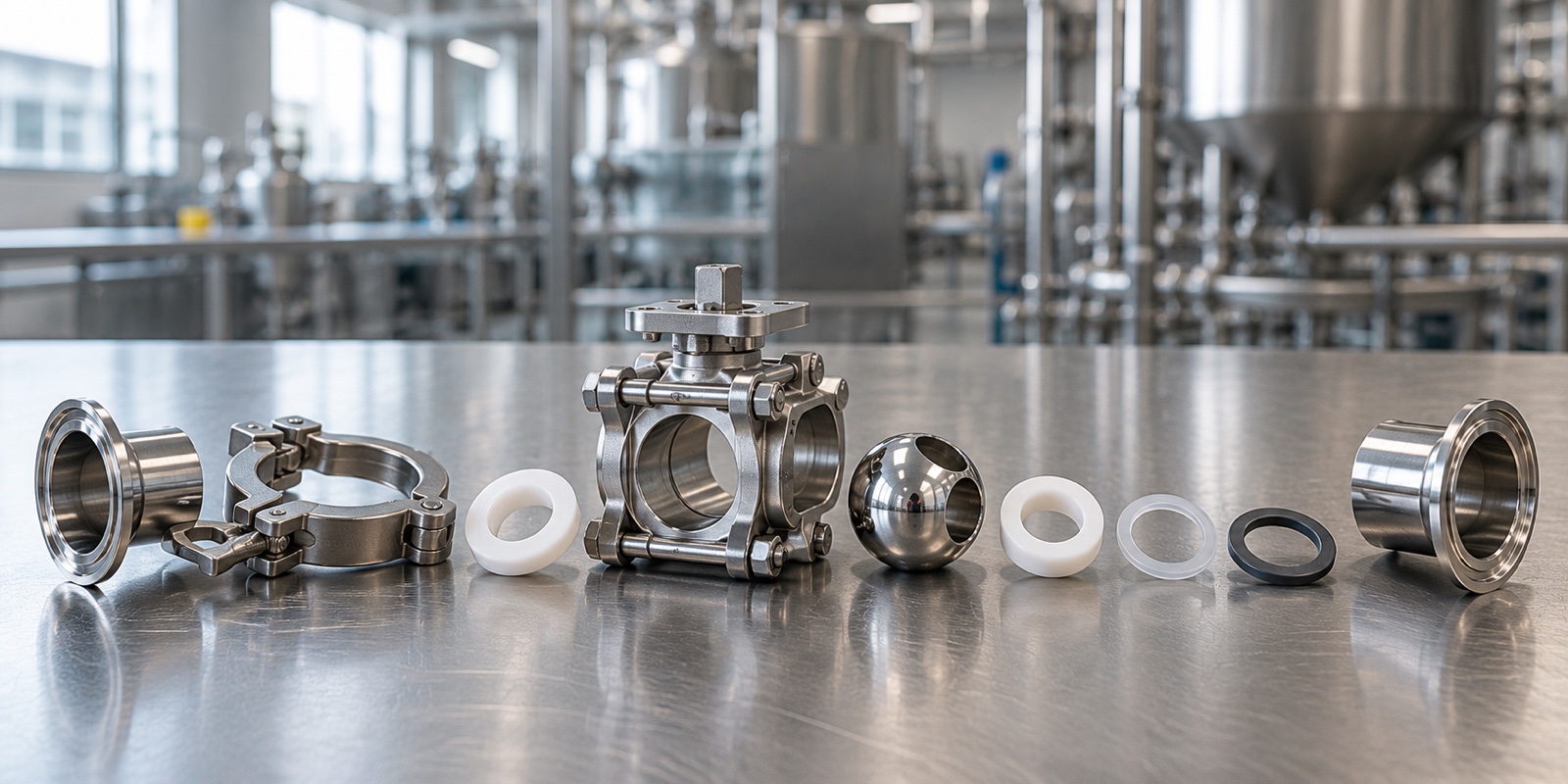
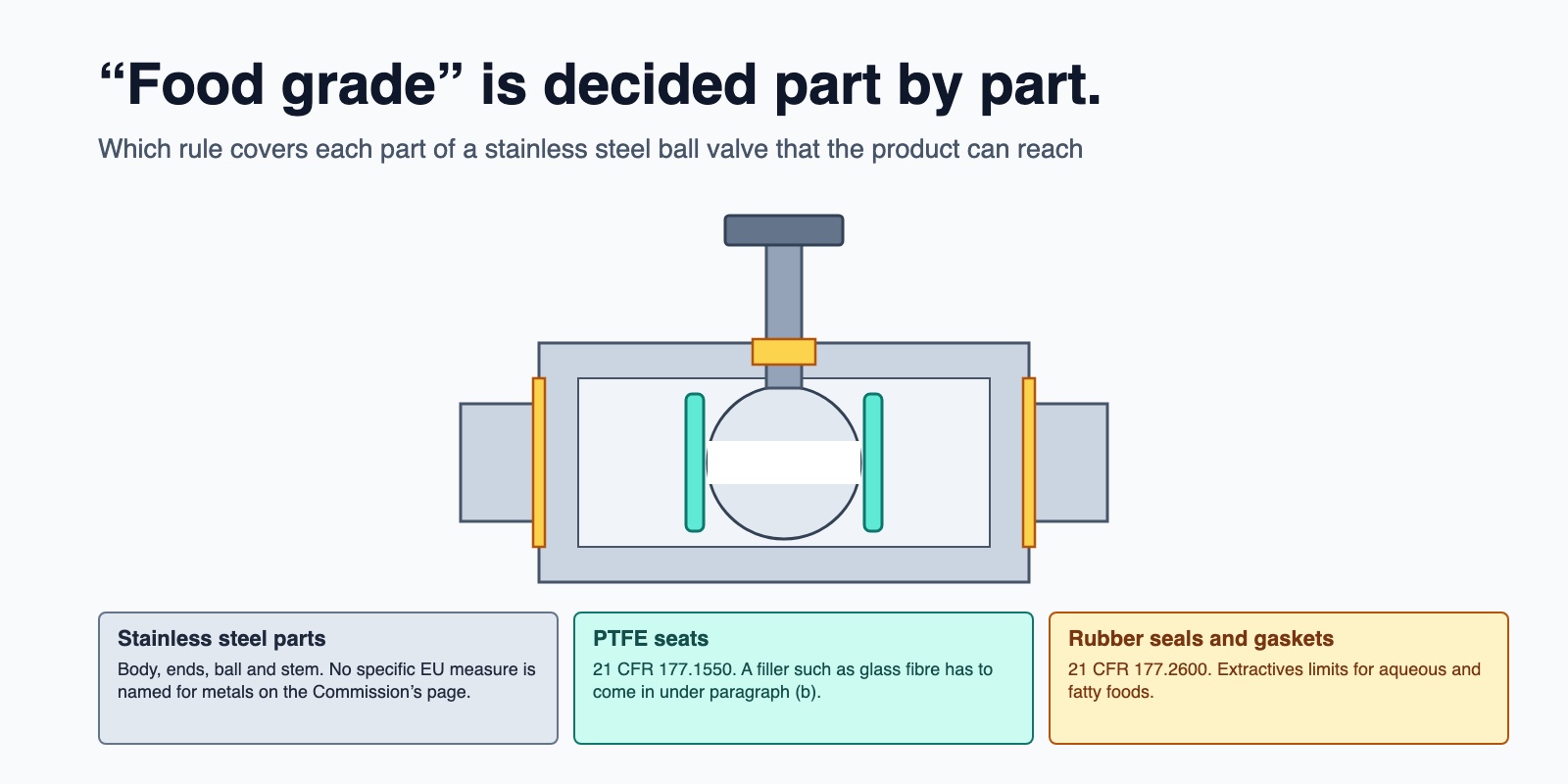
On a three-piece valve the product can reach the body, the end connections, the ball, the seats, the body seals, and the stem and its seal where the product can get to them. Some are stainless steel. Some are polymer. They are governed separately.
| Part | Usual material | US route | EU route |
|---|---|---|---|
| Body, ends, ball, stem | Stainless steel, cast or wrought | Not named in the two sections read for this article | Not on the Commission’s list of materials with specific EU measures; Member States may keep national rules |
| Seats | PTFE, or PTFE with glass fibre | 21 CFR 177.1550 | Plastics measure, Regulation (EU) 10/2011 |
| Body seals, gaskets | EPDM, fluoroelastomer, silicone | 21 CFR 177.2600 for repeated-use rubber articles | Framework Regulation (EC) 1935/2004; text of any specific measure not read |
What does 21 CFR 177.1550 cover, and what does it leave out?
Section 177.1550 covers perfluorocarbon resins, defined in paragraph (a) as those made by homopolymerising or copolymerising hexafluoropropylene and tetrafluoroethylene, and those made by copolymerising perfluoropropylvinylether with tetrafluoroethylene. The resin has to meet specifications in paragraph (d): a minimum melt viscosity, and for the tetrafluoroethylene homopolymer a limit on the thermal instability index. Paragraph (e) sets extraction limits.
Those specifications are on the resin. A seat is a moulded compound, and the section’s paragraph (b) lists what the resin or the article made from it may contain as optional components. There are four routes: substances generally recognised as safe, substances under a prior sanction, substances authorised elsewhere in parts 175, 177 and 178, and the short list of named substances in (b)(4). The named list contains lithium polysilicate and a naphthalene sulfonic acid formaldehyde condensate. It does not name glass fibre, carbon or graphite.
That matters because a reinforced seat is PTFE with a filler, and the seat material article gives the usual RPTFE as 15 to 25 % glass fibre. The section does not say a glass-filled seat is excluded. It says a filler has to come in through one of the other routes in paragraph (b). A statement that “the seat complies with 21 CFR 177.1550” is therefore a statement about a specific compound, and for a filled grade the useful follow-up is how the filler is covered.
What do the rubber seals have to meet?
Section 177.2600 covers rubber articles intended for repeated use in producing, packing, processing, holding or transporting food. Paragraph (c)(4)(i) lists the permitted elastomers. Three of the ones that matter on a valve are there: ethylene-propylene copolymer elastomers, which may contain no more than 5 weight percent of units from the two named norbornene dienes; vinylidene fluoride-hexafluoropropylene copolymers with a minimum number average molecular weight of 70,000; and silicone basic polymer as described in ASTM D1418.
The section then limits what comes out of the finished article. Extracted with distilled water at reflux, the food-contact surface may yield no more than 20 milligrams per square inch of total extractives in the first 7 hours and 1 milligram per square inch in the next 2 hours (paragraph (e)). For fatty foods the extraction is with n-hexane, and the limits are 175 and 4 milligrams per square inch (paragraph (f)). Paragraph (g) says finished articles are to be thoroughly cleansed before first use in contact with food.
Both limits apply to the finished article. A statement that names only the polymer, EPDM or silicone, does not say the gasket that ships met them.
Does FDA approve a valve as food grade?
FDA’s page on determining regulatory status lists five ways a component of a food contact material can be legally used: a regulation in Title 21 of the CFR, GRAS status, a prior sanction, a threshold of regulation exemption, or an effective food contact notification. It states that the responsibility for ensuring the material complies with the authorisation lies with the manufacturer.
In practice “FDA compliant” is a manufacturer’s statement that each polymer in the valve falls under one of those five routes and meets its conditions. It is not an approval of the valve. The page describes authorisation of substances and does not describe a certificate for a finished valve.
What changes for a valve going to the EU?
The European Commission’s legislation page names Regulation (EC) No 1935/2004 as the framework for all food contact materials, Regulation (EC) No 2023/2006 for good manufacturing practice, and Regulation (EU) No 10/2011 for plastic materials and articles. Among its specific measures it lists plastics, active and intelligent materials, ceramics and regenerated cellulose film, and it says that where there is no specific EU measure, Member States may keep or adopt national provisions.
Stainless steel is not on that list. Two articles of the framework regulation decide what follows from that. Article 16 says that where a specific measure exists, the material has to be accompanied by a written declaration of compliance, with supporting documentation available to the authorities. It also says that where there is no specific measure, Member States may keep or adopt national provisions on declarations. So a plastic part such as a PTFE seat, which the plastics measure covers, needs a declaration, while the declaration for the stainless parts is a matter of national rules.
Article 17 applies to every material. It requires traceability at all stages, with businesses able to identify who supplied them and whom they supplied. For the metal parts that points back to the heat number, the record the factory audit checklist already asks for. The Council of Europe has also published guidance on metals and alloys in food contact, which was not read for this article.
What should a food-grade valve order ask for?
- A parts list of what the product can reach, with the material and grade of each part.
- For each polymer part, the basis stated: the 21 CFR section for the US, the EU measure or framework for the EU.
- For a filled seat, how the filler is covered. Under 177.1550(b) it has to come through GRAS, a prior sanction, another authorising regulation or the named list.
- For rubber parts, the polymer and whether the statement covers aqueous or fatty food, since 177.2600 sets separate extraction limits for each.
- A statement that names the part and the compound. A line on the valve datasheet is not a statement about the gasket that ships with it.
- Heat-number traceability for the metal parts, as set out in the factory audit checklist. For the EU, Article 17 of Regulation 1935/2004 asks for traceability at all stages.
What does this not settle?
It does not say whether a given valve is hygienic by design. That is a question about cavities, drainage, bore and finish. EHEDG publishes hygienic design guidance, and the sanitary piping rules article sets out how 3-A and ASME BPE differ. Those documents carry their own requirements, and a declaration under any of them has to be requested in its own right. Nor does it say whether the stainless parts have been cleaned of iron after machining, which is the subject of the passivation article.
The regulatory sections were read as published in the eCFR on the date below. Both are US rules for food contact in general. Which food, at which temperature, for how long, and whether the use is single or repeated, decide what applies to a particular line. That is a question for the plant’s food safety authority, not for a valve datasheet.
Frequently Asked Questions
Is a stainless steel ball valve automatically food grade?
No. The stainless parts are one group. The seats and seals are polymer and are governed by their own rules, and the valve also has to be cleanable. A stainless body with a seat or seal that has no stated compliance basis has not been shown to be food grade.
Does FDA approve ball valves?
FDA’s page on regulatory status describes five ways a component can be legally used in a food contact material and puts the responsibility for compliance on the manufacturer. It does not describe an approval of a finished valve.
Is PTFE FDA compliant?
PTFE falls within the perfluorocarbon resins described in 21 CFR 177.1550, subject to the resin specifications and limitations in that section. A specific seat compound still has to meet them, and a glass-filled seat needs its filler covered by one of the routes in paragraph (b).
Which rule covers EPDM, silicone and FKM seals?
In the US, 21 CFR 177.2600 covers rubber articles intended for repeated use. It lists ethylene-propylene copolymer elastomers, silicone and vinylidene fluoride-hexafluoropropylene copolymers, and limits extractives to 20 mg per square inch of food-contact surface in aqueous extraction and 175 mg per square inch in fatty-food extraction over the first 7 hours.
Does the EU have a food contact rule for stainless steel?
The European Commission’s legislation page lists, among its specific EU measures, those for plastics, active and intelligent materials, ceramics and regenerated cellulose film, and it does not name metals. It says Member States may keep or adopt national provisions where no EU measure exists. The framework Regulation (EC) 1935/2004 applies to all food contact materials.
Which parts does a food-contact declaration have to cover?
Every part the product can reach: the stainless parts, the seats and the seals. A statement for one polymer part says nothing about the others.
Related Articles
- How Do You Specify a Tri-Clamp Sanitary 3-Piece Ball Valve So It Actually Fits?
- What Surface Finish Does a Sanitary Valve Need?
- Ball Valve Seat Material Guide: PTFE vs RPTFE vs PEEK vs Metal
- What Does ASTM A967 Specify When a Stainless Steel Ball Valve Is Called Passivated?
- Why Are Coolant Loops Adopting Sanitary Piping Rules?
- What Should You Check When You Audit a Ball Valve Factory?
Sources: 21 CFR 177.1550, perfluorocarbon resins and 21 CFR 177.2600, rubber articles intended for repeated use, read as full text in the eCFR; FDA, Determining the Regulatory Status of Components of a Food Contact Material; European Commission, food contact materials legislation; Regulation (EC) No 1935/2004, Articles 16 and 17.
The EUR-Lex pages could not be opened directly. The wording of Articles 16 and 17 of Regulation (EC) 1935/2004 was taken from a search result quoting the EUR-Lex text. Not read: Regulations 2023/2006 and (EU) 10/2011, the Council of Europe guidance on metals and alloys, and any US regulation or guidance on stainless steel as a food-contact metal. Statements about those are limited to what the sources above say. The cover image is a generated illustration of the parts, not a photograph of a particular product. Verify against the current text before specifying.