What Do 4-Fen and 6-Fen Mean on a Stainless Steel Ball Valve? Reading Size, Thread and 1000 WOG
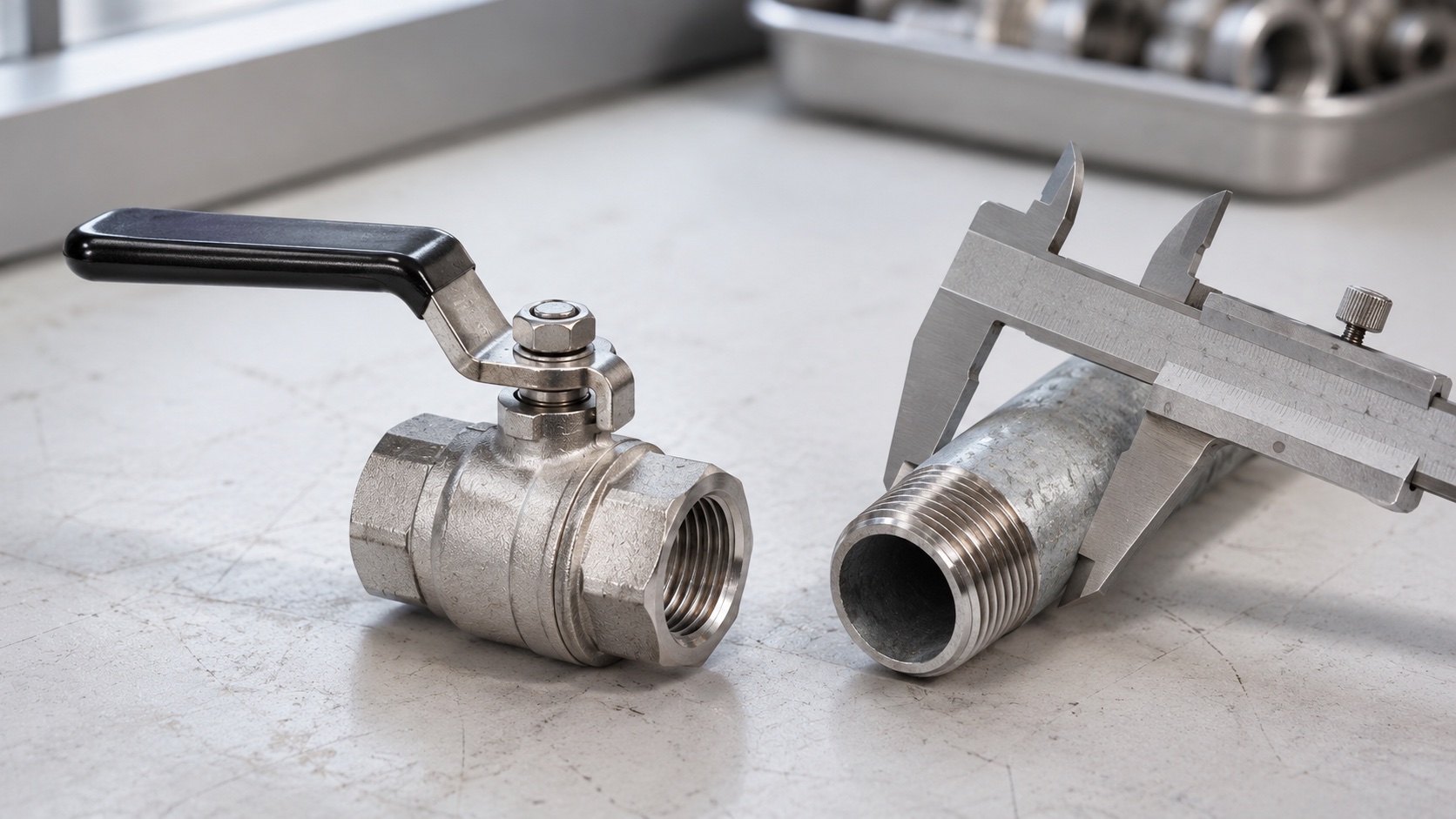
Key Takeaways
In Taiwan, pipe size is often quoted in fen (分), where 1 fen is 1/8 inch. A 4-fen (4分) valve is 1/2 inch, DN15. A 6-fen valve is 3/4 inch, DN20, and 8-fen is 1 inch, DN25. These are names for the pipe, not measured sizes: a 4-fen steel pipe is 21.3 mm across, not 12.7. When you order a ball valve, write the thread type (PT or NPT), the bore and the pressure marking as well as the size. 1000 WOG applies to water, oil and gas at ambient temperature. It does not mean the valve holds 1000 psi at any temperature.
How Do You Convert Fen to Inches and DN?
Taiwanese plumbers and valve shops quote pipe size in fen (分). One fen is 1/8 inch, so 4-fen is 4/8 = 1/2 inch, 6-fen is 6/8 = 3/4 inch, and 8-fen is exactly 1 inch. On the metric side the size is DN (nominal diameter): 1/2 inch corresponds to DN15, 3/4 inch to DN20, and 1 inch to DN25. Above 1 inch, the table below gives inches and DN only.
On the Taiwanese market a ball valve is often listed as 球塞閥 (qiu sai fa) or 球塞凡而. They are the same valve.
| Trade name | Inch size | Nominal diameter | Steel pipe OD (mm) |
|---|---|---|---|
| 3-fen | 3/8 inch | DN10 | 17.2 |
| 4-fen | 1/2 inch | DN15 | 21.3 |
| 6-fen | 3/4 inch | DN20 | 26.9 |
| 8-fen (1 inch) | 1 inch | DN25 | 33.7 |
| (none) | 1 1/4 inch | DN32 | 42.4 |
| (none) | 1 1/2 inch | DN40 | 48.3 |
| (none) | 2 inch | DN50 | 60.3 |
The outside diameter column is the steel pipe OD listed in ISO 6708. PVC, copper and thin-wall stainless tube each have their own OD standards, so this table does not apply to them.
Is a 4-Fen Valve 12.7 mm?
A common calculation is 4-fen = 1/2 inch = 12.7 mm. Then someone puts a caliper on the pipe, reads 21 mm, and assumes the wrong size was bought.
Converting 1/2 inch to millimetres does give 12.7, but that only converts the name. ISO 6708 defines DN as a designation that is only “indirectly related” to the bore or outside diameter, so DN15 does not mean any dimension is exactly 15 mm. A 4-fen threaded steel pipe measures 21.3 mm across.
In practice, on threaded steel pipe, measure the outside diameter: about 21 mm is 4-fen, 26.7 to 26.9 mm is 6-fen, and 33.4 to 33.7 mm is 1 inch.
The size on a valve describes the pipe connection, not the hole through the ball. Two valves that are both 4-fen can have a full port or a standard (reduced) port bore, and their flow differs. The details are in our full port and reduced port comparison.
What Is PT Thread, and Can It Be Mixed with NPT?
PT is the older JIS name for the tapered pipe thread. The current JIS B 0203 is based on ISO 7-1, with the symbols R (male, tapered), Rc (female, tapered) and Rp (female, parallel). The old PT and PS designations moved to an appendix. A product page may say PT while a drawing says R or Rc. They refer to the same family of thread, in the old and new notation.
NPT is the US thread, specified in ASME B1.20.1, and also listed among the referenced documents of MSS SP-110. Its thread angle and pitch both differ from PT. The two are compared in our article on telling NPT and BSP threads apart.
The usual trap is that “4-fen” gives you the pipe size but not the thread. A 4-fen PT valve and a 4-fen NPT pipe are both called 4-fen by name, yet the threads will not mate. Put both on the order.
What Does 1000 WOG Mean?
WOG stands for Water, Oil, Gas, meaning the valve is suitable for those media. Tameson classes it as an older marking, though it still appears on both old and new valves. The unit after 1000 is psi, about 69 bar.
The same marking is often printed next to CWP. CWP is the cold working pressure, and it covers −29 to 38°C. Steam has its own marking, WSP, and manufacturers’ data sheets often read “1000 WOG ‑ 150 WSP”, the second figure being the steam working pressure. Threaded-end ball valves are covered by the standard MSS SP-110, whose scope runs from 1/4 to 4 inch.
A common misreading is to take 1000 WOG as meaning the valve will hold 1000 psi at any temperature and with any fluid. The marking covers ambient temperature only. For hot water, steam or thermal oil, use the manufacturer’s pressure-temperature chart. The seat material helps decide how hot the valve can go, as covered in our seat material comparison. For how pressure classes came about, see ball valve pressure ratings.
What Goes on One Line When You Order a Ball Valve?
| Item | How to write it | What goes wrong if it is vague |
|---|---|---|
| Size | 4-fen (1/2 inch, DN15) | If you only write “4-fen”, the supplier has to guess whether you mean the inch or the metric name. |
| Thread | PT female, or NPT female | PT and NPT cannot be joined, yet both are called 4-fen. |
| Bore | Full port, or standard port | The through-bore differs, and so do flow and pressure drop. |
| Construction | One-piece, two-piece or three-piece | Decides whether the valve can be serviced without taking the pipe apart. See the 2-piece and 3-piece comparison. |
| Pressure marking | 1000 WOG (ambient temperature) | For hot water or steam, state the temperature separately. |
| Material | How to write SUS316 or CF8M | Drawings use several names for the same grade. The ordering guide has a cross-reference table. |
Written as one line it might read: 4-fen (1/2 inch, DN15), PT female, two-piece, full port, 1000 WOG, material stated separately. For the material field, see how to order a 316 stainless steel ball valve.
Checks to make before ordering, in order
- First confirm how many fen the pipe is. For steel threaded pipe you can measure the outside diameter: about 21 mm is 4-fen, 26.7 to 26.9 mm is 6-fen, and 33.4 to 33.7 mm is 1 inch. PVC, copper and thin-wall stainless tube follow their own standards, so this range does not apply. Read the marking on the pipe.
- Confirm the thread type. Check whether the marking says PT (or R, Rc) or NPT. If you cannot tell, compare thread angle and pitch using our article on telling NPT and BSP apart.
- Decide the bore. Full port and standard (reduced) port have different through-bores, and therefore different flow and pressure drop. Both are called 4-fen.
- Read the pressure marking on the valve body. Check whether it says 1000 WOG, CWP or PN, and confirm the temperature that figure applies to.
- Write it on one line. Put size, thread, bore, construction, pressure and material on the same line, in that order, so the supplier does not have to guess.
What Does This Article Not Answer?
- The fen conversion is the usual trade usage in Taiwan. We found no CNS clause to cite, so the table labels it only as a trade name.
- The full text of MSS SP-110 has to be purchased. This article cites only its publicly available scope statement.
- Length, weight and bore differ between manufacturers' 4-fen ball valves. Check each maker's data sheet. This article does not compare them.
- Outside diameters of PVC, copper and thin-wall stainless tube are not in the table here.
Frequently Asked Questions
Is a 4-fen ball valve the same as a 1/2 inch ball valve?
They are two names for the same size. The Taiwanese unit fen (分) is 1/8 inch, so 4-fen is 4/8 = 1/2 inch, and the metric name is DN15. All three are names. The actual outside diameter of the steel pipe is 21.3 mm.
Is 6-fen the same as DN20?
Yes. 6-fen = 3/4 inch = DN20. The steel pipe outside diameter listed in ISO 6708 is 26.9 mm, and the ASME column gives 26.7 mm.
Can PT thread and NPT thread be joined?
They should not be mixed. PT is the older JIS name for the tapered pipe thread. Current JIS is based on the ISO R series, with PT kept in an appendix. NPT is the US thread. The thread angle and pitch differ. See our article on telling NPT and BSP apart.
Can a 1000 WOG valve be used on hot water?
The WOG figure applies at ambient temperature only. Tameson explains that CWP covers −29 to 38°C. For hot water, steam or thermal oil, use the manufacturer’s pressure-temperature chart, and note that the seat material also limits the usable temperature.
Is a qiu sai fa (球塞閥) different from a ball valve?
It is the same valve. 球塞閥 (qiu sai fa) is what ball valves are called on the Taiwanese market. Both use a ball with a bore that turns 90 degrees to open and close. Product names are also often written as 球塞凡而.
Related Articles
Referenced sources: Engineering ToolBox, NPS and DN (ISO 6708), Tameson, How to Read Ball Valve Markings, Kuroda Precision, Pipe thread (JIS B 0203), MSS SP-110 Ball Valves Threaded, Socket-Welding, Solder Joint, Grooved and Flared Ends, ISO 6708:1995 (iso.org), ISO 7-1:1994 (iso.org)
The outside diameter and DN figures come from the Engineering ToolBox ISO 6708 table (read on 27 November 2026). The WOG and CWP explanations come from the Tameson page read the same day. The relationship between PT and R, Rc, Rp comes from the Kuroda Precision page read the same day.