How to Qualify a Thermostatic Mixing Valve Supplier for the US Market
Quick Summary
Most thermostatic mixing valve sourcing decisions fail at the certification step, not the product step. A valve can perform well and still be unusable on a US project, for three reasons: the ASSE listing does not match where the valve will be installed, the listing is held against a different factory than the one filling your order, or the wetted material does not meet the lead-free requirement. This guide covers which ASSE standard applies where (1017, 1070, 1016, 1069, 1071), the one distinction that creates liability — an ASSE 1017 master valve used alone is not scald protection — and an eight-point qualification checklist you can send to any supplier, and a six-step method for verifying a certification listing yourself.
If you are sourcing thermostatic mixing valves (TMVs) for a US project, the technical datasheet is the easy part. Every serious manufacturer can hold a setpoint. What separates a usable supplier from an unusable one is whether the product can be listed, accepted by the authority having jurisdiction, and traced back to the factory that actually built it.
This guide is written for procurement and specification teams, not for installers. It covers what to verify, in what order, and why each item can stop a project.
Why Do US Buildings Require Thermostatic Mixing Valves at All?
Understanding the requirement matters commercially, because it tells you which of your customers cannot substitute the product away.
Two hazards live in the same hot water system and pull temperature in opposite directions. Legionella pneumophila multiplies in warm water, with a growth range of roughly 77°F to 113°F (25°C to 45°C), so industry guidance points toward storing at or above roughly 135–140°F. But water that hot injures people fast. The reference data most widely cited in US practice, from the 1946 Moritz and Henriques scald studies compiled by the U.S. Consumer Product Safety Commission:
| Water Temperature | Exposure Time to Produce a Serious Burn (adult skin) |
|---|---|
| 122°F (50°C) | 5 minutes |
| 131°F (55°C) | 25 seconds |
| 140°F (60°C) | 5 seconds |
| 149°F (65°C) | 2 seconds |
| 154°F (68°C) | 1 second |
A single water heater thermostat controls one temperature and cannot satisfy both conditions. The mixing valve is the only device that separates them: store at 140°F, deliver at 120°F or below. That makes it a code-driven purchase rather than a discretionary one — the demand does not disappear in a downturn.
Which ASSE Standard Does Your Application Actually Need?
This is where sourcing errors concentrate. The diagram below shows where each standard sits in a single building, and why one device cannot do two jobs.
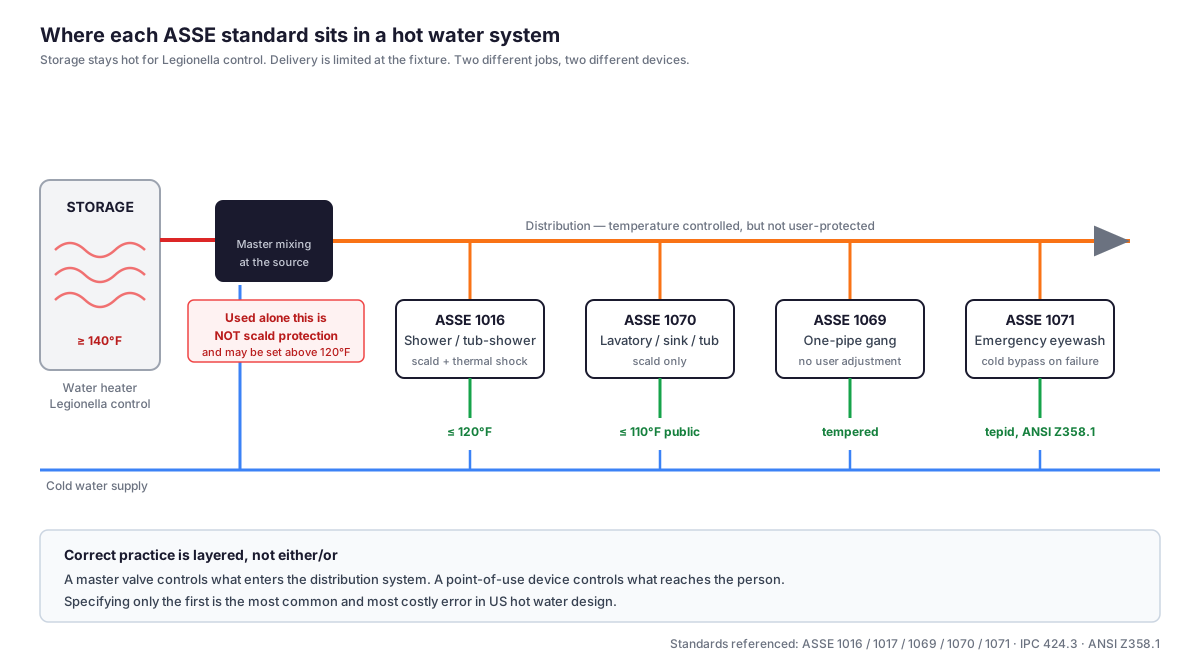
"Thermostatic mixing valve" is not one product category with one certification. The applicable standard is determined by where the valve sits and what protection it must provide.
| Standard | Device Type | Installed Location | Protection Provided |
|---|---|---|---|
| ASSE 1016 | Automatic compensating valves for individual showers and tub/shower combinations | At the individual shower or tub/shower fixture | Scald and thermal shock protection. Limit stop set at or below 120°F. |
| ASSE 1017 | Temperature actuated mixing valves for hot water distribution — "master" or point-of-distribution valve | At or near the outlet of the hot water source only | System distribution temperature control. Used alone, does not provide thermal shock or adequate scald protection. |
| ASSE 1062 | Temperature actuated flow reduction (TAFR) valves | On the discharge outlet of, or integrated into, a fixture fitting | Reduces flow to a trickle (up to 0.25 gpm) within five seconds when temperature exceeds the preset limit. Supplemental only. |
| ASSE 1069 | Automatic temperature control mixing valves | One-pipe gang showers, sitz baths, spas, gang lavatories | Tempered supply where the user cannot adjust temperature at the outlet |
| ASSE 1070 | Water temperature limiting devices | Supplying, or integrated with, fittings for sinks, lavatories, bidets, bathtubs | Scald protection only; no thermal shock protection. Adjustable up to a maximum of 120°F. |
| ASSE 1071 | Temperature actuated mixing valves for plumbed emergency equipment | As close as possible to emergency eyewash and drench showers | Tepid water for equipment complying with ANSI Z358.1, with cold water bypass on hot water failure. |
The One Distinction That Creates Liability: ASSE 1017 vs ASSE 1070
State this plainly to any supplier who blurs it.
An ASSE 1017 master mixing valve delivers a uniform, controlled temperature into the distribution system. It does not — and is not designed to — protect a specific user at a specific fixture from a pressure or temperature swing downstream of it. ASSE 1017 valves are point-of-distribution devices and can be adjusted above 120°F.
An ASSE 1070 water temperature limiting device sits at the fixture and caps what the user can receive, adjustable up to a maximum of 120°F.
Correct US practice is layered: an ASSE 1017 valve at the hot water source, plus the appropriate point-of-use device — ASSE 1016 at showers, ASSE 1070 at lavatories and tubs, ASSE 1069 for gang fixtures.
What Do US Codes Require at the Fixture?
Model plumbing codes do not set a maximum storage temperature. They regulate what comes out of the fixture, which is precisely why mixing is required downstream. Under the International Plumbing Code (IPC):
- Showers and tub-shower combinations (IPC 424.3) — valves must conform to ASSE 1016 or ASME A112.18.1/CSA B125.1, with a means to limit the maximum setting to 120°F (49°C).
- Public lavatories — limited to 110°F (43°C). Where multiple lavatories share a one-pipe tempered supply, control must be by a device complying with ASSE 1070/ASME A112.1070/CSA B125.70, or a water heater complying with ASSE 1084.
- Bathtubs and bidets — limited by temperature-limiting devices, bidets commonly at 110°F.
Why Healthcare Buyers Apply a Higher Bar
For hospitals and long-term care, temperature control is a condition of federal reimbursement, not just a plumbing matter. CMS memorandum S&C 17-30 (June 2017, updated July 2018) requires these facilities to implement policies reducing Legionella risk in building water systems, with water management programs expected to consider ANSI/ASHRAE Standard 188 (current edition 188-2021).
The commercial consequence: these buyers must be able to show a surveyor documented, certified valve performance. They will ask for listing numbers, material certificates and test records, documents that rarely come up outside this segment. A supplier who cannot produce them loses the segment entirely.
What Does Lead-Free Mean, and How Does It Disqualify a Supplier?
A TMV carries potable water, so it falls under the Safe Drinking Water Act's lead-free requirement regardless of thermal performance.
"Lead free" means a weighted average lead content of not more than 0.25% across the wetted surfaces, and not more than 0.2% for solder and flux. The weighted-average methodology lives in NSF/ANSI/CAN 372; it moved out of NSF/ANSI 61 in October 2013. The two answer different questions:
- NSF/ANSI 61 — what may migrate from the material into the water (health effects)
- NSF/ANSI/CAN 372 — how much lead is contained in the wetted material (lead content)
This disqualifies traditional alloys outright: free-cutting brass C36000 contains 2.5–3.7% lead, and cast bronze C83600 contains about 5%. Both were standard in potable water for decades. The industry moved to lead-free grades such as C69300 and C46500 in brass, and C89833 and related EnviroBrass grades in castings.
Note also that ASSE 1017 certification itself requires compliance with NSF 61. Material selection is therefore not a downstream detail — it determines whether the valve can be certified at all. Ask for documentation covering the specific wetted materials and the specific model, not a generic company statement.
The Eight-Point TMV Supplier Qualification Checklist
Send this to any supplier under consideration. Items 6 through 8 are where suppliers differ in ways a datasheet does not reveal.
| # | Requirement | What to Ask For |
|---|---|---|
| 1 | Correct ASSE standard for the application | Confirm the listing matches the installed position (1017 at source, 1070 at fixture, 1016 at shower, 1069 gang, 1071 emergency). Ask which standard. |
| 2 | Third-party certification listing | A listing from an accredited certification body. Request the listing number and verify it in the certifier's online directory yourself. |
| 3 | Listing tied to the actual production site | A listing is not portable across factories. Certification processes include a pre-listing audit of the manufacturing location and ongoing unannounced inspections. Confirm the plant filling your order is the plant on the listing. |
| 4 | Lead-free documentation | Certification covering the specific wetted materials and the specific model — not a blanket statement. |
| 5 | Canadian harmonization (if applicable) | CSA B125.3 listing, where the product will also be sold into Canada. |
| 6 | Documented performance data | Temperature stability under inlet pressure and temperature variation, flow capacity (Cv) across the range, and the minimum flow at which the valve still regulates. |
| 7 | Material and traceability | Wetted material specification, heat and lot traceability, and dezincification resistance where brass is used. |
| 8 | Manufacturing controls | Quality system certification, in-house casting and machining versus subcontracted supply, and pressure-test and temperature-calibration records. |
Two valves can hold identical ASSE listings and behave very differently at low flow — a real condition at a single lavatory — or over a five-year service life in hard water. Point 8 is the one most often skipped and the one that predicts field performance best.
A Note on Private-Label and OEM Supply
A significant share of the TMVs sold in the US are manufactured under private-label or OEM arrangements rather than by the brand on the body. This is normal and does not indicate lower quality — but it changes what to verify. Where a product is private labeled, the name of the customer for whom it was manufactured must appear on the product and packaging markings along with the model number.
Because listings are tied to audited production sites, the relevant questions are: which facility actually manufactures the valve, does that facility appear on the listing, and what in-process controls does it apply to thermostatic element calibration and final temperature testing. A brand that cannot answer these is passing your question down its own supply chain.
How to Verify a Certification Listing Yourself
Every item above depends on one skill that is rarely taught: reading a listing rather than accepting a claim. It takes about five minutes per supplier.
- Get the listing number and the exact model designation. Not a certificate image, not a logo on a datasheet — the number under which the product is listed, and the model string it is listed against.
- Look it up in the certification body's own online directory, not on the supplier's site. Accredited bodies publish searchable directories; a listing that cannot be found in one is not a listing.
- Check the standard named on the listing against the installed position. A product listed to ASSE 1017 is not approved for the duty of an ASSE 1070 device, however it is marketed.
- Check the manufacturing location named on the listing. This is the step most often skipped. Compare it against the address that will appear on your commercial invoice and packing list. If they differ, ask why before you order.
- Check the scope. Listings cover specific sizes, connection types and configurations. A range is rarely listed in its entirety — confirm your size and end connection are inside the listed scope.
- Check the expiry or revision date and whether the listing is current rather than withdrawn.
If a supplier resists any of these six steps, that resistance is itself the answer. A manufacturer that regularly ships into the US has been asked all of this before and will have it ready.
Summary: Three Questions That Decide Whether a Valve Can Be Installed
- Does the listing match the application? ASSE 1017 at the source is not a substitute for point-of-use protection.
- Is the listing held against the facility that will build your order? Listings do not travel between factories.
- Does the wetted material meet the lead-free requirement for the destination market, documented per model?
Thermal performance matters, but these three come first. A valve that outperforms on paper and cannot be listed is not a candidate.
Frequently Asked Questions
A one-line version to keep:
Match the listing to the installed position, verify the listing in the certifier's directory rather than the supplier's brochure, confirm the listed facility is the facility that will fill the order, and get lead-free documentation for the specific model. Everything else is negotiable; these four are not.
References
- ASSE International — Product Standards (ASSE 1016, 1017, 1062, 1069, 1070, 1071)
- International Plumbing Code, Section 424.3 — Shower and Tub Valves
- ANSI/ASHRAE Standard 188-2021 — Legionellosis: Risk Management for Building Water Systems
- CMS Memorandum S&C 17-30 (June 2017, revised July 2018) — Requirement to Reduce Legionella Risk
- Moritz, A.R. and Henriques, F.C., "Studies of Thermal Injury," 1946; compiled by the U.S. Consumer Product Safety Commission
- NSF/ANSI 61 — Drinking Water System Components: Health Effects
- NSF/ANSI/CAN 372 — Drinking Water System Components: Lead Content
- Safe Drinking Water Act — lead-free definition (0.25% weighted average)
This article is provided for general reference. Code requirements vary by adopted edition and local amendment; the authority having jurisdiction governs on any specific project. Certification scope varies by model — confirm applicable listings for your specification before purchase.