Why Liquid Cooling Will Be a Huge Market
Key Takeaway
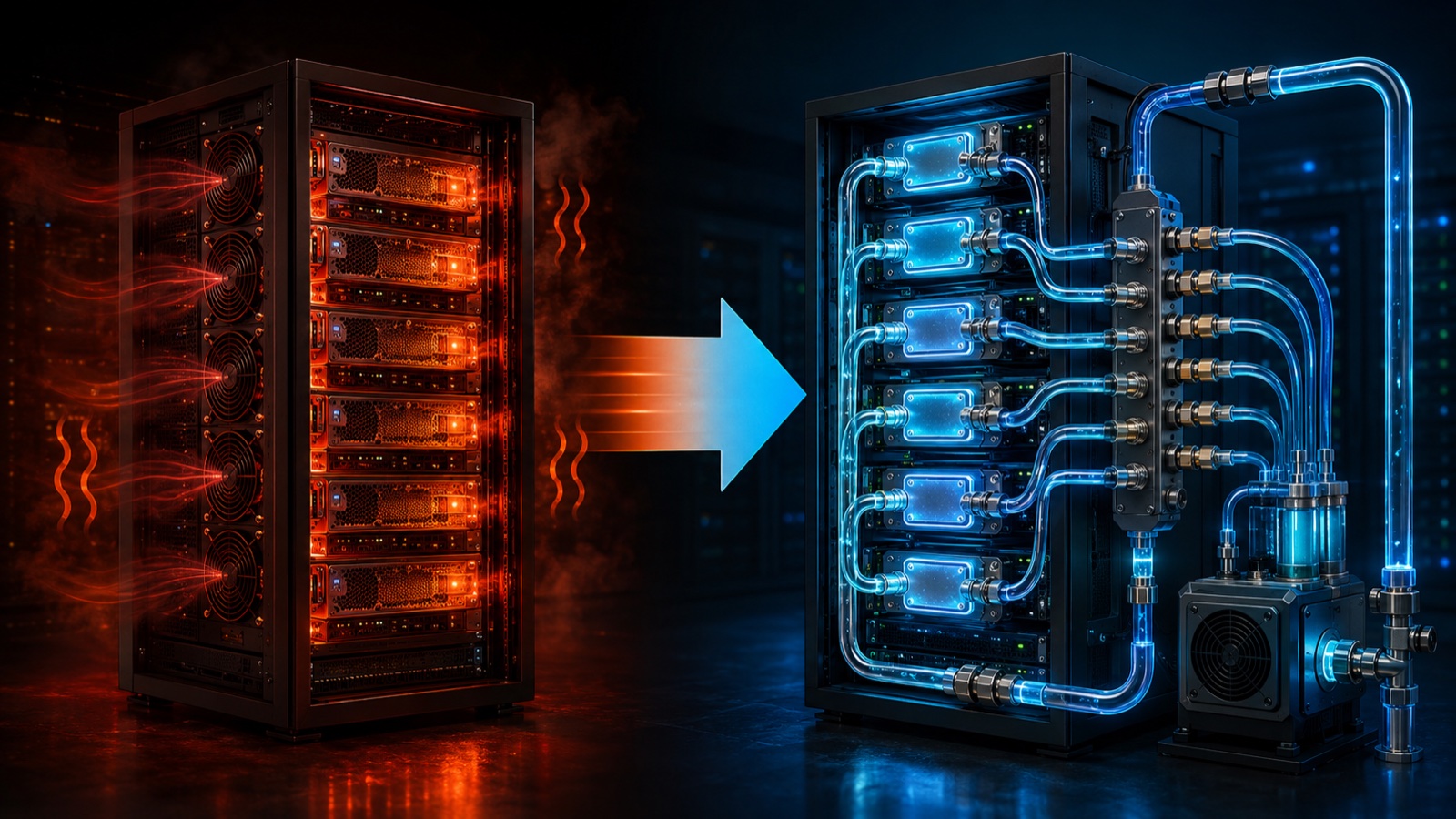
Liquid cooling is no longer optional for AI data centers — it's mandatory. NVIDIA's latest GPUs (GB200 at 1,200W, GB300 at 1,400W) don't even have an air-cooled option. Air cooling handles 15–20 kW per rack; AI racks need 120–150+ kW. Water carries 3,500x more heat than air. The market hit $6 billion in 2026, growing 31.7% per year. Goldman Sachs says 76% of AI servers will be liquid-cooled by end of 2026. This is creating massive demand for valves, manifolds, quick disconnects, and piping.
Why Can't Air Cooling Keep Up Anymore?
For 20 years, data centers relied on air conditioning and fans to stay cool. But AI changed everything.
Think of it this way: your home AC handles about 3–5 kW of heat. NVIDIA's latest GB200 GPU draws 1,200W per chip, and the GB300 draws 1,400W.
Pack 72 of these GPUs into one rack, and you're looking at 120–130 kW of heat — equivalent to running 40 home AC units, all crammed into a single refrigerator-sized cabinet.
Traditional air cooling's limit? About 15–20 kW per rack. That's not even one-sixth of what an AI rack needs.
Here's the kicker: NVIDIA GB200 and GB300 don't even come in an air-cooled version. They ship from the factory with liquid cooling manifolds pre-installed. Liquid cooling isn't an option — it's the only way.
Air Cooling vs Liquid Cooling: What's the Difference?
| Criteria | Traditional Air Cooling | Liquid Cooling |
|---|---|---|
| Cooling capacity per rack | 10–20 kW | 100–250 kW |
| Heat removal efficiency | 1x (baseline) | 3,500x (water carries 3,500x more heat than air) |
| Can it run the latest NVIDIA AI chips? | No, not even close | Yes — it's the only option |
| Power efficiency (PUE) | 1.5–2.0 (wastes 50–100% of power on cooling) | 1.03–1.15 (almost all power goes to computing) |
| Noise | Very loud (high-speed fans) | Quiet (liquid pumps replace fans) |
| Valves needed per rack | 0 | 6–12 |
In simple terms: air cooling is like using a desk fan to cool an oven. Liquid cooling is like using a car's radiator system. Beyond a certain heat level, no amount of air will do — only water can carry that much heat away.
How Big Is This Market?
- 2026 global liquid cooling market: $6 billion, growing 31.7% per year
- The valve sub-market alone is going from $210 million (2024) to $1.8 billion (2032) — an 8.5x increase
- Goldman Sachs forecasts liquid-cooled AI servers rising from 15% (2024) to 76% (2026)
- Every major tech company (Google, Meta, Amazon, Microsoft) is building liquid-cooled data centers at scale
Why is the valve market growing faster than overall liquid cooling?
Because as chips get hotter, each rack needs more valves — more isolation points, more flow regulation, more safety protection. Valves are an accelerator in this wave, not just a follower.
What's Inside a Liquid Cooling System?
Think of a liquid cooling system like a car's cooling system — coolant circulates through pipes, absorbs heat, and gets cooled down before cycling back. It's the same idea, just more precise:
| Component | Plain English | Qty per Rack |
|---|---|---|
| CDU (Coolant Distribution Unit) | The "heart" of the system — pumps coolant, cools it down, filters it | 1 per row of racks |
| Ball Valve | A "faucet" that turns flow on/off — lets you shut down one rack without affecting others | 4–6 |
| Butterfly Valve | A big-pipe on/off switch for the main water line | Depends on layout |
| Manifold | Splits one big pipe into many small pipes, sending coolant to each server | 1–2 sets |
| Quick Disconnect (QD) | Like a gas pump nozzle — pull it off, no leaks. Lets you swap a server in seconds | 2 per server |
| Check Valve | A one-way door that prevents water from flowing backwards | 1–2 |
| Cold Plate | A metal plate mounted directly on the GPU — water flows through it and carries heat away | 1 per GPU |
A single GB200 rack needs over 700 liters per minute of coolant flowing through it. That's like filling 3.5 bathtubs every minute, cycling continuously through the rack.
Why Are Quick Disconnects (QDs) So Important?
Servers break all the time in data centers. If you had to shut down an entire rack's cooling loop just to fix one server, the downtime costs would be enormous.
Quick disconnects let technicians "unplug" one server's water lines like pulling an electrical plug — no leaks, other servers keep running. The OCP standard allows less than 1cc of spillage on disconnect — about one drop of water.
A 72-GPU rack needs dozens of quick disconnects.
Why Is Stainless Steel Replacing Brass?
Traditional industrial valves are often made from brass — it's cheap and easy to machine. But in liquid cooling, brass has a fatal flaw: zinc leaches out and contaminates the coolant, clogging the precision cold plate channels.
The international standard ASHRAE now states: brass with more than 15% zinc cannot be used in liquid cooling systems.
The industry is rapidly shifting to SS304/SS316L stainless steel, which now accounts for 70–80% of the valve market in liquid cooling. For valve manufacturers with stainless steel casting capabilities, this is a massive opportunity.
What Does This Trend Mean for the Valve Industry?
- AI chips are getting hotter → air can't keep up → liquid cooling is mandatory
- Every liquid-cooled rack needs 6–12 valves
- Data centers are being built worldwide at record pace → valve demand is exploding
- Brass is being phased out → stainless steel valve demand is surging
- The valve market will grow 8.5x in 8 years (2024–2032)
Liquid cooling isn't a future trend — it's happening right now.