How Home Plumbing Works: Water Supply, Drainage & Every Valve In Between
Quick Summary
Your home has two separate plumbing systems that never mix: the water supply system (pressurized at 40-80 PSI, bringing clean water in) and the drain-waste-vent (DWV) system (gravity-driven, taking wastewater out). Valves control every critical transition point — from the main shut-off where water enters your house, to individual fixture stops, to the temperature and pressure relief valve on your water heater. Understanding how these systems work helps you prevent the failures that cause 14,000+ water damage insurance claims every day in the U.S.
How Does Water Get Into Your Home?
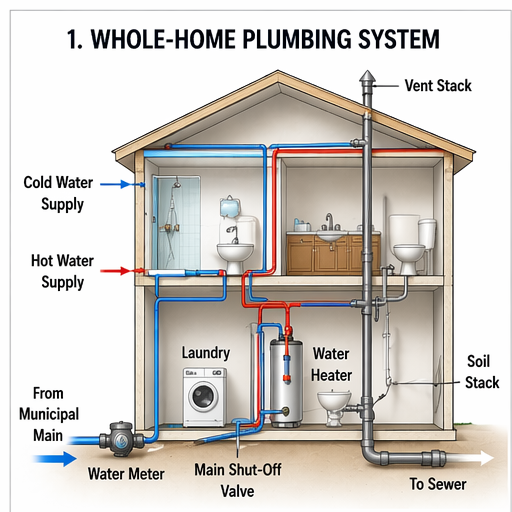
A home plumbing system has two independent subsystems — supply (blue/red) and drainage (gray).
Water travels from a municipal treatment plant (or a private well) through underground mains to your property. At the point of entry — usually where the pipe penetrates the foundation wall or comes up through the slab — two critical components sit in sequence:
- The water meter. Measures total consumption in gallons or cubic feet. Owned by the utility company.
- The main shut-off valve. Your control point. Closing this valve stops all water flow into the entire house. In emergencies — burst pipe, major leak, frozen line — this is the first thing you reach for.
From the main shut-off, a single cold water supply line (typically 3/4" or 1" copper, PEX, or CPVC) runs through the house. This trunk line branches into smaller lines (1/2") that feed individual fixtures: sinks, toilets, showers, dishwashers, washing machines, and outdoor hose bibs.
Why Is the Main Shut-Off Valve the Most Important Component?
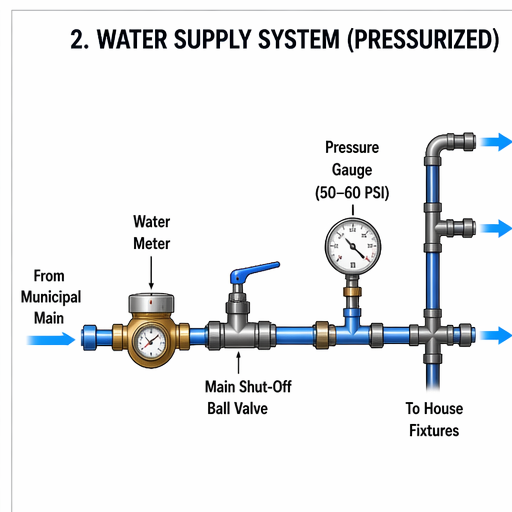
A quarter-turn ball valve provides instant, reliable shut-off at the main water entry.
The main shut-off valve is the single point of control between your home and the city water main. If it fails to close — which happens more often than you'd expect — a burst pipe upstream becomes an uncontrollable flood.
Older homes typically have gate valves at this position. Gate valves use a multi-turn handwheel to raise and lower a metal gate across the flow path. The problem: gate valves left in the open position for years often seize from internal corrosion. When you finally need to close one in an emergency, the handle won't turn.
Modern plumbing codes and experienced contractors specify quarter-turn ball valves at the main shut-off. A ball valve closes in under one second with a simple 90-degree lever turn, achieves ANSI Class VI zero-leakage shutoff, and resists seizure even after years of inactivity.
| Feature | Gate Valve (Old Standard) | Ball Valve (Modern Standard) |
|---|---|---|
| Shut-off speed | 15-60 seconds (10-25 turns) | < 1 second (quarter-turn) |
| Leakage class | ANSI Class IV (0.01%) | ANSI Class VI (zero) |
| Seizure risk after years | High — metal gate corrodes in body | Low — ball rotates freely on PTFE seats |
| Visual position indicator | None — must count turns | Handle perpendicular = closed |
How Does the Water Heater Fit Into the System?
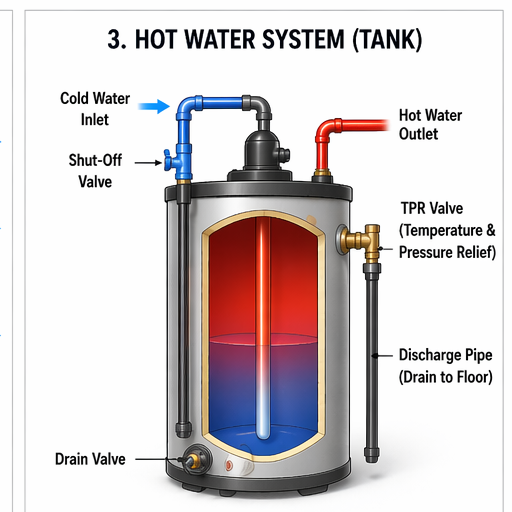
Three valves protect your water heater — and your home — from pressure and temperature extremes.
The cold water supply line splits at a T-junction. One branch continues to cold-water fixtures. The other feeds the water heater. At the water heater, three separate valves serve distinct safety functions:
1. Cold Water Inlet Shut-Off Valve
Installed on the cold supply pipe directly above the water heater. Allows you to isolate the heater for maintenance or replacement without shutting off water to the rest of the house. A ball valve is preferred here — fast closure matters if the heater develops a tank leak.
2. Temperature & Pressure Relief (TPR) Valve
Mounted on the side or top of the tank. This is a safety device that automatically opens if water temperature exceeds 210°F (99°C) or pressure exceeds 150 PSI. Without a functioning TPR valve, a malfunctioning thermostat could turn your water heater into a pressure vessel — with explosive consequences. The TPR discharge pipe must run downward to within 6 inches of the floor or to an outside drain.
3. Drain Valve
Located at the bottom of the tank. Used to flush sediment buildup (recommended annually) or to drain the tank for replacement. Most stock drain valves are low-quality plastic gate valves. Plumbers often replace them with brass ball valves for more reliable operation.
Once heated, water exits the top of the tank through the hot water outlet and travels through dedicated hot water lines (red) to every fixture that needs hot water. The hot and cold lines run in parallel throughout the house, meeting at mixing valves or faucets where you control the temperature blend.
How Does the Drain-Waste-Vent (DWV) System Remove Wastewater?
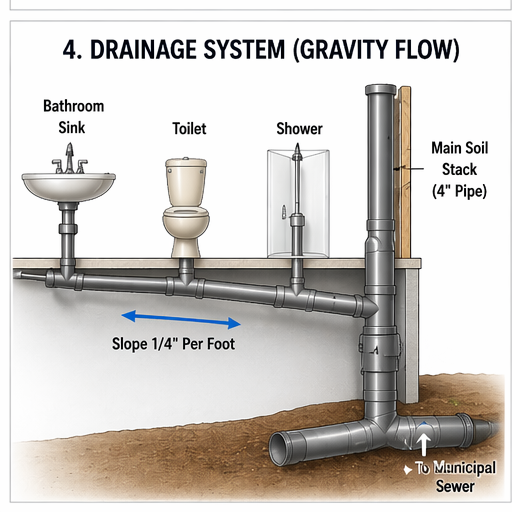
The DWV system uses gravity and air pressure equalization — no pumps, no valves, just physics.
While the supply system uses pressure to push water upward and throughout the house, the drainage system uses gravity. Every drain pipe in your home is sloped downward at approximately 1/4 inch per foot toward the main sewer line. Three components make this work:
Drain Pipes
Branch drain lines (1.5" to 2" diameter) connect individual fixtures to the main soil stack — a vertical 3" or 4" pipe that runs from the basement to above the roof. All wastewater eventually reaches the soil stack and flows down to the sewer lateral (the pipe connecting your house to the municipal sewer main).
P-Traps
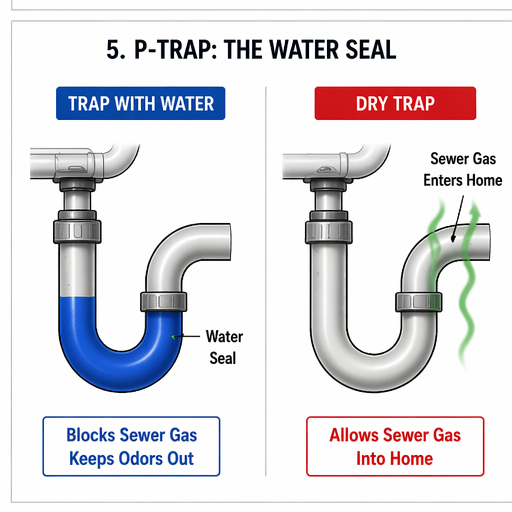
Left: a working P-trap holds water that blocks sewer gas. Right: a dry trap lets gas into your home.
Every drain fixture has a P-trap (or S-trap in older homes) — a U-shaped section of pipe that holds approximately 2 inches of standing water. This water seal blocks sewer gases (methane, hydrogen sulfide) from entering your living space through the drain opening. If you smell sewer gas from a rarely-used drain, run water for 30 seconds to refill the trap.
Vent Stack
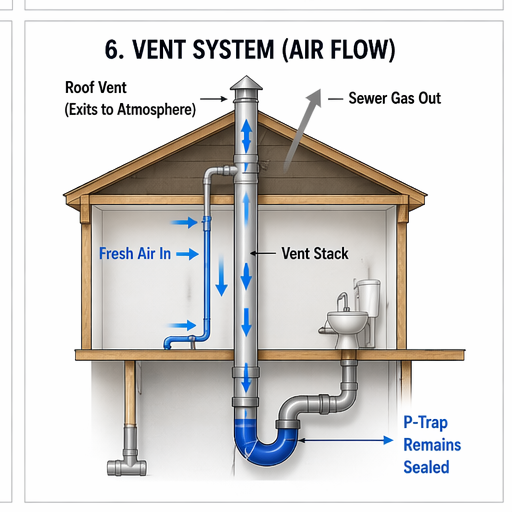
The vent system equalizes air pressure and safely exhausts sewer gas above the roofline.
The vent pipe extends from the top of the soil stack through the roof, open to the atmosphere. Its purpose: equalize air pressure in the drain pipes. Without venting, draining water creates a vacuum that siphons water out of P-traps (breaking the gas seal) and slows drainage to a gurgling crawl. The vent also allows sewer gases to escape harmlessly above the roofline.
What Types of Valves Are Used Throughout the System?
| Valve Type | Function | Where Used | Key Spec |
|---|---|---|---|
| Ball Valve | On/off isolation | Main shut-off, fixture stops, water heater inlet | Quarter-turn, Class VI zero leakage |
| Gate Valve | On/off isolation (legacy) | Older main shut-offs, fire sprinkler systems | Multi-turn, Class IV leakage |
| Check Valve | Prevent backflow | Sump pump discharge, irrigation tie-ins, boiler return | Swing or spring type, prevents reverse flow |
| TPR Valve | Safety relief | Water heater (temp > 210°F or pressure > 150 PSI) | ASME/ASSE 1002 rated |
| PRV (Pressure Reducing Valve) | Regulate incoming pressure | After main shut-off (if city pressure > 80 PSI) | Adjustable, typically set to 50-60 PSI |
Where Most Systems Fail (And How to Prevent It)
Insurance data shows water damage is the second most common homeowner claim in the U.S. Most failures aren't dramatic pipe bursts — they're slow, preventable failures at valve and connection points.
1. Pressure Issues
Municipal water pressure fluctuates between 40-100+ PSI. Pressure above 80 PSI accelerates wear on every connection, valve seat, and fixture in your system. Symptoms: dripping faucets, running toilets, water hammer noise, and premature appliance failure. Solution: Install a pressure reducing valve (PRV) after the main shut-off, set to 50-60 PSI.
2. Temperature Instability
A water heater without a functioning TPR valve or with a failed thermostat can overheat water to dangerous levels. Excessive temperature also accelerates pipe corrosion and scale buildup. Solution: Test the TPR valve annually (lift the lever — water should discharge and stop when released). Set the thermostat to 120°F (49°C) — hot enough to prevent Legionella bacteria, cool enough to reduce scalding risk and energy waste.
3. System Imbalance
Older homes with a mix of pipe materials (copper, galvanized steel, PEX) can develop galvanic corrosion at dissimilar-metal joints. Corroded gate valves that can't close. Partially blocked vent stacks that cause slow drains. Dried-out P-traps that let sewer gas in. These aren't one-time events — they're cumulative. Solution: Annual plumbing inspection with valve exercise (open/close every shut-off valve once a year to prevent seizure).
Frequently Asked Questions
Need reliable valves for residential, commercial, or industrial plumbing systems? Contact LINS Valve — we manufacture ball valves, check valves, and gate valves in SS316 and bronze for OEM and wholesale customers worldwide.